
Creative Biolabs is offering the most comprehensive services for antibody development projects. With strict regulation and effective execution, we are dedicated to providing the most valuable solutions to complete your projects.
HighlightsCreative Biolabs is offering the most comprehensive services for antibody development projects. With strict regulation and effective execution, we are dedicated to providing the most valuable solutions to complete your projects.
HighlightsCreative Biolabs has established a broad range of platforms for developing novel antibodies or equivalents. These cutting-edge technologies enable our scientists to meet your demands from different aspects and tailor the most appropriate solution that contributes to the success of your projects.
HighlightsWith deep understanding in antibody-related realms and extensive project experience, Creative Biolabs offers a variety of references to help you learn more about our capacities and achievements, including infographic, flyer, case study, peer-reviewed publications, and all kinds of knowledge that can assist your projects. You are also welcome to contact us directly for more specific solutions.
HighlightsGet a real taste of Creative Biolabs, one of the most professional custom service providers in the world. We are committed to providing highly customized comprehensive solutions with the best quality to advance your projects.
Highlights Loading...
All listed services and products are For Research Use Only. Do Not use in any diagnostic or therapeutic applications.
Annexin A1 (ANXA1) is a 37 kDa calcium-dependent phospholipid-binding protein that belongs to the evolutionarily conserved annexins superfamily. It was initially defined as a glucocorticoid-inducible protein and is highly expressed by neutrophils, monocytes, macrophages, epithelial cells and various neoplastic cell populations. It canonically activates the resolution of inflammation: upon glucocorticoid activation, ANXA1 translocates from cytoplasmic stores to the plasma membrane and extracellular space where it promotes neutrophil apoptosis, down-regulates leukocyte transmigration and phospholipase A2-noxious eicosanoid biosynthesis. In more recent times, ANXA1 has been implicated as a key orchestrator of membrane repair (mr), exocytosis and oncogenic signal transduction. Aberrant expression of ANXA1 in hepatocellular carcinoma (upregulation) and esophageal squamous cell carcinoma (down-regulation), has been firmly associated with the pathogenesis for both diseases, making this protein an attractive candidate biomarker and therapeutic target for engineering.
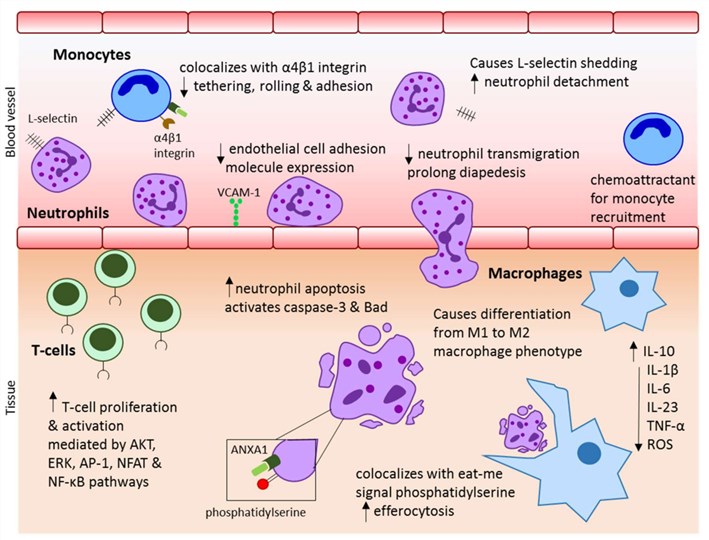 Fig.1 Summary of the role ANXA1 in controlling inflammation through its effect on immune cells.1
ANXA1 executes a range of biological programs that are much larger than its classical anti-inflammatory role:
We present a collection of high-quality recombinant ANXA1 proteins designed to support biochemical, structural, and membrane-binding studies. As Ca²⁺-dependent phospholipid binding, N-terminal regulation, and proper folding of the four conserved annexin repeats are important for ANXA1 function, our protein preparations are developed to support relevant functional and interaction studies. These proteins may be suitable for phospholipid-binding assays, characterization of protein–protein interactions, screening of compounds that modulate ANXA1 function, and investigation of membrane recruitment and related structural transitions. Appropriate quality assessment is performed according to the intended research application and specific product format.
Not finding the protein product you need? Contact us to start your one-stop custom service!
Establishing physiologically faithful cellular platforms is essential to decode ANXA1-driven signaling networks and in order to expedite therapeutic discovery pipelines. Using a hybrid approach that uses lentiviral transduction to set up stable transposable cell lines, we provide reproducible high-quality ANXA1 genes into diverse species with accurate subcellular localization, native post-translational modification signature and functionally relevant responses when the glucocorticoids or calcium responded. In addition to wild-type ANXA1, our platforms also include disease-relevant mutant variants (including phosphorylation-site mutants and truncation constructs), as well as multiple inducible expression systems plus reporter-coupled readouts for apoptosis, efferocytosis and NF-κB activation. These scalable cellular resources provide robust instruments for autoimmune mechanism investigations, oncology drug screening campaigns as well as future biologics against the ANXA1 axis.
Not finding the stable cell line product you need? Contact us to start your one-stop custom service!
Explore ANXA1 with high-affinity, sequence-defined recombinant monoclonal antibodies designed to support research on this multifunctional annexin. Our antibodies can be used for the detection and analysis of ANXA1 in a range of research samples and model systems. Depending on the specific product, selected antibodies may be suitable or available for applications such as Western Blotting, ELISA, Flow Cytometry, Immunofluorescence, confocal imaging, and Immunohistochemistry. For research requiring specific epitope recognition or functional properties, customized antibody development and suitability assessment can be discussed according to the intended experimental design.
Not finding the recombinant antibody product you need? Contact us to start your one-stop custom service!
When you only need a few targets, we also offer complete end-to-end protein design and engineering services for challenging annexin research programs in addition to our extensive catalog offerings:
Absolutely. We offer both full-length ANXA1 and N-terminally modified variants that differentially mimic the secreted, membrane-associated, and cytosolic pools.
Yes. The ANXA1 proteins were expressed and refolded under conditions optimal for maintaining the integrity of the four annexin repeats, as well carry out a calcium-coordination geometry suitable for high-affinity phospholipid membrane engagement. In each batch, functional binding is verified using homogeneous liposome sedimentation assays and surface plasmon resonance.
Certainly. We have generated phosphorylation-mimetic mutants (S27D, S27A), acetylation-site variants as well as N-terminal truncation constructs that model regulatory events occurring naturally. These engineered proteins are provided as purified recombinant preparations or stably integrated cell lines for comprehensive mechanistic and drug-discovery studies.
Yes. Targeted deletions of the N-terminal regulatory domain, single annexin repeats and the C terminal tail are available. These constructs, which lack the domains that allow for such interactions or function in vivo through non-functional protein-protein binding, are a boon to dissecting lipid-binding cooperativity, mapping of interactions between proteins, and development of dominant-negative strategies.








