
Creative Biolabs is offering the most comprehensive services for antibody development projects. With strict regulation and effective execution, we are dedicated to providing the most valuable solutions to complete your projects.
HighlightsCreative Biolabs is offering the most comprehensive services for antibody development projects. With strict regulation and effective execution, we are dedicated to providing the most valuable solutions to complete your projects.
HighlightsCreative Biolabs has established a broad range of platforms for developing novel antibodies or equivalents. These cutting-edge technologies enable our scientists to meet your demands from different aspects and tailor the most appropriate solution that contributes to the success of your projects.
HighlightsWith deep understanding in antibody-related realms and extensive project experience, Creative Biolabs offers a variety of references to help you learn more about our capacities and achievements, including infographic, flyer, case study, peer-reviewed publications, and all kinds of knowledge that can assist your projects. You are also welcome to contact us directly for more specific solutions.
HighlightsGet a real taste of Creative Biolabs, one of the most professional custom service providers in the world. We are committed to providing highly customized comprehensive solutions with the best quality to advance your projects.
Highlights Loading...
All listed services and products are For Research Use Only. Do Not use in any diagnostic or therapeutic applications.
Amine oxidase, copper carrying 2 (AOC2) simply referred to as slate retina-specific amine oxidase (RAO), is a type-II transmembrane metalloenzyme with its own unique niche within the scope of the larger family of copper-dependent amine oxidases. The protein, which is mature and spans 85 to 100 kDa depending on the few kinds of (tissue-specific) N-linked glycosylation that may differ from type to type is structurally defined by a catalytic center characterized as coordinating a single copper ion plus a covalently bound topaquinone (TOPA) cofactor generated via post-translational autocatalytic modification of an evolutionary-conserved tyrosine residue 7. In contrast to its homolog, ARP3, AOC2 exhibits a very restricted expression profile restricted mostly to the retinal pigment epithelium (RPE) layer of the eye, neural retina, with lesser representations in the testis and heart. AOC2 catalyzes the oxidative deamination of short-chain primary amines such as methylamine and aminoacetone to their corresponding aldehydic metabolites, ammonia, and hydrogen peroxide in the ocular microenvironment. This enzymatic activity serves a complex physiological role in biogenic amine clearance and metabolic regulation, however, dysregulated or exacerbated AOC2 activity produces oxidative byproducts that exceed endogenous antioxidant buffering capacity leading to lipid peroxidation and advanced glycation end-product (AGE) accumulation causing retinal pigment epithelium dysfunction. Indeed, a growing body of evidence implicates AOC2 as a key player in the pathogenesis of age-related macular degeneration (AMD), diabetic retinopathy and inherited retinal degenerations, by virtue of accelerated photoreceptor loss and choroidal neovascularization resulting from high expression of the coupled enzyme along with increased availability of amine substrates. Such unique ocular and metabolic characteristics differentiate AOC2 from its more extensively investigated family member AOC3, positioning AOC2 as a promising, highly selective target for ocular drug development, biomarker discovery, and precision interventions to preserve vision.
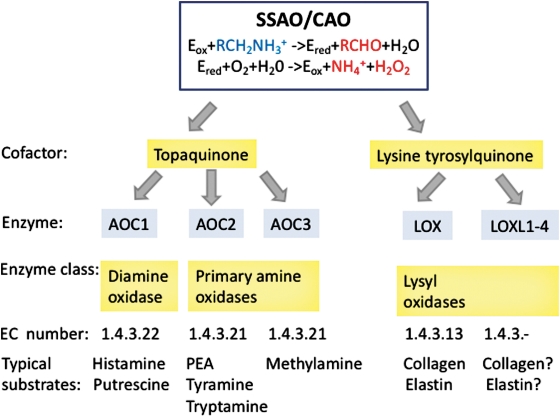 Fig.1 SSAOs/CAOs oxidate primary amines into aldehydes, ammonium and hydrogen peroxide in a two-step reaction.1
AOC2 participates in biological programs that are distinct from those of other copper amine oxidases, reflecting its specialized retinal function:
We present a versatile portfolio of extensively engineered, full-length AOC2 membrane proteins constructed to retain native copper coordination, and glycosylation patterns.Our preferred production platform was mammalian suspension cultures which allow for accurate signal peptide cleavage, copper chaperone-assisted metal incorporation and autocatalytic formation in the active site. For structural biology initiatives or inhibitor screening campaigns requiring alternative formats, we additionally offer different cell expression and proprietary refolding protocols for bacterial-derived inclusion bodies to support comparative ophthalmology and toxicology studies.
Not finding the membrane protein product you need? Contact us to start your one-stop custom service!
The establishment of cellular platforms that faithfully recapitulate surface presentation and enzymatic secretion of AOC2 are critical for elucidating its roles in vascular pathology, as well as to facilitate the rapid discovery anti-inflammatory researches. Here, we present a comprehensive characterization of AOC2 stable cell lines that maintain authentic plasma membrane localization as well as copper-dependent catalytic activity and functional responsiveness to inflammatory cytokines/metabolic stress by combining lentiviral transduction with transposon-based genomic integration. This collection goes beyond constitutive wild-type expression, incorporating different systems that allow precise temporal surface density control and catalytically inactive mutants for adhesion-only mechanistic studies through co-expression with AOC2 as well as an integrin ligand or other components of extracellular matrix in a single cellular background.
Not finding the stable cell line product you need? Contact us to start your one-stop custom service!
Advance your AOC2 research programs with our comprehensively validated collection of sequence-defined, high-affinity monoclonal antibodies. Our antibodies selectively recognize the properly folded, glycosylated AOC2 ectodomain, thereby eliminating the confounding specificity issues that have historically plagued this enzyme family. They detect both the membrane-anchored full-length protein and any soluble shed forms, distinguish AOC2 from different orthologs, and bind catalytically active as well as copper-depleted conformations.
Not finding the recombinant antibody product you need? Contact us to start your one-stop custom service!
Far more than a catalog; we provide turnkey discovery and manufacturing solutions, customized to meet the complex requirements of products aimed at AOC2 development:
Certainly. You routinely generate catalytically inactive variants containing amino acid substitutions in the copper-coordinating histidines, TOPA-deficient mutants that abolish amine oxidation and ectodomain truncations retaining adhesive activity with loss of enzymatic function. These custom constructs are provided as high-purity recombinant proteins or genetically stable cell lines, along with complete sequence verification and thorough mass spectrometric identity confirmation, functional characterization via enzymatic kinetic assaysand leukocyte binding experiments.
Yes. Our situation ensures faithful metal insertion, and autocatalytic establishment of TOPA biogenesis in the active site using our mammalian expression systems (with copper chaperone co-expression only when needed). Inductively coupled plasma mass spectrometry is used to carry out a stoichiometric verification for copper (Cu) content of each batch. UV spectroscopy is run for the characteristic absorbance spectrum along with quantification achieved from specific activity measurements obtained from standard amine substrate oxidation assays concluding that functional integrity was maintained prior to product release.
Absolutely. We raise our monoclonal antibodies against specific regions of AOC2 scavenger receptor cysteine-rich domain and the copper-binding region that have very low sequence homology to those with respect to either AOC3, lysyl oxidase or diamine oxidase. Western blot, ELISA and immunohistochemistry cross-reactivity testing extensively demonstrates exquisite specificity thus making them excellent candidates for diagnostic quantification in complex biological matrices.
Yes. We engineer dedicated bicistronic and dual-promoter expression plasmids that support co-expressed detection of AOC2 with integrin ligands, selectins or extracellular matrix components from single stable cell line. These platforms are functionally-validated for leukocyte rolling, firm adhesion and transmigration under shear flow conditions offering off-the-shelf cell substrates for compound screening and mechanistic studies of vascular inflammation.








