
Creative Biolabs is offering the most comprehensive services for antibody development projects. With strict regulation and effective execution, we are dedicated to providing the most valuable solutions to complete your projects.
HighlightsCreative Biolabs is offering the most comprehensive services for antibody development projects. With strict regulation and effective execution, we are dedicated to providing the most valuable solutions to complete your projects.
HighlightsCreative Biolabs has established a broad range of platforms for developing novel antibodies or equivalents. These cutting-edge technologies enable our scientists to meet your demands from different aspects and tailor the most appropriate solution that contributes to the success of your projects.
HighlightsWith deep understanding in antibody-related realms and extensive project experience, Creative Biolabs offers a variety of references to help you learn more about our capacities and achievements, including infographic, flyer, case study, peer-reviewed publications, and all kinds of knowledge that can assist your projects. You are also welcome to contact us directly for more specific solutions.
HighlightsGet a real taste of Creative Biolabs, one of the most professional custom service providers in the world. We are committed to providing highly customized comprehensive solutions with the best quality to advance your projects.
Highlights Loading...
All listed services and products are For Research Use Only. Do Not use in any diagnostic or therapeutic applications.
Asialoglycoprotein receptor 1 (ASGR1) is the core subunit of the asialoglycoprotein receptor responsible for ligand binding. This receptor itself is a class of calcium-dependent lectin receptors that only appears densely and specifically on the surface of hepatocytes, and does not appear abundantly on cells of other organs. It can accurately recognize glycoproteins with terminally exposed galactose or N-acetylgalactosamine residues—these residues are originally covered by terminal sialic acid, and are only exposed after sialic acid is cleaved by enzymes. After recognizing these abnormally exposed glycoproteins, ASGR1 initiates the cell's endocytic process, engulfs these glycoproteins into the cell, and then transports them to lysosomes for catabolism. Through this patrol and clearance mechanism, it stabilizes the level of glycoproteins in the blood, prevents the accumulation of these substances that should be cleared in the circulation, regulates the flow of lipids and bile acids in the liver, and even participates in the entire process of the liver processing immune complexes and desialylated lipoproteins, making it a key hub for maintaining liver homeostasis. In addition to this classic clearance function, ASGR1 is also a classic research case of human genetics facilitating preclinical target discovery. An accidental finding from large-scale population sequencing at that time showed that some people carry natural loss-of-function variants in the ASGR1 gene, and the levels of non-high-density lipoprotein cholesterol in their blood are lower than those of the general population, and their risk of developing coronary heart disease is also significantly reduced. This discovery immediately set off a research boom targeting ASGR1, and the academic community generally regards it as a key node in the lipid metabolism pathway for in-depth exploration. From a pathological perspective, once the expression or function of ASGR1 is abnormal, it will also lead to many problems. It is closely related to chronic liver disease, hepatocellular malignancy, virus invasion of hepatocytes, and inflammatory remodeling of liver tissue, and is an important influencing factor in the occurrence and development of many liver diseases.
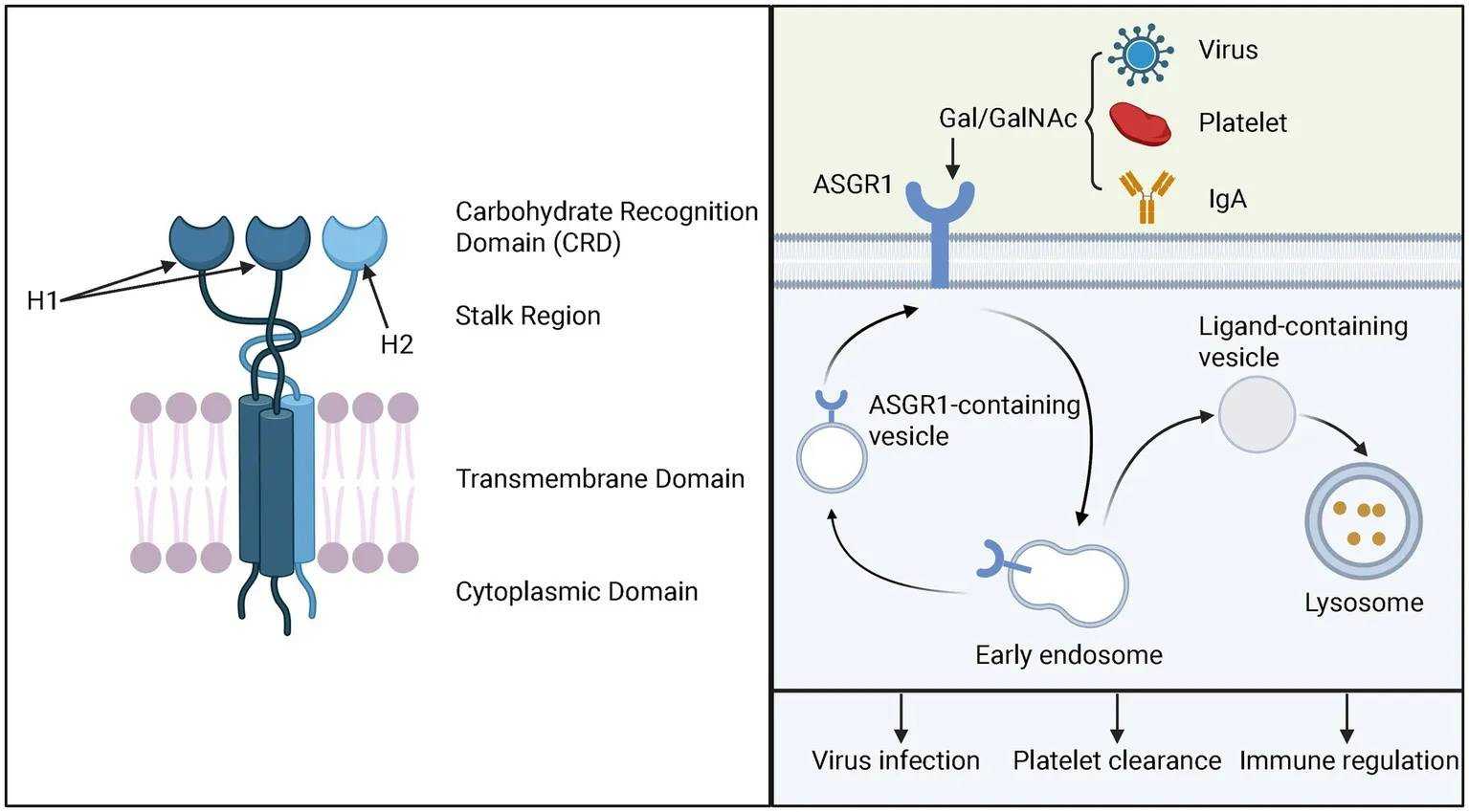 Fig.1 ASGPR receptor structure (Left) and ASGR1-mediated endocytosis process and its biological functions (Right).1
Current research continues to expand the regulatory network coordinated by ASGR1:
Our line of ASGR1 membrane protein products was anchored to one core principle from the very beginning of their design: to conduct rigorous research, the receptor must first be able to complete normal clearance, fold naturally, and anchor accurately to the cell membrane. Simply put, only when ASGR1 can function normally as it does in native cells can the experimental results produced with it be reliable. This is the foundation on which we develop all our products. For the carbohydrate recognition domain of ASGR1 to work properly, it relies on naturally paired disulfide bonds and the coordination of calcium ions. The single transmembrane structure that anchors the protein can regulate multimer formation through interactions with its supporting subunits, and can also work in concert with the cell's endocytosis mechanism. These are all irreplaceable key properties for ASGR1 to perform its normal physiological functions; without any one of them, the protein cannot function as it does. To preserve these critical properties, all our full-length ASGR1 products are manufactured in an optimized system, which fully retains authentic post-translational modifications—we never omit the key modifications that the protein would carry in its native state, nor add any unintended structures, to restore ASGR1 to its original form to the greatest extent possible. The currently available products fall into two categories: one is full-length ASGR1 for structural and biophysical characterization; the other is variant for studying ligand binding, uptake, and transport processes. Every batch of manufactured products undergoes strict verification of quality attributes, including purity testing via SDS-PAGE, analytical size-exclusion chromatography, and light scattering methods. The quality of each batch is supported by clear testing data, eliminating batch-to-batch quality fluctuations.
Not finding the membrane protein product you need? Contact us to start your one-stop custom service!
Our cell platform, which closely mimics physiological conditions, serves as the core support for studying ASGR1-mediated recognition, internalization, and subsequent biological processes under controlled laboratory conditions. To thoroughly investigate the series of processes that ASGR1 is involved in, we first need a cellular environment that approximates in vivo conditions. Otherwise, if experimental conditions deviate too far from real physiological situations, the conclusions drawn cannot explain actual problems. Using sequence-optimized stable integration technology, we have developed customizable high-expression stable cell lines that can continuously and uniformly express ASGR1. This eliminates issues such as variable expression levels from day to day, or inconsistent expression across different cell populations, ensuring stable and reproducible experimental readings for all assays. You can trigger expression when you need it, and pause it when you do not, which is perfectly suited for research that requires precise control of receptor expression. Every monoclonal cell line has undergone comprehensive phenotypic validation to ensure stable performance, so they are ready to use immediately upon receipt, with no need to spend extra time verifying the cell state.
Not finding the stable cell line product you need? Contact us to start your one-stop custom service!
When paired with our validated panel of recombinant anti-ASGR1 antibodies, you can support analytical and functional studies of ASGR1 using clones selected for documented applications. Monoclonal and recombinant reagents can target distinct epitopes in the extracellular carbohydrate-recognition region or cytoplasmic tail. Specificity, quantitative performance, and application suitability are reported according to the validation data available for each clone. Sequence-confirmed recombinant production is used to support lot-to-lot consistency under validated conditions, allowing antibody selection to be matched to the intended experimental format.
Not finding the recombinant antibody product you need? Contact us to start your one-stop custom service!
Extending well beyond our standard catalog, we deliver fully customizable discovery and manufacturing solutions meticulously tailored to the sophisticated demands of ASGR1-targeted research and precompound development:
It is fully applicable. This type of protein comes in two forms: one only carries the extracellular domain fragment, and the other is the full-length intact protein.
Yes. The ASGR1 products we provide retain the native transmembrane anchoring property and can maintain the lateral mobility of the protein on the membrane. This form is the industry-recognized gold standard for high-resolution structural studies and biophysical studies of single-pass transmembrane receptors.
All ASGR1-related products and services are exclusively for preclinical research. They have never been designed, validated, or authorized for any human application, and must never be used in any human-related application scenario.
Yeah. Every constructed engineered cell line completes phenotypic testing before sale, with three core indicators verified: receptor density on the cell surface, receptor localization on the cell membrane, and the glycosylation status of the receptor.









