Creative Biolabs is offering the most comprehensive services for antibody development projects. With strict regulation and effective execution, we are dedicated to providing the most valuable solutions to complete your projects.
HighlightsCreative Biolabs is offering the most comprehensive services for antibody development projects. With strict regulation and effective execution, we are dedicated to providing the most valuable solutions to complete your projects.
HighlightsCreative Biolabs has established a broad range of platforms for developing novel antibodies or equivalents. These cutting-edge technologies enable our scientists to meet your demands from different aspects and tailor the most appropriate solution that contributes to the success of your projects.
HighlightsWith deep understanding in antibody-related realms and extensive project experience, Creative Biolabs offers a variety of references to help you learn more about our capacities and achievements, including infographic, flyer, case study, peer-reviewed publications, and all kinds of knowledge that can assist your projects. You are also welcome to contact us directly for more specific solutions.
HighlightsGet a real taste of Creative Biolabs, one of the most professional custom service providers in the world. We are committed to providing highly customized comprehensive solutions with the best quality to advance your projects.
Highlights Loading...
All listed services and products are For Research Use Only. Do Not use in any diagnostic or therapeutic applications.
Activating transcription factor 6 (ATF6) is an ER-resident type II transmembrane transcription factor encoded by ATF6 gene, serving as one of three core signal transducers of the mammalian unfolded protein response (UPR) activated upon accumulation of misfolded proteins within endoplasmic reticulum lumens. Under basal non-stress physiological conditions, full-length ATF6 remains anchored to ER membranes via its N-terminal cytoplasmic transcription activation domain and C-terminal luminal sensor domain, stably bound to ER chaperone BiP/GRP78 that masks ATF6 luminal retention motifs to prevent constitutive trafficking. When unfolded protein load exceeds ER folding capacity, BiP dissociates from ATF6 to bind misfolded luminal polypeptides, releasing ATF6 for transport to Golgi apparatus membrane compartments; sequential site-1 and site-2 protease cleavage liberates the cytoplasmic ATF6 N-terminal fragment that translocates into cell nuclei to bind ER stress response elements and drive transcription of chaperone, folding enzyme and ER-associated degradation genes to restore proteostasis. Under mild physiological ER stress, ATF6 signaling acts as an adaptive protective cascade to expand ER folding capacity and clear toxic aggregated polypeptides; upon prolonged severe stress, sustained ATF6 transcriptional output coordinates with other UPR branches to initiate apoptotic cell death programs to eliminate irreparably damaged cells. Distinct from PERK and IRE1 UPR sensors with kinase/ribonuclease activity, ATF6 operates exclusively as a trafficking-regulated transcription factor with no intrinsic enzymatic function, bearing unique adaptive ER expansion regulatory roles that cannot be fully substituted by the other two UPR pathways. Suppressed ATF6 signaling impairs cellular capacity to resolve protein misfolding stress and increases susceptibility to toxic aggregate buildup, while persistent hyperactivated ATF6 cleavage amplifies pro-apoptotic transcriptional programs and accelerates stress-induced tissue injury, establishing ATF6 as a core research target for ER proteostasis biology and metabolic/neurodegenerative stress pathway-modulator screening.
ATF6 executes core ER stress adaptive transcriptional function via regulated membrane trafficking and sequential proteolytic cleavage cascade triggered by BiP dissociation during luminal protein misfolding stress. Full-length ER-bound ATF6 undergoes COPII vesicle-mediated transport to Golgi membranes only after BiP release, where two sequential intramembrane and luminal proteases separate the transcriptionally active cytoplasmic fragment from the ER-sensing luminal domain to enable nuclear translocation. Conserved basic leucine zipper DNA binding motifs within the liberated N-terminal fragment selectively recognize ER stress response promoter sequences to coordinate broad transcriptional reprogramming targeting ER folding, degradation and lipid biogenesis machinery. ATF6-dependent transcriptional reprogramming sustains balanced cellular ER proteostasis, covering adaptive ER membrane expansion and controlled stress-triggered apoptotic signaling upon irreversible damage. ATF6 participates in a broad spectrum of physiological and stress response processes including developmental protein folding homeostasis, nutrient metabolic stress adaptation and toxic aggregate clearance regulation. Disrupted ATF6 signal transduction blunts adaptive UPR responses and exacerbates misfolded protein-mediated cellular toxicity. Therefore, ATF6 represents a pivotal research target for ER transmembrane transcription factor study and stress-protective compound discovery.
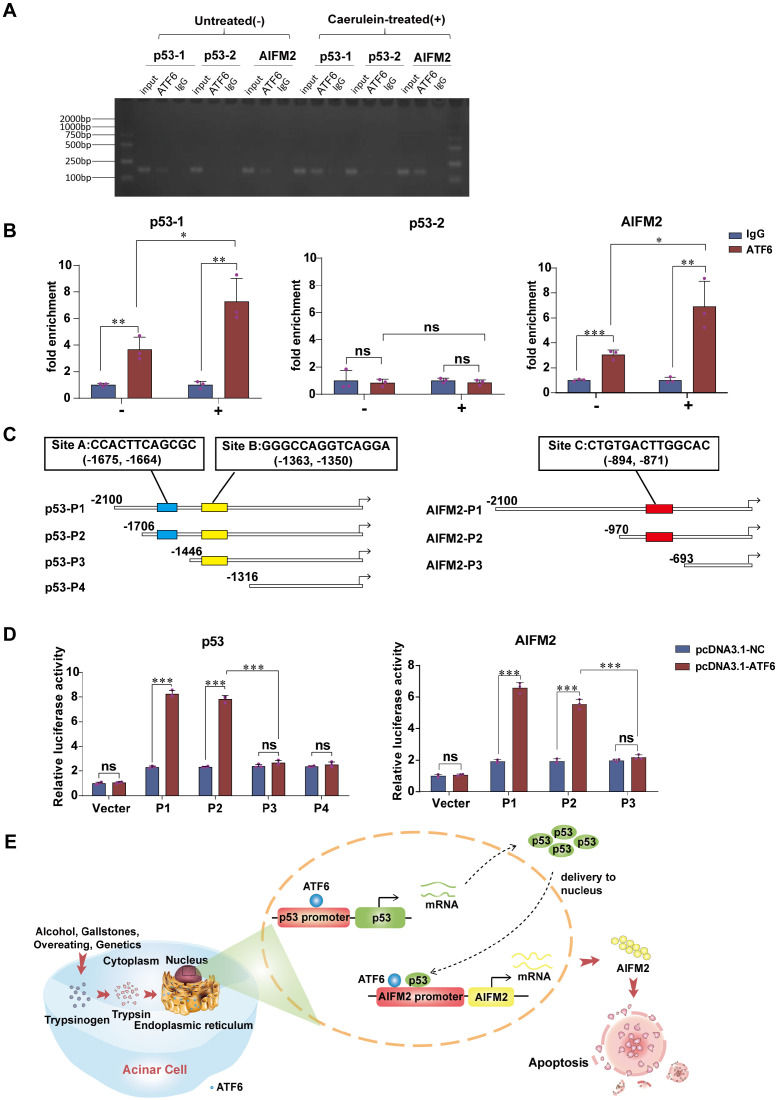 Fig. 1 Experimental data confirm ATF6 occupies the promoter regions of p53 and AIFM2, transcriptionally activating their expression in pancreatic acinar cells to drive apoptotic progress under pancreatitis‑inducing risk factors.1
The biological functions of ATF6 are focused on ER luminal stress detection, regulated Golgi proteolysis and adaptive UPR transcriptional programming:
Creative Biolabs offers high-quality ATF6 proteins through optimized expression systems, including full-length ER membrane-bound ATF6 and isolated nuclear active N-terminal transcription domain variants. These products retain native conformational characteristics and BiP binding / DNA transcriptional binding biological activity, suitable for ER stress protein interaction assays and UPR adaptive modulator screening. All ATF6 proteins undergo strict quality control to ensure consistent performance and reliable application across diverse research platforms.
Not finding the membrane protein product you need? Contact us to start your one-stop custom service!
Creative Biolabs provides custom-engineered ATF6 stable cell lines, including full-length wild-type and cleavage-deficient mutant control models. These cell lines are optimized for ER unfolded protein response profiling and stress proteostasis functional analysis. Each cell line undergoes stringent validation to ensure stable expression profiles and consistent functional performance in diverse experimental contexts.
Not finding the stable cell line product you need? Contact us to start your one-stop custom service!
High-specificity recombinant antibodies targeting ATF6 are developed via advanced antibody engineering technologies, with no cross-reactivity with other bZIP ER stress transcription factors. These antibodies are validated for ER membrane and nuclear subcellular localization detection and stress tissue expression profiling, and can be paired with BiP and S1P protease detection reagents to track complete ATF6 activation trafficking cascade in proteotoxic stress cell models.
Not finding the recombinant antibody product you need? Contact us to start your one-stop custom service!
Beyond catalog products, Creative Biolabs offers specialized custom services for ATF6 research:
ATF6 is an ER transmembrane transcription factor activated by protein misfolding stress; after Golgi proteolysis its cytoplasmic fragment enters nuclei to drive adaptive unfolded protein response gene expression.
ATF6 mediates adaptive ER expansion and proteotoxic stress resolution, serving as a key target for treating protein aggregate-linked degenerative and metabolic disorders.
No, all ATF6 products and services are strictly for research use only, not intended for clinical diagnosis or treatment.
Offerings include full-length ER ATF6 membrane proteins, cleavage-specific detection antibodies and custom stable cell lines for ER stress proteostasis research.
ATF6 proteins are validated via BiP chaperone binding and ER stress response element DNA transcriptional binding functional testing.