Creative Biolabs is offering the most comprehensive services for antibody development projects. With strict regulation and effective execution, we are dedicated to providing the most valuable solutions to complete your projects.
HighlightsCreative Biolabs is offering the most comprehensive services for antibody development projects. With strict regulation and effective execution, we are dedicated to providing the most valuable solutions to complete your projects.
HighlightsCreative Biolabs has established a broad range of platforms for developing novel antibodies or equivalents. These cutting-edge technologies enable our scientists to meet your demands from different aspects and tailor the most appropriate solution that contributes to the success of your projects.
HighlightsWith deep understanding in antibody-related realms and extensive project experience, Creative Biolabs offers a variety of references to help you learn more about our capacities and achievements, including infographic, flyer, case study, peer-reviewed publications, and all kinds of knowledge that can assist your projects. You are also welcome to contact us directly for more specific solutions.
HighlightsGet a real taste of Creative Biolabs, one of the most professional custom service providers in the world. We are committed to providing highly customized comprehensive solutions with the best quality to advance your projects.
Highlights Loading...
All listed services and products are For Research Use Only. Do Not use in any diagnostic or therapeutic applications.
ATPase cation transporting 13A2 (ATP13A2) is the most mysterious member of the P-type ATPase family. Let us first explain what this family is—they are a class of enzymes that obtain energy by breaking down ATP, and can use this energy for the transmembrane transport of cations, that is, to push positively charged ions across various cell membranes to complete the substance transport work required by cells. Since this gene was first annotated, for many years no one could clarify exactly what endogenous substrates it transports, and even its location within the cell does not align with others—other well-known counterparts all work on the plasma membrane, the outermost membrane of the cell, while ATP13A2 resides on the late endosomes and lysosomes inside the cell. Ever since it was first discovered through genomic screening, it has drawn a clear line between itself and other members of the family. Research on ATP13A2 has unfolded gradually through a series of steadily advancing, interlinked discoveries. First, genetic association studies linked genetic variants of this gene to severe hereditary neurodegenerative diseases; these variants can lead to the phenotype of early-onset Parkinson's syndrome, as well as manifestations similar to lysosomal storage disorders. Long before people clarified its transport chemical mechanism, this protein had already been firmly positioned at the core of neurodegenerative disease research, becoming an unavoidable research focus.
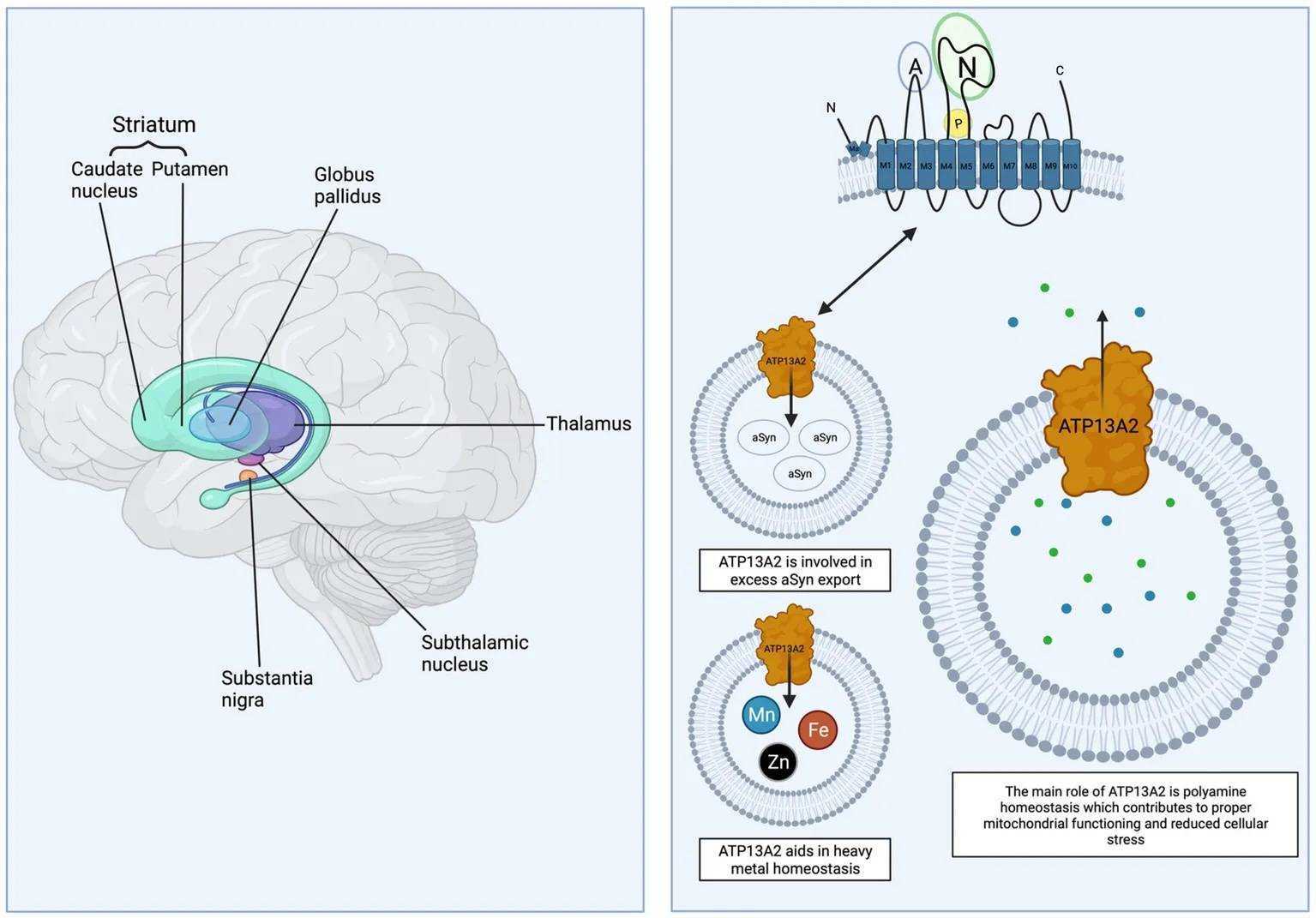 Fig.1 ATP13A2 and the basal ganglia.1
Several research currents keep converging on this pump:
To produce a functional ATP13A2, all its core functions must first be preserved; otherwise, its activity is biologically meaningless. ATP13A2 itself is a "protein pump" that operates within cells, driving substance transport by breaking down ATP—the cell’s universal energy currency. If it can hydrolyze ATP but fail to couple the energy released from that breakdown to the substrate transport process; or if it cannot assemble into a complete ten-helix structure during formation, the core skeleton of the entire pump will lack critical components. Even if it passes routine purity tests, all experiments designed to verify core functions will fail. Put simply, this seemingly pure protein cannot perform the job it is meant to carry out. The full-length, correctly folded ATP13A2 we produce is all derived from an optimized eukaryotic expression platform. Quality inspections are conducted before product release, including purity confirmation via SDS-PAGE, which acts as an initial checkpoint through routine protein purity testing; only products meeting purity standards are delivered. If your research requires a specific mutation background, customized substrate conditions, or a formulation compatible with the pump detection assay you use, we can adjust our preparation protocol to fit your experimental plan. Every batch of protein is custom-made for the research that uses it, eliminating any mismatch between the product and experimental needs.
Not finding the membrane protein product you need? Contact us to start your one-stop custom service!
We offer isogenic stable cell lines that can express wild-type ATP13A2, or have custom mutation sequences inserted. Researchers can use these cell lines to separately study the basic ATP hydrolysis activity and the efficiency of transport-energy coupling, preventing the two processes from becoming conflated and unanalyzable. Every cell line undergoes comprehensive validation before delivery: we quantify its protein expression level using calibrated standards, establishing its baseline expression characteristics before it enters your experimental workflow. You can use it immediately upon receipt, without spending time repeatedly measuring the cell line’s baseline expression. If your project requires a specific mutation background, designated cell density tiers, or an induced expression timeline that aligns with your stress stimulation experimental protocol, our platform can customize all of these adjustments. Every cell line is constructed to support the experimental design it will participate in, perfectly matching the pace of your research.
Not finding the stable cell line product you need? Contact us to start your one-stop custom service!
Our recombinant antibody panel is screened for ATP13A2 selectivity against relevant related ATPase family members, with the validated specificity range documented for supported applications. Multiple formats can support detection of epitopes exposed on different sides of the lysosomal membrane. Defined-sequence recombinant production is used to support lot-to-lot consistency under validated conditions. Custom conjugates, additional sample-type validation, or alternative antibody formats can be considered on request according to project requirements.
Not finding the recombinant antibody product you need? Contact us to start your one-stop custom service!
Extending well beyond our standard catalog, we deliver fully customizable discovery and manufacturing solutions meticulously tailored to the sophisticated demands of ATP13A2-targeted research and precompound development:
All useless or damaged substances in the cell must be sent here to be broken down, and the usable raw materials can be recycled and reused. To maintain the normal operation of this work, the chemical environment inside lysosomes must always be kept within an appropriate range, and the body will strictly control this environment to prevent any chaos. There is also a type of pump in lysosomes, whose function is to transport out the substances that need to be removed from inside the lysosomes, and this pump itself directly affects whether the chemical environment inside lysosomes remains stable. This is the reason why once this type of pump is missing, the entire organelle starts to be damaged from the inside.
Scientists analyzed evidence obtained from genetic research together with conclusions drawn from biochemical experiments, and found that if this pump malfunctions and cannot work normally, polyamines will be trapped inside lysosomes and cannot be expelled at all. This finding linked the chemical changes in the transport process to the lysosomal dysfunction previously observed in loss-of-function models.
Inherited variants produce severe neuronal phenotypes in research models, and the mechanistic chain runs through lysosomal dysfunction, impaired clearance, and neuronal stress resilience. The research program this connection launched spans lysosome biology and neuronal survival.
Research on neurodegenerative diseases refers to the relevant research that specifically studies diseases that cause the gradual necrosis of nerve cells and the progressive decline of their functions. The connection between this pump and this field of research needs to be explained step by step. First of all, if heritable mutations occur in the gene of this pump—that is, genetic changes that can be passed from one generation to the next—they will trigger severe neurological abnormalities in experimental models.