Creative Biolabs is offering the most comprehensive services for antibody development projects. With strict regulation and effective execution, we are dedicated to providing the most valuable solutions to complete your projects.
HighlightsCreative Biolabs is offering the most comprehensive services for antibody development projects. With strict regulation and effective execution, we are dedicated to providing the most valuable solutions to complete your projects.
HighlightsCreative Biolabs has established a broad range of platforms for developing novel antibodies or equivalents. These cutting-edge technologies enable our scientists to meet your demands from different aspects and tailor the most appropriate solution that contributes to the success of your projects.
HighlightsWith deep understanding in antibody-related realms and extensive project experience, Creative Biolabs offers a variety of references to help you learn more about our capacities and achievements, including infographic, flyer, case study, peer-reviewed publications, and all kinds of knowledge that can assist your projects. You are also welcome to contact us directly for more specific solutions.
HighlightsGet a real taste of Creative Biolabs, one of the most professional custom service providers in the world. We are committed to providing highly customized comprehensive solutions with the best quality to advance your projects.
Highlights Loading...
All listed services and products are For Research Use Only. Do Not use in any diagnostic or therapeutic applications.
ATPase sarcoplasmic/endoplasmic reticulum Ca²⁺ transporting 1 (ATP2A1), also known as SERCA1 or SR Ca²⁺-ATPase 1, is encoded by the ATP2A1 gene on chromosome 16p11.2. The gene spans approximately 26 kb and contains 23 exons, one of which undergoes alternative splicing to generate the SERCA1a and SERCA1b isoforms. The encoded protein belongs to the P-type ATPase family and functions as a multi-pass transmembrane calcium pump localized to the sarcoplasmic reticulum (SR) membrane. ATP2A1 contains a large cytoplasmic headpiece with nucleotide-binding (N), phosphorylation (P), and actuator (A) domains, ten transmembrane helices that form the calcium translocation pathway, and a C-terminal region. The protein assembles as a monomer and is regulated by the small transmembrane peptide sarcolipin (SLN); interactions with phospholamban (PLN) have also been studied in selected coexpression systems. Crystal structures of SERCA1a in complex with SLN have been determined, revealing a stabilized E1 state with calcium sites exposed to the cytoplasm. ATP2A1 is expressed predominantly in fast-twitch (type II) skeletal muscle fibers, with SERCA1a accounting for more than 99% of SERCA1 isoforms in adult skeletal muscle and SERCA1b predominating in neonatal muscle.
ATP2A1 catalyzes the ATP-dependent transport of Ca²⁺ from the cytosol into the SR lumen, the reaction that drives muscle relaxation following contraction. This enzyme couples the hydrolysis of one ATP molecule to the translocation of two Ca²⁺ ions against their concentration gradient. During excitation-contraction coupling, Ca²⁺ released from the SR through ryanodine receptor 1 (RYR1) activates muscle contraction, and ATP2A1 then sequesters Ca²⁺ back into the SR to restore the resting cytosolic Ca²⁺ concentration and enable relaxation. ATP2A1 activity is modulated by sarcolipin; phospholamban-dependent regulation has also been reported in selected experimental coexpression systems, which uncouples ATP hydrolysis from calcium transport and promotes thermogenesis. Biallelic loss-of-function variants in ATP2A1 cause Brody myopathy (also known as Brody disease), an autosomal recessive disorder characterized by exercise-induced impairment of muscle relaxation, muscle stiffness, and cramping.
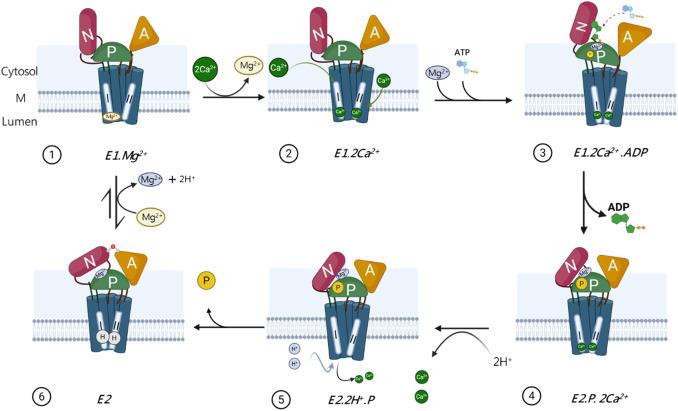 Fig. 1 Simplified forward catalytic cycle of SERCA pumps (adapted from a SERCA3-focused review; the schematic is not direct evidence of SERCA1-specific regulatory interactions).1
ATP2A1, encoded by the ATP2A1 gene, functions as an SR membrane calcium pump that regulates cytosolic Ca²⁺ clearance and muscle relaxation:
Creative Biolabs provides ATP2A1 membrane protein products produced using optimized expression systems. These include full-length multi-pass transmembrane protein that retains the native P-type ATPase domain architecture, including the nucleotide-binding, phosphorylation, and actuator domains, as well as isolated cytoplasmic domain variants. The cytoplasmic domains mediate ATP binding and phosphorylation, while the transmembrane helices form the calcium translocation pathway, making these proteins suitable for studies of P-type ATPase kinetics, calcium transport mechanisms, and regulatory protein interactions. All ATP2A1 proteins undergo strict quality control to support consistent performance across applicable research platforms.
Not finding the protein product you need? Contact us to start your one-stop custom service!
Creative Biolabs provides custom-engineered ATP2A1 stable cell lines, including overexpression and knockdown models. These cell lines are optimized for studies of calcium transport, muscle relaxation, excitation-contraction coupling, and ATP2A1-associated myopathy mechanisms. Each cell line undergoes stringent validation to ensure stable expression profiles and consistent functional performance in diverse experimental contexts.
Not finding the stable cell line product you need? Contact us to start your one-stop custom service!
High-specificity recombinant antibodies targeting ATP2A1 are developed using antibody engineering techniques for research applications involving ATP2A1 expression and localization. These antibodies can be used in studies of ATP2A1 distribution in skeletal muscle SR fractions and may also support characterization of ATP2A1-containing calcium transport complexes in combination with appropriate detection reagents.
Not finding the recombinant antibody product you need? Contact us to start your one-stop custom service!
Beyond catalog products, Creative Biolabs offers specialized custom services for ATP2A1 research:
ATP2A1 is an SR membrane P-type ATPase that catalyzes ATP-dependent Ca²⁺ transport from the cytosol into the SR lumen, driving muscle relaxation and replenishing SR calcium stores.
ATP2A1 is essential for skeletal muscle relaxation and calcium homeostasis, and its loss-of-function mutations cause Brody myopathy, making it important for studies of calcium transport, excitation-contraction coupling, and muscle physiology.
No, all ATP2A1 products and services are strictly for research use only, not intended for clinical diagnosis or treatment.
Offerings include full-length ATP2A1 membrane proteins, cytoplasmic domain variants, specific detection antibodies, and custom stable cell lines for calcium transport and muscle physiology research.
ATP2A1 proteins may support research on ATPase activity and calcium uptake, depending on protein format and experimental context.