Creative Biolabs is offering the most comprehensive services for antibody development projects. With strict regulation and effective execution, we are dedicated to providing the most valuable solutions to complete your projects.
HighlightsCreative Biolabs is offering the most comprehensive services for antibody development projects. With strict regulation and effective execution, we are dedicated to providing the most valuable solutions to complete your projects.
HighlightsCreative Biolabs has established a broad range of platforms for developing novel antibodies or equivalents. These cutting-edge technologies enable our scientists to meet your demands from different aspects and tailor the most appropriate solution that contributes to the success of your projects.
HighlightsWith deep understanding in antibody-related realms and extensive project experience, Creative Biolabs offers a variety of references to help you learn more about our capacities and achievements, including infographic, flyer, case study, peer-reviewed publications, and all kinds of knowledge that can assist your projects. You are also welcome to contact us directly for more specific solutions.
HighlightsGet a real taste of Creative Biolabs, one of the most professional custom service providers in the world. We are committed to providing highly customized comprehensive solutions with the best quality to advance your projects.
Highlights Loading...
All listed services and products are For Research Use Only. Do Not use in any diagnostic or therapeutic applications.
ATPase sarcoplasmic/endoplasmic reticulum Ca2+ transporting 2 (ATP2A2), best known by its common name SERCA2, is a major intracellular calcium pump, responsible for transporting calcium ions into the sarcoplasmic reticulum and endoplasmic reticulum. The sarcoplasmic reticulum and endoplasmic reticulum are major intracellular Ca2+ stores, and SERCA2 helps restore cytosolic Ca2+ toward resting levels by sequestering Ca2+ into these stores after signaling events. This P-type ATPase, with a molecular weight of approximately 110 kDa, crosses the membrane enclosing the sarcoplasmic reticulum and endoplasmic reticulum ten times, and undertakes an extremely challenging task in the field of membrane transport: it breaks down one ATP molecule, and uses the energy released from hydrolysis to push two calcium ions to move against a steep concentration gradient into the warehouse—that is, to squeeze them into the lumen, where the calcium concentration is already very high, and seal them inside the lumen; every time a calcium signaling event concludes and the cell's signaling activity comes to an end, it also clears excess calcium ions from the cytoplasm, resetting the cytoplasmic calcium concentration to the resting level the cell maintained before initiating signals. ATP2A2 influences an equally wide range of physiological processes. The gene that encodes it undergoes alternative processing, meaning the same stretch of gene produces different protein versions, or isoforms: one class of isoforms is enriched in specific tissues, specially adapted to meet the working demands of contractile systems; another class of isoforms is widely distributed, and carries a regulatory tail located within the lumen. The combined action of these distinct protein variants affects not only muscle relaxation, neuronal excitability, and cellular secretory function, but also the basal cytoplasmic calcium level in nearly all cell types.
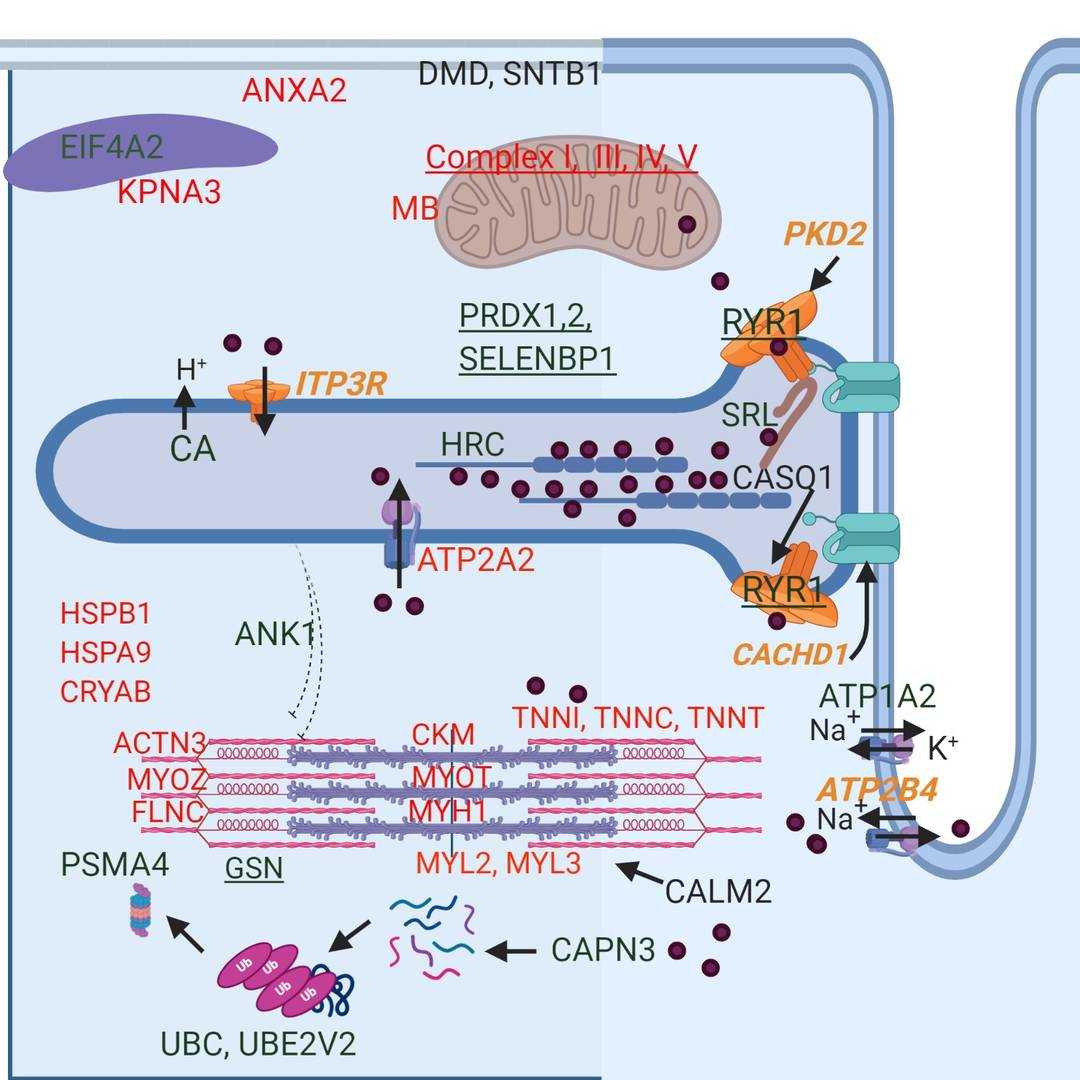 Fig.1 Depiction of the cellular location of differentially expressed proteins and select differentially expressed genes in RER-susceptible horses.1
Current research on ATP2A2 is advancing along three interconnected directions:
The core logic of our product line related to the ATP2A2 membrane protein is very simple: ATP2A2 itself is a protein present on cell membranes, which is essentially an ion pump. Whether an ion pump is reliable depends entirely on the completeness of its catalytic function. For ATP2A2 to complete a full material transport process, several structural segments that extend into the cytoplasm inside the cell and the core portion that spans the cell membrane must work in perfect coordination; even a minor error will prevent it from functioning normally. Given such high requirements for coordination precision, all the ATP2A2 proteins we produce are full-length, with no truncations whatsoever. To culture these proteins, we use a specially optimized eukaryotic expression system — that is, a system tailored to produce proteins for organisms with complete cell nuclei. The original design goal of this system is to preserve these key characteristics that require precise coordination, preventing them from being damaged during the production process. Every batch of the produced proteins undergoes multi-dimensional quality testing: purity is confirmed using SDS-PAGE technology, and monodispersity — that is, the state of whether proteins will randomly aggregate — is verified via analytical size-exclusion chromatography. A batch is only considered qualified when all indicators meet the standards.
Not finding the membrane protein product you need? Contact us to start your one-stop custom service!
If you wish to use a cell-based platform to study ATP2A2, this cell platform must meet three mandatory requirements: it must be able to control the protein's expression level, avoiding unregulated random production; it must enable the protein to accurately anchor to the correct position on the endoplasmic reticulum, preventing mislocalization; and it must allow this pump protein to function normally, so that it is not produced but unable to perform its role. After all, whether this protein can fulfill its original function depends entirely on its localization within the cell and the activity of its working cycle — neither factor can afford to go wrong. In addition to purified finished protein products, we also provide customized stable cell lines that can stably express large quantities of ATP2A2. These cells do not lose their ability to produce the protein after only a few uses; they are constructed using sequence-optimized stable integration technology, which ensures that within a reproducible and consistent cellular background, the density of the pump protein in each cell is uniform and stable. There will be no instances of some cells expressing high levels while others express low, or the quantity changing over repeated use. Our cell line library has a complete range of categories to cover different research needs: it includes cells that can stably overexpress native ATP2A2, which are further divided into fixed expression level tiers, so there are corresponding cell lines available whether you want to produce higher or lower quantities; it also includes cell clones carrying artificially engineered mutations, for researchers to conduct relevant experiments. Regardless of the type of cell clone, all will first complete comprehensive phenotypic validation to confirm all indicators meet requirements before being delivered to customers.
Not finding the stable cell line product you need? Contact us to start your one-stop custom service!
If you are advancing a research project on ATP2A2, you may also pair it with our validated recombinant antibody panel. These monoclonal and recombinant antibodies target defined ATP2A2 epitopes, with specificity, quantitative performance, and application suitability reported according to available validation data. Sequence-confirmed recombinant production is used to support lot-to-lot consistency under validated conditions. Validation information is provided for supported experimental formats so antibody selection can be matched to the intended workflow.
Not finding the recombinant antibody product you need? Contact us to start your one-stop custom service!
In addition to our catalog products, Creative Biolabs specializes in custom services for membrane protein and antibody discovery & development. Using our deep knowledge and sophisticated platforms we can support you with:
Yes. Clones are screened for selective ATP2A2 recognition and counter-screened against related family members using recombinant protein panels.
We do. Custom constructs carrying alterations can be produced and purified under the same quality framework as wild-type material.
Both constitutive and inducible formats are available. Each clone ships with measured expression, localization, and functional data, so pump density can be matched precisely to your experimental design.
All ATP2A2 products and services are provided strictly for preclinical research. They are not designed, validated, or authorized for any use involving human subjects.