Creative Biolabs is offering the most comprehensive services for antibody development projects. With strict regulation and effective execution, we are dedicated to providing the most valuable solutions to complete your projects.
HighlightsCreative Biolabs is offering the most comprehensive services for antibody development projects. With strict regulation and effective execution, we are dedicated to providing the most valuable solutions to complete your projects.
HighlightsCreative Biolabs has established a broad range of platforms for developing novel antibodies or equivalents. These cutting-edge technologies enable our scientists to meet your demands from different aspects and tailor the most appropriate solution that contributes to the success of your projects.
HighlightsWith deep understanding in antibody-related realms and extensive project experience, Creative Biolabs offers a variety of references to help you learn more about our capacities and achievements, including infographic, flyer, case study, peer-reviewed publications, and all kinds of knowledge that can assist your projects. You are also welcome to contact us directly for more specific solutions.
HighlightsGet a real taste of Creative Biolabs, one of the most professional custom service providers in the world. We are committed to providing highly customized comprehensive solutions with the best quality to advance your projects.
Highlights Loading...
All listed services and products are For Research Use Only. Do Not use in any diagnostic or therapeutic applications.
ATPase H⁺ transporting accessory protein 1 (ATP6AP1), also known as Ac45, ATP6S1, or XAP-3, is encoded by the ATP6AP1 gene on chromosome Xq28. This gene encodes the S1 subunit of the vacuolar H⁺-ATPase (V-ATPase), a 45-kDa polypeptide belonging to the V-ATP enzyme attachment subunit family. ATP6AP1 is a type I transmembrane glycoprotein that undergoes proteolytic processing of its luminal domain. This protein is highly N-glycosylated, with several reported N-linked glycosylation sites, which are crucial for its folding and stability. ATP6AP1 is located in the lysosomal and endosomal membranes, where ATP6AP1 is associated with the membrane-encapsulated V0 portion of the V-ATP enzyme.
ATP6AP1 serves as a structural hub for V0 complex assembly. The cryo-electron microscopy structure of the complete human V-ATPase reveals that ATP6AP1 connects multiple V0 subunits and phospholipids within the c-ring, acting as a central organizer of V-ATPase biogenesis. V-ATP enzymes are ATP-driven proton pumps composed of cytoplasmic V1 complexes for ATP hydrolysis and membrane-embedded V0 complexes for proton transfer. By stabilizing the V0 complexes, ATP6AP1 is necessary for the acidification of the intracellular organelles and extracellular environment mediated by V-ATP enzymes. In osteoclasts, ATP6AP1 is highly induced by RANKL during differentiation and is essential for extracellular acidification, lysosomal trafficking, and protease exocytosis.
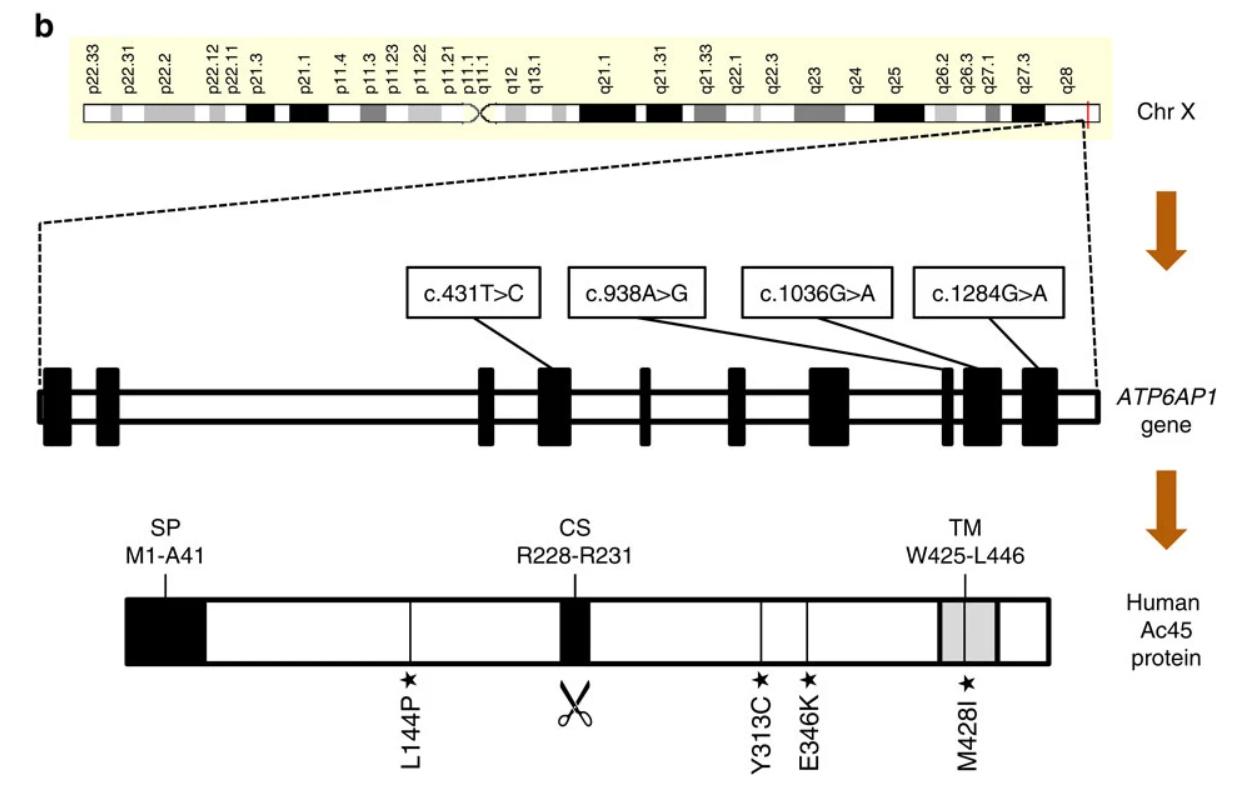 Fig. 1 ATP6AP1 gene, located on chromosome Xq28, and its gene structure consisting of 10 exons.1
ATP6AP1, encoded by the ATP6AP1 gene, functions as an essential accessory subunit of the V-ATPase that regulates organellar acidification and autophagic flux:
Creative Biolabs provides ATP6AP1 membrane protein products produced using optimized expression systems. These include full-length ATP6AP1 transmembrane protein that retains the native luminal domain, transmembrane region, and cytoplasmic tail, as well as isolated luminal domain variants. The N-glycosylation sites and the luminal domain mediate V0 subunit association and structural hub function, making these proteins suitable for studies of V-ATPase assembly, lysosomal acidification mechanisms, and accessory subunit function characterization. All ATP6AP1 proteins undergo strict quality control to support consistent performance across applicable research platforms.
Not finding the protein product you need? Contact us to start your one-stop custom service!
Creative Biolabs provides custom-engineered ATP6AP1 stable cell lines, including overexpression and knockdown models. These cell lines are optimized for studies of V-ATPase assembly, lysosomal acidification, autophagic flux, and ATP6AP1-associated congenital disorders of glycosylation. Each cell line undergoes stringent validation to ensure stable expression profiles and consistent functional performance in diverse experimental contexts.
Not finding the stable cell line product you need? Contact us to start your one-stop custom service!
High-specificity recombinant antibodies targeting ATP6AP1 are developed using antibody engineering techniques for research applications involving ATP6AP1 expression and localization. These antibodies can be used in studies of ATP6AP1 distribution in lysosomal and endosomal fractions and may also support characterization of ATP6AP1-containing V-ATPase complexes in combination with appropriate detection reagents.
Not finding the recombinant antibody product you need? Contact us to start your one-stop custom service!
Beyond catalog products, Creative Biolabs offers specialized custom services for ATP6AP1 research:
ATP6AP1 is an accessory subunit of the V-ATPase that functions as a structural hub for V0 complex assembly, regulating lysosomal acidification and autophagic flux.
ATP6AP1 is essential for V-ATPase assembly and lysosomal function, and its mutations cause an X-linked congenital disorder of glycosylation with immunodeficiency and hepatopathy. It also regulates autophagy and mTORC1 signaling.
No, all ATP6AP1 products and services are strictly for research use only, not intended for clinical diagnosis or treatment.
Offerings include full-length ATP6AP1 membrane proteins, domain variants, specific detection antibodies, and custom stable cell lines for V-ATPase and lysosomal function research.
ATP6AP1 proteins may support research on V-ATPase assembly and lysosomal acidification, depending on protein format and experimental context.