
Creative Biolabs is offering the most comprehensive services for antibody development projects. With strict regulation and effective execution, we are dedicated to providing the most valuable solutions to complete your projects.
HighlightsCreative Biolabs is offering the most comprehensive services for antibody development projects. With strict regulation and effective execution, we are dedicated to providing the most valuable solutions to complete your projects.
HighlightsCreative Biolabs has established a broad range of platforms for developing novel antibodies or equivalents. These cutting-edge technologies enable our scientists to meet your demands from different aspects and tailor the most appropriate solution that contributes to the success of your projects.
HighlightsWith deep understanding in antibody-related realms and extensive project experience, Creative Biolabs offers a variety of references to help you learn more about our capacities and achievements, including infographic, flyer, case study, peer-reviewed publications, and all kinds of knowledge that can assist your projects. You are also welcome to contact us directly for more specific solutions.
HighlightsGet a real taste of Creative Biolabs, one of the most professional custom service providers in the world. We are committed to providing highly customized comprehensive solutions with the best quality to advance your projects.
Highlights Loading...
All listed services and products are For Research Use Only. Do Not use in any diagnostic or therapeutic applications.
The protein Attractin (ATRN) has never been confined to a single biological research field. It is a large type I membrane protein, assembled from multiple functional modules—including CUB repeats, growth factor-like fragments, and cysteine-rich fragments. Unlike ordinary simple receptors that only receive one or two specific signals, it acts more like a molecular workbench laid out within the cell, with structurally divided regions that each take on distinct tasks, enabling it to carry out a wide range of unrelated functions inside the cell. This protein exists in the body primarily in two forms, both with indispensable physiological functions. Dissecting their respective roles to study them separately is the first hurdle every researcher new to ATRN must overcome. One is the full-length membrane-anchored version, firmly fixed to the cell surface, only exerting its effects on the cell that produces it; the other is a shorter secreted subtype that detaches from the cell, enters the extracellular space, diffuses through bodily fluids to other parts of the body, and acts far from its origin.Research in the metabolic field first identified ATRN through a landmark genetic discovery: in research models, an inactivating mutation in this gene would cause severe impacts on body weight regulation and blood glucose processing. Later, ATRN was shown to participate in agouti/ASIP-mediated melanocortin signaling as an accessory factor, a pathway involved in satiety and energy expenditure. In immunology, ATRN fulfills an entirely different role: after lymphocytes are activated, they release soluble ATRN, that diffusible secreted subtype, to regulate interactions between immune cells during an immune response.
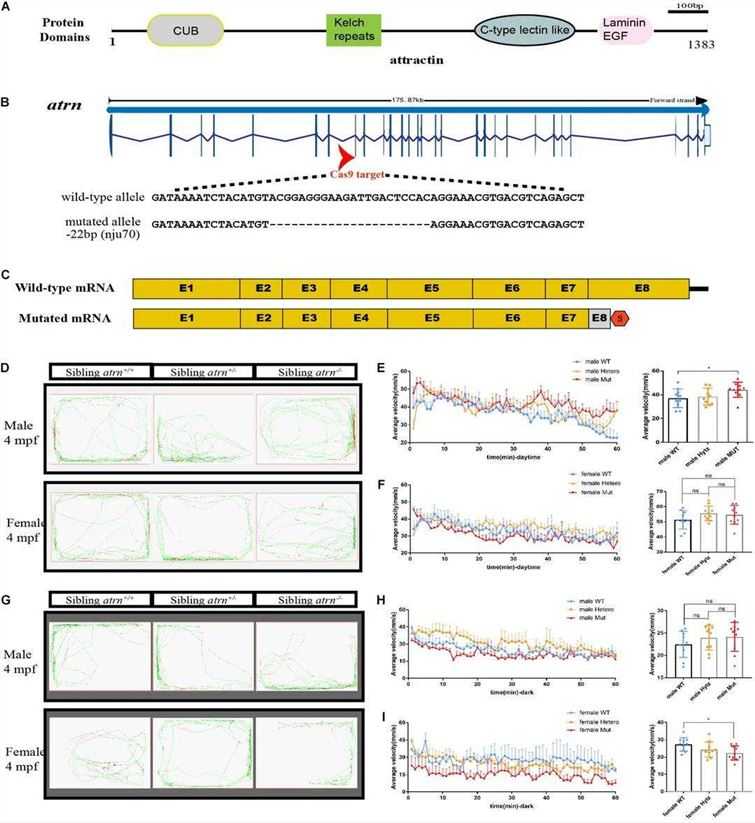 Fig.1 Generation of atrn mutation in zebrafish by CRISPR-Cas9 strategy, and the average velocity of the male mutant is faster than the wild type during the day, but in the dark, the female mutant likes to stay quiet.1
The field keeps circling back to a few recurring themes:
To produce a reliable ATRN product, two core requirements must be met simultaneously: one is the molecular weight of the product itself, and the other is the fact that it naturally exists in two completely distinct functional forms, neither of which can be compromised. The protein expression systems we use to produce ATRN are all specifically selected: they must be compatible with this large multi-domain protein, able to assist the protein in folding correctly into its native conformation, and capable of supporting corresponding quality inspections matched to its molecular structure. Every link from production to quality control is strictly enforced. The finished ATRN products we can provide are mainly full-length ATRN with a cell membrane anchoring structure, which can be stably displayed on the cell surface for researchers to study its interactions with other substances. For every batch of products shipped, qualified release test data is attached to confirm that the product status meets standards.
Not finding the membrane protein product you need? Contact us to start your one-stop custom service!
Among commonly used cell lines, wild-type overexpression cell lines can maintain a stable, measurable density of membrane-bound ATRN on the cell surface, with controllable quantities, facilitating experiments that require unified variables. Before each cell clone is shipped, comprehensive testing is completed to verify all basic parameters: the ATRN expression level on the cell surface is quantitatively detected using calibrated standards, the intracellular localization of ATRN is recorded via imaging, the production profiles of the two forms are analyzed simultaneously, and the ratio of the two ATRN forms in the cell line is confirmed in advance. This ensures that users have a clear understanding immediately upon receiving the products, without needing to spend a great deal of time conducting basic characterization themselves.
Not finding the stable cell line product you need? Contact us to start your one-stop custom service!
The recombinant antibody panel is designed to support studies of membrane-associated and soluble ATRN forms. Clone selection, epitope information, and application suitability are reported according to the validated scope for each reagent. Sequence-defined recombinant production is used to support lot-to-lot consistency under validated conditions, while additional formats or application validation can be considered according to project requirements.
Not finding the recombinant antibody product you need? Contact us to start your one-stop custom service!
Extending well beyond our standard catalog, we deliver fully customizable discovery and manufacturing solutions meticulously tailored to the sophisticated demands of ATRN-targeted research and precompound development:
A brief description of the application, the format envisioned, and any acceptance criteria already in mind is sufficient. Technical details can be refined together from there.
Yes. Custom formats and integrated multi-component engagements are routine, with unified quality frameworks keeping specifications aligned.
Yes. The scientific team stays reachable for assay guidance and troubleshooting for as long as the materials are in use.
All ATRN products and services are provided strictly for preclinical research. They are not designed, validated, or authorized for any use involving human subjects.









