Creative Biolabs is offering the most comprehensive services for antibody development projects. With strict regulation and effective execution, we are dedicated to providing the most valuable solutions to complete your projects.
HighlightsCreative Biolabs is offering the most comprehensive services for antibody development projects. With strict regulation and effective execution, we are dedicated to providing the most valuable solutions to complete your projects.
HighlightsCreative Biolabs has established a broad range of platforms for developing novel antibodies or equivalents. These cutting-edge technologies enable our scientists to meet your demands from different aspects and tailor the most appropriate solution that contributes to the success of your projects.
HighlightsWith deep understanding in antibody-related realms and extensive project experience, Creative Biolabs offers a variety of references to help you learn more about our capacities and achievements, including infographic, flyer, case study, peer-reviewed publications, and all kinds of knowledge that can assist your projects. You are also welcome to contact us directly for more specific solutions.
HighlightsGet a real taste of Creative Biolabs, one of the most professional custom service providers in the world. We are committed to providing highly customized comprehensive solutions with the best quality to advance your projects.
Highlights Loading...
All listed services and products are For Research Use Only. Do Not use in any diagnostic or therapeutic applications.
BNIP3 (BCL2/adenovirus E1B 19 kDa protein-interacting protein) or NIP3 is a single-pass transmembrane protein of 194-amino acids that belongs to the atypical BH3-only subfamily from the BCL-2 family with an estimated molecular weight of approximately 21.8kDa in prediction and its SDS-PAGE derived gel migration shows an apparent dimerization band at about 30–35kD due to possible post-translational modifications resulting by glycosylation, phosphorylation. In normal physiological settings, BNIP3 is mostly located in the cytoplasm without a significant monomeric activity or weakly associated with OMM and endoplasmic reticulum. Under hypoxic stress, BNIP3 is transcriptionally activated by HIF-1αthrough binding to the hypoxia response elements (HRE) in the promoter of its gene region and robust upregulation. In addition to its role in mitophagy, BNIP3 also has pro-apoptotic activity via the action of it's BH3 domain and TMD that can induce mitochondrial permeability transition (MPT), ROS production, and cytochrome c-independent cell death.
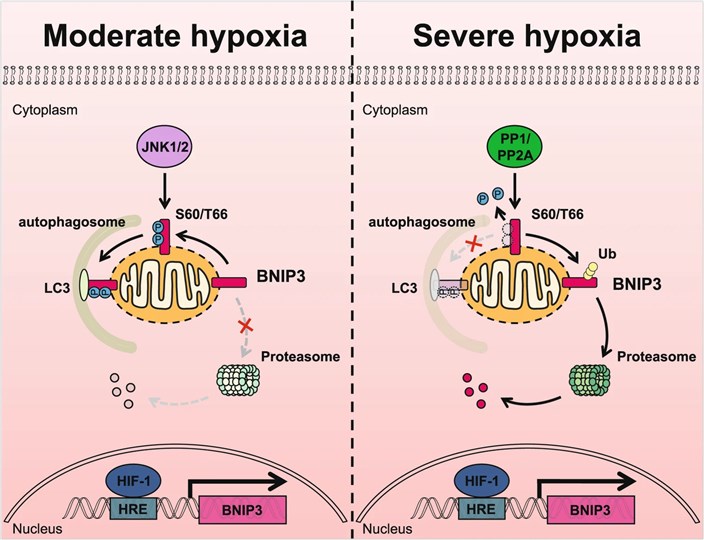 Fig.1 The hypothetical mechanism of BNIP3 phosphorylation-mediated mitophagy under hypoxia.1
The functional versatility of BNIP3 is due to its particular ability to combine mitochondrial quality control and programmed cell death:
We offer high-quality BNIP3 membrane protein products designed to support structural and functional studies of this mitophagy-related protein. Our Membrane Protein Platform provides BNIP3 constructs and preparations suitable for a range of research applications, including antibody development and characterization, binding studies, protein–protein interaction analysis, and investigation of BNIP3-related mitophagy and apoptosis mechanisms. These products can support studies of BNIP3 interactions with LC3, BCL-2, Beclin-1, and other components of autophagy-related pathways. Available formats and construct designs may vary according to specific research requirements, with appropriate quality assessment applied based on the intended application.
Not finding the membrane protein product you need? Contact us to start your one-stop custom service!
BNIP3 research requires robust cellular models. Our stable cell lines are designed to support mitophagy studies, hypoxia-response research, metabolic investigations, and compound screening related to BNIP3 biology. Leveraging our cell engineering expertise, we provide customized BNIP3 stable expression or regulation models according to specific experimental requirements. These cell models can support gain- or loss-of-function studies and the investigation of BNIP3-mediated mitophagy, metabolic reprogramming, and hypoxia-related signaling. Appropriate expression and functional characterization strategies can be selected based on the intended research application.
Not finding the stable cell line product you need? Contact us to start your one-stop custom service!
We have developed a portfolio of recombinant antibodies against BNIP3 for a range of research applications. Recombinant production supports consistent reagent supply and lot-to-lot reproducibility for routine research use. Depending on the specific product and supporting datasheet, BNIP3 recombinant antibodies may be suitable or available for selected applications such as Western Blotting (WB), ELISA, Flow Cytometry (FCM), Immunofluorescence (IF), Immunocytochemistry (ICC), and Immunohistochemistry (IHC). These antibodies can support the detection and analysis of BNIP3 expression and related biological processes in appropriate research samples and model systems. For studies requiring recognition of specific BNIP3 regions or other specialized antibody properties, customized antibody development and suitability assessment can be discussed according to the intended experimental design.
Not finding the recombinant antibody product you need? Contact us to start your one-stop custom service!
In addition to our catalog products, Creative Biolabs provides high-performing customized services, including but not limited to membrane protein and antibody discovery & development. With this background and our next-generation platforms, we can help you with:
Absolutely. We provide custom protein engineering services for various mutations, such as phosphorylation-mimetic mutants (S17E/S24E/S60E/T66E), LIR-deficient (W18A/L21A) and dimerization-disrupting based on GxxxG substitutions in the TMD replacements, BH3 domain truncations, PEST domain deletions. tag fusions since TMBD-His/Hii6/FAB-FLAG/GFP/biotin /formulation specificizations. We work with our scientific team to help clients develop constructs for structural biology, interaction mapping and therapeutic screening.
No, all reagents and services are only for research use and shall not be used in diagnosing or treating disease.
Yes, we have generated stable lines in which BNIP3 transcription is dependent on a tetracycline responsive promoter. Such a setup allows for highly controlled initiation of expression at predetermined time points, followed by measurements of subsequent mitochondrial depolarization kinetics, Parkin-independent mitophagosome formation and caspase-independent cell death with temporal resolution that is freed from the variabilities associated with transient transfection or hypoxia mimetic compounds.
We have a broad portfolio of products including recombinant BNIP3 membrane proteins, in different formats (detergent-solubilized / liposome-reconstituted / mitochondria-enriched fractions), stable cell lines expressing the BNIP3 protein (overexpressing/knockdown/reporter line; high-affinity recombinant BTN antibodies that bind distinct epitopes and phosphorylation sites, and fully customized for engineering services for new protein and antibody discovery. We have mouse, rat and other mammalian species products.