Creative Biolabs is offering the most comprehensive services for antibody development projects. With strict regulation and effective execution, we are dedicated to providing the most valuable solutions to complete your projects.
HighlightsCreative Biolabs is offering the most comprehensive services for antibody development projects. With strict regulation and effective execution, we are dedicated to providing the most valuable solutions to complete your projects.
HighlightsCreative Biolabs has established a broad range of platforms for developing novel antibodies or equivalents. These cutting-edge technologies enable our scientists to meet your demands from different aspects and tailor the most appropriate solution that contributes to the success of your projects.
HighlightsWith deep understanding in antibody-related realms and extensive project experience, Creative Biolabs offers a variety of references to help you learn more about our capacities and achievements, including infographic, flyer, case study, peer-reviewed publications, and all kinds of knowledge that can assist your projects. You are also welcome to contact us directly for more specific solutions.
HighlightsGet a real taste of Creative Biolabs, one of the most professional custom service providers in the world. We are committed to providing highly customized comprehensive solutions with the best quality to advance your projects.
Highlights Loading...
All listed services and products are For Research Use Only. Do Not use in any diagnostic or therapeutic applications.
Carbonic anhydrase 12, abbreviated CA12 and also annotated as CAXII, is a type I transmembrane metalloenzyme with a molecular weight ranging from 40 to 45 kDa, belonging to the α-carbonic anhydrase family. Its structure is divided into three core parts, each corresponding to its assigned functions: The first part is a large extracellular catalytic domain, the primary site where it exerts its core catalytic function. Within the standard active site of this region, a zinc ion is firmly anchored by three histidine residues. The second part is a single transmembrane α-helix, which spans the entire cell membrane to stably anchor the entire CA12 protein to the cell. The third part is a short C-terminal cytoplasmic tail hidden inside the cell, the short tail domain.CA12 is mostly found on the plasma membrane of epithelial cells in the kidney, colon, and specific glandular tissues, rather than being randomly distributed in any cell of the body. At these locations, it is a core factor regulating systemic and local acid-base balance; without it, the body's pH level is prone to disruption. The core reaction it catalyzes is the reversible conversion of carbon dioxide into bicarbonate and hydrogen ions, meaning this reaction can proceed forward to split carbon dioxide into the other two substances, or reverse to recombine those two substances back into carbon dioxide. This reaction has an extremely high kinetic efficiency, allowing all acid-base related substances to quickly reach equilibrium across the entire extracellular space, preventing drastic local fluctuations in pH. CA12's stable enzymatic activity, clear structural framework, and core role in regulating the pH of the microenvironment surrounding cells, combined together, make it a highly valuable research target in the fields of basic biochemistry, membrane biology, and preclinical compound mechanism research.
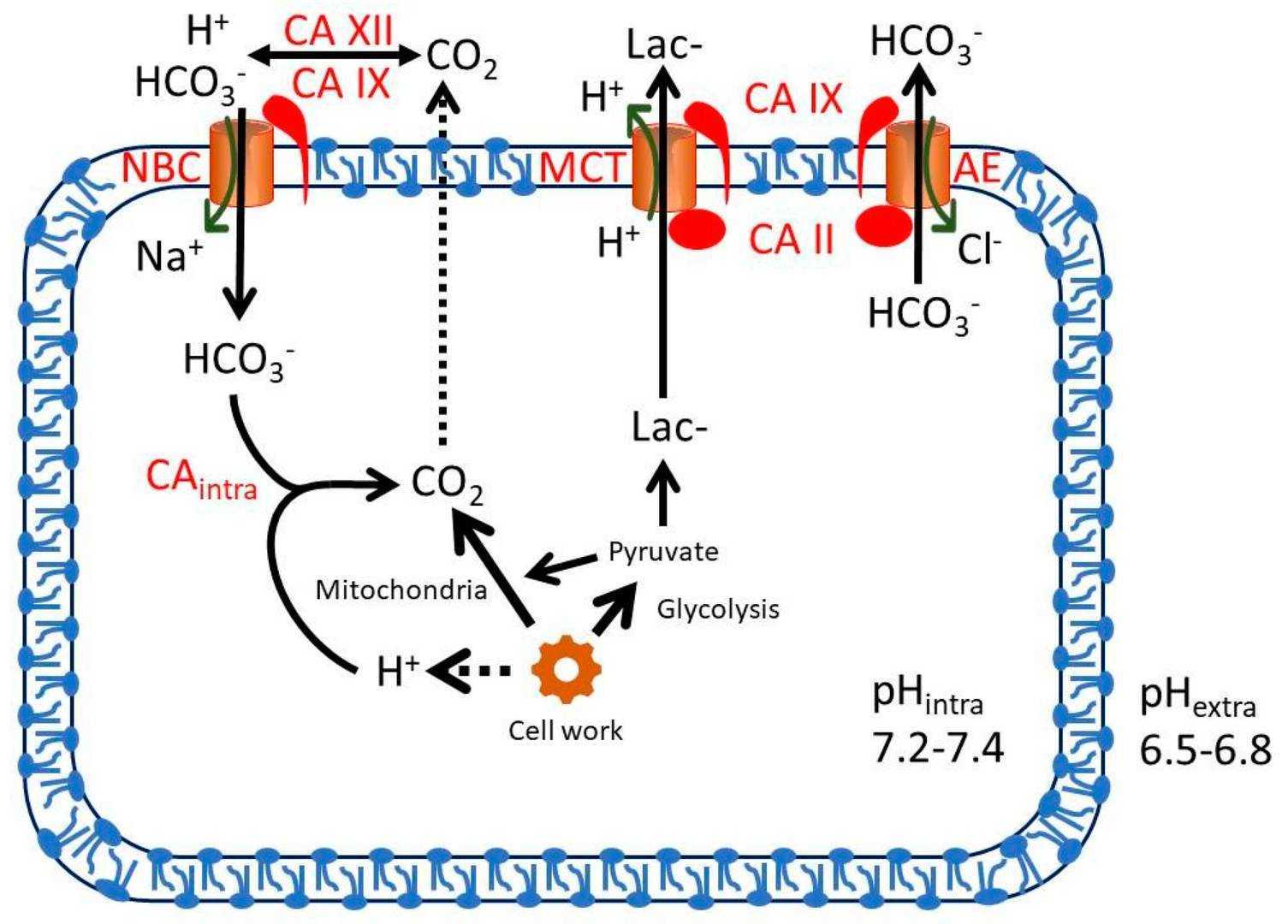 Fig.1 Schematic representation of tumor pH regulation focusing on Carbonic anhydrases (CAs).1
CA12 can coordinate a variety of cellular activities, far beyond the single role of a simple carbon dioxide hydratase:
We have a dedicated protein design division, which can tailor complete CA12 variant design solutions for various experimental goals. CA12 is a specific target protein; a variant refers to a customized version that has partial structural differences from the original CA12, and can adapt to the special requirements of different experiments. If you need to conduct membrane integration-related research—that is, various experiments that integrate CA12 into biological membranes—we can provide CA12 designs with complete sequences and no fragment deletions, which fully meet the requirements of this type of research. Regulating the catalytic activity of proteins, which refers to a protein’s ability to drive relevant biochemical reactions, is one of the core strengths of our design capabilities. We can also produce site-directed mutagenesis CA12 variants, precisely alter the structure of specific sites on the CA12 protein, and obtain identical proteins that completely lose their catalytic activity. This inactivated protein is an indispensable negative control in enzyme experiments and binding experiments—that is, a reference sample used to eliminate other interfering factors in experiments and help you confirm that the experimental results are truly caused by the target protein. Each round of design includes a verification phase, with repeated communication and verification with you throughout the process, and the final delivered protein structure can fully match all your subsequent experimental needs.
Not finding the membrane protein product you need? Contact us to start your one-stop custom service!
For CA12 cell-based research, stable expression and correct cell-surface localization are important for interpreting catalytic and pH-regulation phenotypes. We can develop stable cell lines expressing wild-type or engineered CA12 at defined levels, with characterization focused on expression, surface localization, and relevant catalytic or extracellular pH responses. Custom variants or expression formats can be aligned with the experimental design, and release testing is documented for the delivered cell model.
Not finding the stable cell line product you need? Contact us to start your one-stop custom service!
You can advance CA12 research using monoclonal or recombinant antibodies selected for defined epitopes and supported applications. Specificity, affinity, and application suitability are reported according to available validation data for each reagent. Where additional sample types, labels, or assay formats are required, customization can be considered based on project requirements.
Not finding the recombinant antibody product you need? Contact us to start your one-stop custom service!
Extending well beyond our standard catalog, we deliver fully customizable discovery and manufacturing solutions meticulously tailored to the sophisticated demands of CA12-targeted research and precompound development:
Yes. We offer biotinylation and site-specific conjugation services that preserve catalytic and structural integrity while enabling oriented immobilization on streptavidin or other capture surfaces. These formats are particularly valuable for label-free interaction analysis and high-throughput screening workflows.
No. All CA12 proteins, cell platforms, and related services are intended strictly for preclinical research purposes. They are not formulated, tested, or approved for administration to human subjects, nor for any application involving human sample analysis beyond standard laboratory research protocols.
Yes. Our protein engineering team routinely designs and produces site-specific variants. We also engineer domain truncations—ranging from signal peptide modifications to complete intracellular tail removals—based on your experimental specifications.
Yes. Beyond the standard tripartite offering of proteins, cell lines, and antibodies, fully customized protein engineering services accommodate the production of variants bearing defined alterations within glycosylation sequons, modified stalk lengths, or truncated cytoplasmic segments.