Creative Biolabs is offering the most comprehensive services for antibody development projects. With strict regulation and effective execution, we are dedicated to providing the most valuable solutions to complete your projects.
HighlightsCreative Biolabs is offering the most comprehensive services for antibody development projects. With strict regulation and effective execution, we are dedicated to providing the most valuable solutions to complete your projects.
HighlightsCreative Biolabs has established a broad range of platforms for developing novel antibodies or equivalents. These cutting-edge technologies enable our scientists to meet your demands from different aspects and tailor the most appropriate solution that contributes to the success of your projects.
HighlightsWith deep understanding in antibody-related realms and extensive project experience, Creative Biolabs offers a variety of references to help you learn more about our capacities and achievements, including infographic, flyer, case study, peer-reviewed publications, and all kinds of knowledge that can assist your projects. You are also welcome to contact us directly for more specific solutions.
HighlightsGet a real taste of Creative Biolabs, one of the most professional custom service providers in the world. We are committed to providing highly customized comprehensive solutions with the best quality to advance your projects.
Highlights Loading...
All listed services and products are For Research Use Only. Do Not use in any diagnostic or therapeutic applications.
The gene CACNA1E encodes the pore-forming core of the R-type voltage-gated calcium channel. The R-type channel belongs to a category of calcium channels that only activate when the cell membrane potential changes to reach a relatively high threshold. The entire family of such high-voltage-activated calcium channels has only five members, and all excitable cells capable of generating electrical activity rely on these five types of channels to convert membrane potential changes into intracellular physiological activities related to calcium ions. The large protein encoded by CACNA1E is firmly embedded in the cell membrane. It contains four repeated structural domains with highly similar sequences, each of which folds into six transmembrane helices, and every helix carries its own set of structures that sense potential changes. The four domains cluster together, forming an exclusive pore in the center that only permits calcium ions to pass through: when the cell membrane undergoes depolarization, that is, when the potential difference across the membrane shrinks, these potential-sensing structures move outward, the central pore opens smoothly, and calcium ions can flow into the cell. CACNA1E is primarily and abundantly expressed in neurons, meaning nerve cells produce this protein in large quantities. Once the corresponding calcium channel pore opens, the inflowing calcium ions generate successive calcium pulses, which have three core functions: first, to promote the release of neurotransmitters, enabling nerve cells to transmit signals to the next cell; second, to adjust the firing pattern of the nerve cell itself, that is, the pattern in which it generates its own electrical signals; third, to regulate the efficiency of synaptic transmission between all neurons in the entire central and peripheral nervous systems, that is, the strength of intercellular signal transmission.
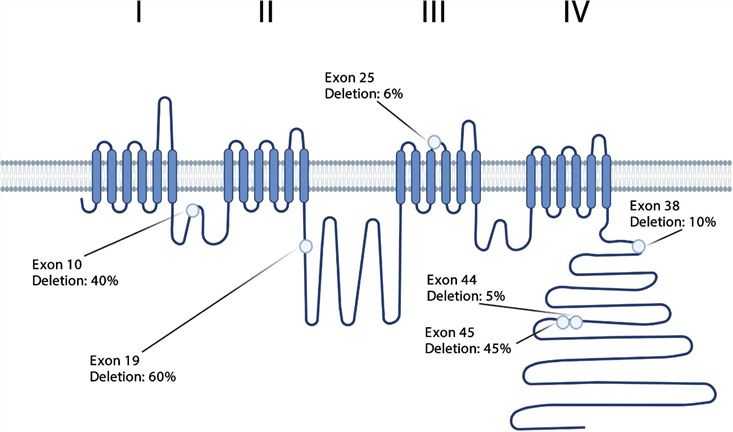 Fig.1 Location of most common splicing events on Cacna1e structure.1
Several research currents keep converging on this subunit:
To produce CACNA1E that is complete and fully functional, the production process must match its scale requirements, so as to create materials that can support credible research. CACNA1E itself is a type of large channel protein; only by adjusting production logic to align with its size characteristics first can qualified, usable experimental materials be generated. Our eukaryotic expression platform has been specially optimized to assemble this category of large channel proteins—not only can it assist proteins in correctly folding into their intended three-dimensional structure, but all quality inspection standards also fully conform to the unique structural requirements of CACNA1E, preventing universal standards from obscuring its specific performance requirements. If your research requires a specific mutation background, a designated combination of auxiliary subunits, or adjustments to the protein form to fit your electrophysiology experimental equipment, the entire production process can be modified to follow your experimental protocol. All preparation work serves your research, and will never force your research to accommodate standard products instead.
Not finding the membrane protein product you need? Contact us to start your one-stop custom service!
Cell models used for CACNA1E-related research must meet two conditions simultaneously: matching expression levels and complete assembly of protein complexes, to obtain accurate experimental data. Simply put, for CACNA1E in these cells to function normally, all necessary conditions must be met. The pore-forming subunits that make up the channel must successfully localize to the cell surface carrying all core functional components, and all required auxiliary subunits must also be in place to enable normal electrical conductivity. If any single link is missing, the entire channel cannot function, and the experimental data will naturally lack validity. We have a ready-made cell line panel, including strains that can overexpress wild-type CACNA1E, as well as strains carrying different mutations, allowing researchers to precisely control variables and dissect the working mechanism of the channel. Every cell line undergoes comprehensive characteristic testing before delivery; before you start your experiment, its basic properties have already been fully confirmed, so you do not need to spend extra time and effort conducting a examination of the cell line first. If your project requires a specific mutation background, a specific combination of auxiliary subunits, or customization of the protein's expression timeline to coordinate with your stimulation experiment protocol, the entire cell platform can be adjusted on demand. The cell line will actively adapt to your experiment, and will never force your experiment to accommodate off-the-shelf cell lines.
Not finding the stable cell line product you need? Contact us to start your one-stop custom service!
Developing research-grade antibodies for CACNA1E requires confronting a core challenge common to the entire voltage-gated calcium channel family: all members of this category of channels have conserved repeat domains, much like nearly identical twins. Ordinary antibodies struggle to distinguish between them, and off-target cross-reactions easily occur. If multiple types of channels coexist in a sample, the results of quantitative detection will be interfered with—you may believe the signal you detected comes from CACNA1E, but it is actually mixed with signals from many other family channels, leading to fundamentally inaccurate experimental data. All antibodies are produced from defined amino acid sequences, supporting lot-to-lot consistency under validated conditions. Application and sample-type validation is documented for supported formats, and alternative labels or antibody formats can be considered where project requirements call for them.
Not finding the recombinant antibody product you need? Contact us to start your one-stop custom service!
Extending well beyond our standard catalog, we deliver fully customizable discovery and manufacturing solutions meticulously tailored to the sophisticated demands of CACNA1E-targeted research and precompound development:
The pore and its four voltage-sensing domains are distributed across a twenty-four-helix architecture that cannot be truncated without losing gating and conductance. Full-length integrity is therefore the baseline quality attribute, not an upgrade.
Fast inactivation means the channel's output depends on recent stimulation history. Protocols account for this history-dependence so that inactivation kinetics are measured rather than accidentally created.
Clones are screened against related channel subunits during selection, and off-target panel results accompany product documentation so specificity claims remain transparent.
All CACNA1E products and services are provided strictly for preclinical research. They are not designed, validated, or authorized for any use involving human subjects.