
Creative Biolabs is offering the most comprehensive services for antibody development projects. With strict regulation and effective execution, we are dedicated to providing the most valuable solutions to complete your projects.
HighlightsCreative Biolabs is offering the most comprehensive services for antibody development projects. With strict regulation and effective execution, we are dedicated to providing the most valuable solutions to complete your projects.
HighlightsCreative Biolabs has established a broad range of platforms for developing novel antibodies or equivalents. These cutting-edge technologies enable our scientists to meet your demands from different aspects and tailor the most appropriate solution that contributes to the success of your projects.
HighlightsWith deep understanding in antibody-related realms and extensive project experience, Creative Biolabs offers a variety of references to help you learn more about our capacities and achievements, including infographic, flyer, case study, peer-reviewed publications, and all kinds of knowledge that can assist your projects. You are also welcome to contact us directly for more specific solutions.
HighlightsGet a real taste of Creative Biolabs, one of the most professional custom service providers in the world. We are committed to providing highly customized comprehensive solutions with the best quality to advance your projects.
Highlights Loading...
All listed services and products are For Research Use Only. Do Not use in any diagnostic or therapeutic applications.
Calcitonin receptor (CALCR) is a 7‑transmembrane class B1 GPCR encoded by the CALCR gene. This receptor localizes to the plasma membrane of somatic cells within bone‑associated and kidney tissues. Distinct from soluble cytoplasmic hydrolases lacking hydrophobic helical segments, CALCR contains seven transmembrane helical segments together with a large extracellular N‑terminal ligand‑binding region. This structural feature enables recognition of calcitonin‑derived polypeptide molecules. Under physiological states with maintained calcium homeostasis, CALCR functions as a membrane‑localized signal transducer. It converts circulating polypeptide‑derived stimuli into intracellular second‑messenger cascades and facilitates signal transmission across the plasma membrane. Loss of CALCR‑mediated signal buffering capacity could permit unrestrained downstream signaling events, which might disturb systemic cation balance. CALCR tends to shape ligand‑response amplitude and supports dynamic calcium turnover within bone microenvironments, and is recognized as an important participant in bone‑related calcium metabolic homeostasis. Diverse cell populations within bone and kidney exhibit distinct cation‑regulatory profiles. Cellular ion transport processes in these tissues likely rely on coordinated signaling output downstream of CALCR to sustain stable extracellular calcium levels in interstitial compartments. Plasma‑membrane‑resident CALCR might engage secreted polypeptide mediators and dampen excessive signal propagation, which could mitigate perturbations to tissue mineral homeostasis driven by drastic cation flux shifts. The extracellular binding region of CALCR holds high sequence conservation and displays selective interaction preferences toward target polypeptides. This property appears to reduce non‑specific cross‑interaction with unrelated circulating signaling peptides and supports the fidelity of downstream signaling cascades.
CALCR is proposed to assemble heteromeric complexes with receptor‑activity‑modifying auxiliary proteins to tune the magnitude of downstream signaling output. Sequence variations mapped to the CALCR gene could alter polypeptide interaction profiles and may correlate with perturbed tissue cation regulatory status. No other class B1 GPCR fully reproduces the dual response profile exhibited by CALCR toward relevant polypeptide cues and cytoplasmic messenger cascade activation. Variations in CALCR expression levels likely correlate with tissue calcium turnover demands, rendering this receptor a compelling subject for class B1 GPCR structural research and mineral‑homeostasis‑related signaling investigation. CALCR localizes exclusively to the plasma membrane and does not occupy luminal spaces of intracellular organelles. Such membrane‑anchored characteristics separate CALCR from soluble cytosolic proteins. It may contribute to tissue‑level cation flux modulation and participates in mineral‑associated signaling cascades. Diminished functional CALCR abundance might weaken cellular responsiveness toward relevant polypeptide stimuli and could promote dysregulated cation transport activity, making CALCR suitable for mechanistic studies focusing on class B1 7‑transmembrane GPCR members.
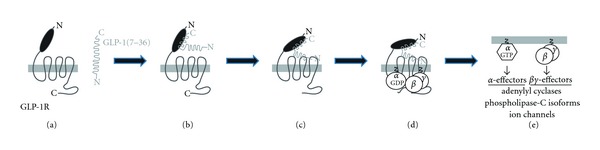 Fig. 1 Schematic illustration of the canonical two‑step activation cascade for class‑B G‑protein‑coupled receptors, including peptide ligand engagement, receptor conformational rearrangement and subsequent G‑protein coupling.1
The biological functions of integral‑membrane CALCR are focused on polypeptide‑related molecular engagement and cytoplasmic messenger cascade transmission:
Creative Biolabs offers purified CALCR membrane‑associated protein samples generated under unified preparation workflows, including full‑length CALCR constructs and isolated variants covering the extracellular ligand‑interacting region. Truncated molecular constructs cannot support complete polypeptide recognition and downstream messenger coupling events, therefore full‑length constructs are better suited for mineral‑homeostasis‑oriented receptor research. Uniform quality assessment is implemented across sample batches. Characterization of molecular performance may be conducted under membrane‑mimetic experimental setups. Extracellular interaction‑region conformation tends to be preserved across batches and supports comparative molecular‑interaction‑oriented research. Purified full‑length CALCR membrane‑associated samples retain intact polypeptide‑interacting surfaces, which could support detection of transient molecular complexes for comparative functional research purposes.
Not finding the Membrane Protein product you need? Contact us to start your one-stop custom service!
Creative Biolabs provides cellular research models featuring adjustable CALCR expression abundance, suitable for class B1 transmembrane receptor structural observation and polypeptide‑receptor interaction‑related research. Sample evaluation covers sustained membrane‑resident receptor detection and polypeptide‑interaction analysis, enabling side‑by‑side comparison of molecular responses under differing receptor abundance conditions. These cellular research models could be combined with cation‑flux‑oriented detection schemes to monitor calcium‑transport‑associated shifts linked to CALCR expression magnitude.
Not finding the stable cell line product you need? Contact us to start your one-stop custom service!
Anti CALCR recombinant antibodies are produced following standardized workflows, compatible with plasma membrane associated receptor localization profiling and polypeptide receptor complex identification. This antibody collection supports multi dimensional observation of receptor distribution within bone and kidney derived tissue research specimens.
Not finding the recombinant antibody product you need? Contact us to start your one-stop custom service!
Beyond catalog products, Creative Biolabs offers specialized custom services for CALCR research:
CALCR is an integral plasma‑membrane‑localized receptor; it may transduce polypeptide‑originated signals and participate in the modulation of cellular calcium‑transport‑related balance within research contexts.
Variations in CALCR expression status might alter tissue‑associated cation‑flux profiles, and CALCR likely acts as an important participant in biological processes linked to mineral homeostasis.
No. All CALCR‑associated products and custom services are strictly for research use only. These reagents are optimized exclusively for basic laboratory research and do not satisfy requirements for clinical‑related workflows.
Offerings include CALCR‑associated membrane protein, target‑directed recombinant antibodies and cellular research models with tunable receptor expression, supporting research investigating polypeptide‑receptor interactions and calcium‑associated signal transduction.
Laboratory‑oriented analytical workflows may adopt polypeptide‑interaction assays within membrane‑mimetic research environments to characterize the molecular recognition profile of CALCR samples.








