
Creative Biolabs is offering the most comprehensive services for antibody development projects. With strict regulation and effective execution, we are dedicated to providing the most valuable solutions to complete your projects.
HighlightsCreative Biolabs is offering the most comprehensive services for antibody development projects. With strict regulation and effective execution, we are dedicated to providing the most valuable solutions to complete your projects.
HighlightsCreative Biolabs has established a broad range of platforms for developing novel antibodies or equivalents. These cutting-edge technologies enable our scientists to meet your demands from different aspects and tailor the most appropriate solution that contributes to the success of your projects.
HighlightsWith deep understanding in antibody-related realms and extensive project experience, Creative Biolabs offers a variety of references to help you learn more about our capacities and achievements, including infographic, flyer, case study, peer-reviewed publications, and all kinds of knowledge that can assist your projects. You are also welcome to contact us directly for more specific solutions.
HighlightsGet a real taste of Creative Biolabs, one of the most professional custom service providers in the world. We are committed to providing highly customized comprehensive solutions with the best quality to advance your projects.
Highlights Loading...
All listed services and products are For Research Use Only. Do Not use in any diagnostic or therapeutic applications.
Calmodulin 1, which is CALM1, has a full length of only 149 amino acids. It is a very small protein, yet it can drive almost all core calcium-dependent processes in eukaryotic cells, with a power that far exceeds its size. You should know that the cells of humans, animals, and plants all belong to the category of eukaryotic cells, which have complete cellular structures. The two spherical lobes wrap around the calcium ions, exposing hydrophobic surfaces that were originally hidden inside the protein. This allows it to seamlessly bind to hundreds of completely distinct target proteins, turning a mere ionic pulse into countless precise cellular responses—whether that means activating enzymes in the cell to produce corresponding activities, adjusting the cell's own structural changes, or triggering reactions related to electrical signals. Few small proteins can, like it, regulate such a wide span of cellular pathways relying on such a simple set of chemical structures. The scope of the target protein network that calmodulin can bind to is impossible to overstate. Calmodulin-dependent protein kinases convert received signals into phosphorylation cascades, regulating memory formation, metabolism, and cytoskeletal activities. Calcineurin, a phosphatase activated by calcium and calmodulin, sits upstream of the transcriptional programs that reshape immune responses; it must be activated before subsequent genetic work can proceed. All major ion channel families—calcium channels, sodium channels, potassium channels—either have calmodulin pre-bound, or recruit it to act as their dedicated calcium signal translator, which sets the duration of ion flow through the channel and the voltage conditions required to activate the channel. Even nitric oxide synthases and myosin light-chain kinase depend on this tiny decoder to function. This small protein, wrapped around four calcium ions, sits stably at the intersection of almost all calcium signal transduction processes, sustaining all the core activities that keep a cell alive.
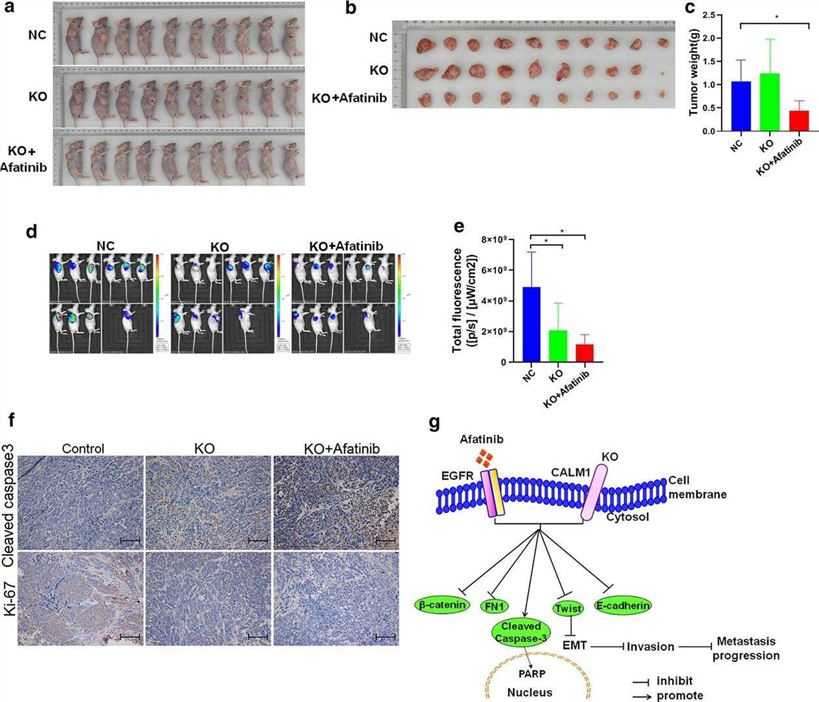 Fig.1 Effects of Knockout of CALM1 and application of EGFR inhibitor on tumorigenesis in nude mice in vivo.1
Several research themes keep this protein in constant circulation:
The full-length CALM1 we produce is derived from a dedicatedly optimized expression platform. The core structure of this protein itself is sufficiently robust and stable, and basically no misfolding occurs during the production process, allowing it to consistently maintain the native folding state it should have in vivo. From the first step of purification all the way to the final delivery to you, the entire process is handled in accordance with unified standards, with strict specifications for the state of every link to prevent disruptions. Before delivery to you, we also conduct two rounds of release testing, and only confirm that it fully meets all requirements before shipment: the first round uses SDS-PAGE to verify the purity of the protein, ensuring that no excess impurities are mixed in; the second round uses analytical size-exclusion chromatography to detect the homogeneity of the protein's properties, guaranteeing that all proteins exist in a unified state without abnormal conditions such as aggregation. If your experimental protocol has special requirements, such as the need for a specific calcium loading state, a buffer matched to the target enzyme you are studying, or a protein concentration adapted to your own experimental setup, all of these can be adjusted by modifying the preparation protocol, and customized exclusively to match the parameters of your research throughout the process.
Not finding the membrane protein product you need? Contact us to start your one-stop custom service!
We also provide two different cell lines to meet diverse research needs. The first is a wild-type overexpression cell line. Using this cell line, the amount of the target protein inside the cell will increase stably, and the specific magnitude of the increase is fully quantifiable, rather than an ambiguous increment. The second is a genetically modified variant cell line, which you can use to test how replacing a specific amino acid on the protein with another alters the protein's calcium-binding capacity, as well as its binding capacity to the target molecule. The seed bank of either cell line will complete a full set of identification procedures before delivery to you. Before you even start your experiments, the basic performance of this cell line has already been confirmed to be qualified and free of issues. If your research has additional special requirements, such as the need for a specific genetic variant background, a fixed protein expression level, or an expression arrangement that aligns with your experimental timeline, the entire platform can be customized to your requirements, and the cell line will be purpose-built for the specific research question you are investigating.
Not finding the stable cell line product you need? Contact us to start your one-stop custom service!
If you plan to use antibodies for research related to CALM1, you must first address two unique issues that are not encountered with the vast majority of experimental targets. The first is that the protein sequences encoded by three genes are completely identical: the proteins produced by the three genes CALM1, CALM2, and CALM3 have identical amino acid sequences, so any antibody targeting this protein will simultaneously detect all expression products of the three genes, and cannot distinguish between them. This property has its uses: if you only need to measure the total content of this protein in cells, using such an antibody is completely fine, but if you want to distinguish which gene's expression pool a specific protein is derived from, this antibody will not be applicable. The recombinant antibody portfolio we provide includes sequence-defined antibody formats that can be evaluated for binding to calcium-bound and calcium-free forms of calmodulin according to specific experimental requirements. All antibodies are produced from defined recombinant sequences, which supports lot-to-lot consistency and reproducibility. If your research has special requirements, such as the need for an antibody clone that preferentially binds to one specific calcium loading state, the need for different conjugates to pair with it, or the need for specialized verification targeting a specific sample type, you can submit a custom request, and appropriate antibody formats and validation strategies can be evaluated according to the intended experimental framework.
Not finding the recombinant antibody product you need? Contact us to start your one-stop custom service!
Extending well beyond our standard catalog, we deliver fully customizable discovery and manufacturing solutions meticulously tailored to the sophisticated demands of CALM1-targeted research and precompound development:
All CALM1 products and services are provided strictly for preclinical research. They are not designed, validated, or authorized for any use involving human subjects.
Yes. Custom formats and integrated multi-component engagements are routine, with unified quality frameworks keeping specifications aligned.
Catalog items work well for standard detection or binding workflows. Custom production makes sense when constructs, formats, or quality attributes step beyond routine specifications. A short consultation is usually enough to decide.
A brief description of the application, the format envisioned, and any acceptance criteria already in mind is sufficient. Technical details can be refined together from there.









