
Creative Biolabs is offering the most comprehensive services for antibody development projects. With strict regulation and effective execution, we are dedicated to providing the most valuable solutions to complete your projects.
HighlightsCreative Biolabs is offering the most comprehensive services for antibody development projects. With strict regulation and effective execution, we are dedicated to providing the most valuable solutions to complete your projects.
HighlightsCreative Biolabs has established a broad range of platforms for developing novel antibodies or equivalents. These cutting-edge technologies enable our scientists to meet your demands from different aspects and tailor the most appropriate solution that contributes to the success of your projects.
HighlightsWith deep understanding in antibody-related realms and extensive project experience, Creative Biolabs offers a variety of references to help you learn more about our capacities and achievements, including infographic, flyer, case study, peer-reviewed publications, and all kinds of knowledge that can assist your projects. You are also welcome to contact us directly for more specific solutions.
HighlightsGet a real taste of Creative Biolabs, one of the most professional custom service providers in the world. We are committed to providing highly customized comprehensive solutions with the best quality to advance your projects.
Highlights Loading...
All listed services and products are For Research Use Only. Do Not use in any diagnostic or therapeutic applications.
CCL11 is a small and secreted protein of about 74 amino acids that belongs to the CC subfamily of chemokines. Increased circulating concentrations of CCL11 are associated with the aging process and increased levels have been reported in several neurodegenerative diseases. In the CNS, CCL11 is released from varieties of cells including choroid plexus epithelial cells, astrocytes, pericytes and microglia which inhibits adult hippocampal neurogenesis, creates excitotoxicity to neurons through NOX1 mediated production of reactive oxygen species and correlates with activation state of microglia. It is implicated in the cardiovascular system as a vascular inflammation and atherogenesis/therosclerosis-inducing chemokine through overlapping inflammatory pathways. It also stimulates various cancers including tumor angiogenesis, epithelial-mesenchymal transition (EMT) and immune evasion.
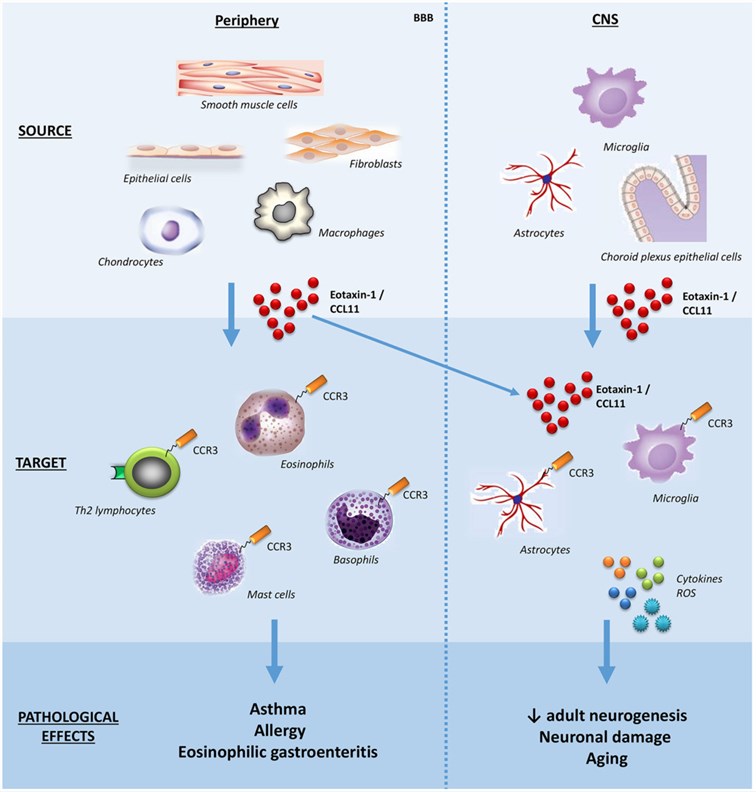 Fig.1 Schematic effects of eotaxin-1/CCL11 in adult subjects.1
CCL11 acts in a wide range of physiological and pathophysiological processes, suggesting the potential roles:
For structural and pharmacological characterization of CCL11, high-quality recombinant protein preparations are important for receptor-binding, biochemical, and functional studies. Creative Biolabs provides customizable CCL11 recombinant protein products designed to support a range of research applications. Available construct formats and preparation options can be tailored according to specific experimental requirements, including studies of chemokine structure, receptor interactions, binding properties, and related biological functions. Project-specific needs can be discussed to determine an appropriate protein format and research-use configuration.
Not finding the membrane protein product you need? Contact us to start your one-stop custom service!
Functional CCL11-secreting or CCL11-responsive cellular models are valuable for chemotaxis assays, receptor internalization studies, and antibody-related research. Creative Biolabs provides customized CCL11 stable cell models designed to support consistent secretion or response according to specific experimental requirements. Cell model design, expression or response strategy, and characterization can be tailored to the intended research application. These models can support studies of CCL11 signaling, chemotactic responses, receptor interactions, and related biological processes.
Not finding the stable cell line product you need? Contact us to start your one-stop custom service!
We provide anti-CCL11 recombinant antibodies with defined amino acid sequences to support CCL11 binding, detection, quantification, localization, and neutralization research. Creative Biolabs offers end-to-end recombinant antibody discovery programs targeting linear or conformational CCL11 epitopes according to specific research requirements. By combining immunogen design, multi-platform selection, and downstream engineering options, our antibody development pipeline supports the generation of binders with properties suitable for diverse research applications. Recombinant expression and clonal sequencing also support renewable antibody production and consistent reagent characterization.
Not finding the recombinant antibody product you need? Contact us to start your one-stop custom service!
Beyond catalog services, Creative Biolabs provides end to end discovery solutions that cover the entire range of requirements for CCL11 research in one package. They are meant for advanced investigators seeking mechanistic understanding requiring custom reagents, complex assay architectures or integrated multi component workflows:
No. All reagents and services are intended for research use only and are not intended for diagnostic, therapeutic, or other clinical applications.
Yes we have created dual-stable lines that constitutively express full-length CCL11 and CCR3 from spatially independent loci. Each batch is released with data documenting receptor internalization and calcium flux response to ligand, enabling long term analysis of autocrine chemotactic signaling in these lines without the need for transient transfection each time.
Yes, we provide recombinant proteins and stable cell lines for the variants that are missing the first two N-terminal residues required for receptor activation. These materials are necessary controls for assigning biological outcomes to direct CCR3 engagement versus heparan sulfate-mediated tissue retention.
Yes, in a defined buffer at physiological pH that has been monitored for endotoxin content and is free of carrier proteins and denaturing agents. This permits immediate dilution into chemotaxis media or co-culture systems with serum-reducing compositions without the need for additional buffer exchange.









