Creative Biolabs is offering the most comprehensive services for antibody development projects. With strict regulation and effective execution, we are dedicated to providing the most valuable solutions to complete your projects.
HighlightsCreative Biolabs is offering the most comprehensive services for antibody development projects. With strict regulation and effective execution, we are dedicated to providing the most valuable solutions to complete your projects.
HighlightsCreative Biolabs has established a broad range of platforms for developing novel antibodies or equivalents. These cutting-edge technologies enable our scientists to meet your demands from different aspects and tailor the most appropriate solution that contributes to the success of your projects.
HighlightsWith deep understanding in antibody-related realms and extensive project experience, Creative Biolabs offers a variety of references to help you learn more about our capacities and achievements, including infographic, flyer, case study, peer-reviewed publications, and all kinds of knowledge that can assist your projects. You are also welcome to contact us directly for more specific solutions.
HighlightsGet a real taste of Creative Biolabs, one of the most professional custom service providers in the world. We are committed to providing highly customized comprehensive solutions with the best quality to advance your projects.
Highlights Loading...
All listed services and products are For Research Use Only. Do Not use in any diagnostic or therapeutic applications.
CD109 is a large glycosyl phosphatidylinositol anchored membrane glycoprotein encoded by CD109 gene, which is located in the lipid raft structure outside the cell membrane and expressed at a low level in normal epithelial cells, but significantly up-regulated in the stem cell subsets of squamous cell carcinoma, glioblastoma and soft tissue sarcoma. This molecule has two-way regulation characteristics different from the classical TGF-β co-receptor: in differentiated epithelial cells, it can inhibit the epithelial-mesenchymal transition mediated by TGF-β pathway and maintain the stability of epithelial polar structure; In tumor stem cells, it can stabilize the structure of EGFR and GP130 receptors and continuously activate the downstream AKT/STAT3 proliferation signal. In normal resting epithelial tissue, the basic expression of CD109 can effectively inhibit the abnormal interstitial transformation of cells and ensure the structural stability of epithelial tissue. After malignant transformation of cells, CD109 is enriched in tumor stem cell membrane, which significantly enhances the self-renewal ability of cells and mediates chemotherapy resistance. At the same time, soluble CD109 can reshape the tumor microenvironment, recruit immunosuppressive macrophages, hinder the infiltration of anti-tumor T cells, and construct the tumor immune escape microenvironment. Other GPI ankyrin can't compensate the specific regulatory function of tumor stem cells, and CD109 knockout can effectively weaken the tumorigenicity of glioma stem cells and enhance the sensitivity of tumors to chemotherapy and immunotherapy. Clinical studies have confirmed that the abnormally high expression of CD109 is closely related to the late tumor progression and poor prognosis, and it is the core specific target for the study of tumor stem cell mechanism and the development of ADC targeted drugs.
CD109 plays a dual signal regulation role by relying on the lipid raft microstructure domain of cell membrane, and binds TGF-β ligand and EGFR/GP130 receptor complex through multiple cysteine-rich domains outside the cell. Its unique GPI anchoring mode is different from transmembrane signal co-receptor, which makes it have dual regulatory characteristics of inhibiting stromal transformation and promoting tumor. CD109-mediated receptor cross-signaling pathway can dynamically balance epithelial homeostasis and tumor stem cell proliferation according to cell transformation status. This protein is involved in many biological processes, such as epidermal differentiation, steady-state maintenance of glioblastoma stem cells and tumor immune microenvironment inhibition. The loss of CD109 function will destroy the stability of carcinogenic receptor complex and relieve the immunosuppression of tumor. To sum up, CD109 is the key research target of GPI glycoprotein mechanism research and solid tumor targeted therapy exploration.
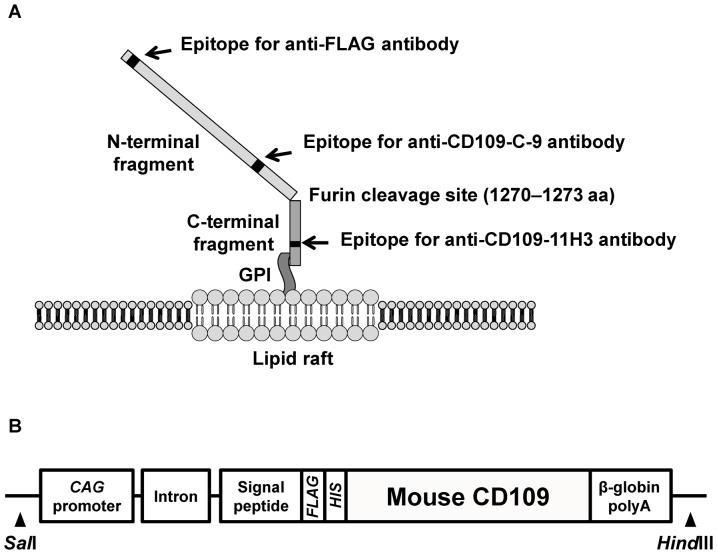 Fig. 1 Mouse CD109 protein structure and overexpression vector: cleavage site, antibody epitopes and plasmid element layout.1
The biological functions of CD109 are fully focused on TGF-β inhibition and EGFR/STAT3 signal amplification:
Creative Biolabs offers high-quality CD109 proteins through optimized mammalian secretion systems, including full-length GPI-anchored glycoprotein and isolated cysteine-rich ligand-binding domain variants. These products retain native TGF-β and EGFR co-binding activity, suitable for tumor stem cell ligand interaction and ADC screening assays. All CD109 proteins undergo strict quality control to ensure consistent performance across oncology research platforms.
Not finding the membrane protein product you need? Contact us to start your one-stop custom service!
Creative Biolabs provides custom-engineered CD109 stable cell lines, including tumor stem-like overexpression and blank empty vector control models. These cell lines are optimized for GPI glycoprotein profiling and STAT3/EGFR oncogenic signal functional analysis. Each cell line undergoes stringent validation to ensure stable expression profiles during long-term sphere-forming culture, and can be applied to tumor chemoresistance compound screening pipelines.
Not finding the stable cell line product you need? Contact us to start your one-stop custom service!
High-specificity recombinant antibodies targeting CD109 are developed via advanced antibody engineering technologies. These antibodies are validated for tumor stem cell membrane immunostaining and squamous tumor tissue profiling, and can be combined with EGFR detection reagents to analyze CD109 oncogenic receptor complexes in glioma cell models.
Not finding the recombinant antibody product you need? Contact us to start your one-stop custom service!
Beyond catalog products, Creative Biolabs offers specialized custom services for CD109 research:
CD109 is a lipid raft GPI glycoprotein that inhibits TGF-β signaling while stabilizing EGFR/STAT3 to sustain tumor stem cell self-renewal.
CD109 is a specific biomarker for chemoresistant solid tumor stem cells, a promising candidate for antibody-drug conjugate development.
No, all CD109 products and services are strictly for research use only, not intended for clinical diagnosis or treatment.
Offerings include full-length CD109 glycoproteins, isoform-specific detection antibodies and custom stable cell lines for tumor stem research.
CD109 proteins are validated via TGF-β and EGFR dual co-binding functional testing.