
Creative Biolabs is offering the most comprehensive services for antibody development projects. With strict regulation and effective execution, we are dedicated to providing the most valuable solutions to complete your projects.
HighlightsCreative Biolabs is offering the most comprehensive services for antibody development projects. With strict regulation and effective execution, we are dedicated to providing the most valuable solutions to complete your projects.
HighlightsCreative Biolabs has established a broad range of platforms for developing novel antibodies or equivalents. These cutting-edge technologies enable our scientists to meet your demands from different aspects and tailor the most appropriate solution that contributes to the success of your projects.
HighlightsWith deep understanding in antibody-related realms and extensive project experience, Creative Biolabs offers a variety of references to help you learn more about our capacities and achievements, including infographic, flyer, case study, peer-reviewed publications, and all kinds of knowledge that can assist your projects. You are also welcome to contact us directly for more specific solutions.
HighlightsGet a real taste of Creative Biolabs, one of the most professional custom service providers in the world. We are committed to providing highly customized comprehensive solutions with the best quality to advance your projects.
Highlights Loading...
All listed services and products are For Research Use Only. Do Not use in any diagnostic or therapeutic applications.
CD177 is a cell surface glycoprotein of the Ly-6/uPAR superfamily, also known as neutrophil antigen-1 (NA-1), and has molecular weight of 58–64 kDa and is glycosylphosphatidylinositol (GPI)-anchored. The CD177 gene on human chromosome 19q13 encodes this itself. CD177 has a very restricted expression, it is only found on neutrophils, precursors of granulocytes in the bone marrow and a small population of myeloid cells. Importantly, CD177 expression is polymorphic in the healthy population, 100% negative neutrophils in some individuals and a varying percentage of neutrophils express protein in most people. The expression of this variable has a homologous pseudogene localization close to the functional CD177 locus that can interfere with transcription. NB1 was first recognized as a protein targeted by alloantibodies responsible for neonatal alloimmune neutropenia and later rediscovered as PRV-1, using differential expression profiling in the blood of polycythemia vera patients.
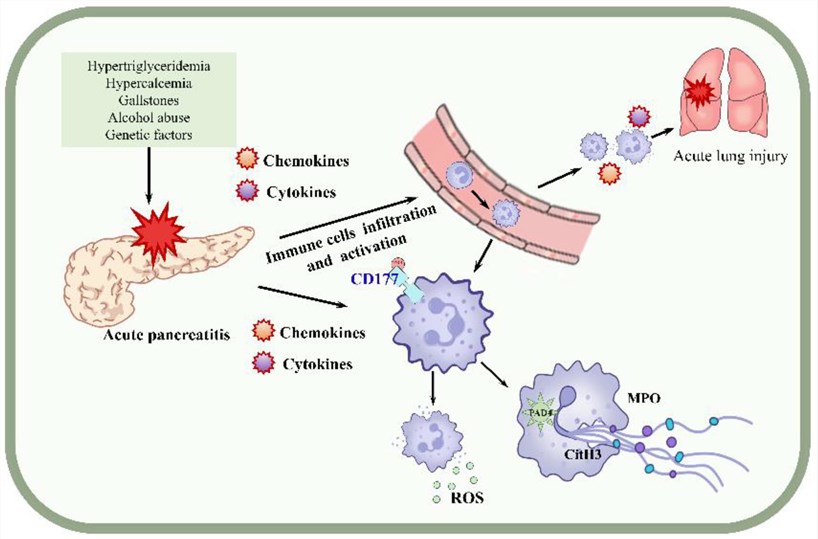 Fig.1 Mechanisms of CD177-regulated NETs in AP and AP-associated ALI.1
CD177 serves multiple purposes that fall under several and related biological umbrellas:
Get an edge in your neutrophil biology and inflammation research using our curated recombinant CD177 protein catalog. We acknowledge that the GPI-anchored topology, extensive glycosylation, and polymorphic expression of CD177 can pose distinct production challenges. We provide recombinant CD177 proteins in formats selected according to specific research requirements, including constructs suitable for structural studies, ligand-binding assays, antibody development, and related biochemical applications. Available products may include full-length or extracellular-domain constructs, depending on the specific product and intended use. Appropriate quality assessment is applied according to the product format and research application.
Not finding the membrane protein product you need? Contact us to start your one-stop custom service!
Reliable, reproducible cellular models are essential to decipher CD177-mediated biology and assess candidate therapeutics. We offer stable cell lines designed to express wild-type or engineered forms of human, mouse and rat CD177, as well as lines for loss-of-function studies with modulated endogenous expression. These platforms are specifically designed to enable high-throughput NET formation assays, quantification of neutrophil-platelet aggregates, studies of PECAM-1 binding and profiling of inflammatory cytokines – affording the experimental high-fidelity necessary for multi-phase research programs.
Not finding the stable cell line product you need? Contact us to start your one-stop custom service!
We also offer high-affinity recombinant antibodies against CD177 that are designed to accommodate the diverse demands of multiple research needs. With superior specificity, sensitivity and batch-to-batch consistency than traditional polyclonal antibodies, these monoclonal antibodies can be produced by leveraging the latest recombinant expertise & technologies. Availability of CD177 recombinant antibodies validated for WB, ELISA, FCM, IF, ICC, IHC and IP provides the ability to detect and quantify native CD177 in various sample types such as neutrophil lysates, bone marrow preparations and inflammatory disease model-derived tissue sections.
Not finding the recombinant antibody product you need? Contact us to start your one-stop custom service!
In addition to catalog products, we provide custom services for protein and antibody discovery and development. Using our deep experience in neutrophil biology and myeloproliferative disease research, we could help:
Yes the immunogen is from a region sufficiently conserved across mammalian species to enable detection of human, cynomolgus monkey and rat neutrophils in whole blood with one set of reagents rather than having to use various species-specific ones.
Yes, some clone have been reliably demonstrated to produce membranous staining with similar patterns in light fixing neutrophil suspensions and archival bone marrow cells following antigen retrieval that correlate with the localization of both granulocytes and myelocytes. Validation encompasses peptide competition supporting epitope specificity.
Yes, we have created dual-stable lines that co-express both full length CD177 and proteinase 3 in an unregulated manner from separate loci. By providing a common reference point for surface co-localization and PR3-binding capacity in each batch, these fluorescently labelled stably-integrated lines can be used as a generic cellular background to enable studies of membrane complex dynamics without the requirement for repeated transient transfection.
Yes. We offer flexible pricing tiers to accommodate your academic and industrial scale-up needs. To get a price quote, please send us your expected volume and timeline via the inquiry portal.








