Creative Biolabs is offering the most comprehensive services for antibody development projects. With strict regulation and effective execution, we are dedicated to providing the most valuable solutions to complete your projects.
HighlightsCreative Biolabs is offering the most comprehensive services for antibody development projects. With strict regulation and effective execution, we are dedicated to providing the most valuable solutions to complete your projects.
HighlightsCreative Biolabs has established a broad range of platforms for developing novel antibodies or equivalents. These cutting-edge technologies enable our scientists to meet your demands from different aspects and tailor the most appropriate solution that contributes to the success of your projects.
HighlightsWith deep understanding in antibody-related realms and extensive project experience, Creative Biolabs offers a variety of references to help you learn more about our capacities and achievements, including infographic, flyer, case study, peer-reviewed publications, and all kinds of knowledge that can assist your projects. You are also welcome to contact us directly for more specific solutions.
HighlightsGet a real taste of Creative Biolabs, one of the most professional custom service providers in the world. We are committed to providing highly customized comprehensive solutions with the best quality to advance your projects.
Highlights Loading...
All listed services and products are For Research Use Only. Do Not use in any diagnostic or therapeutic applications.
CD1D is a non-polymorphic MHC class I-like glycoprotein and the main antigen-presenting molecule for invariant natural killer T (iNKT) cells, linking innate and adaptive immunity through recognition of lipid antigens. Human CD1D is a heterodimeric complex of a non-covalently bound heavy α chain of 278 aa and β2-microglobulin. This type I transmembrane protein has three ectodomains, a single transmembrane domain, and a short cytoplasmic tail. The antigen-binding platform is formed by the α1 and α2 domains, comprising two anti-parallel α-helices that sit above an eight-stranded β-sheet, resulting in a binding groove that is deep, narrow and hydrophobic, completely different from the peptide binding cleft of classical MHC molecules. The groove has two main channels: the A′ pocket and the F′ pocket, taking up the lipid tails of glycolipid antigens, while the sugar headgroup protrudes from port into space for binding to semi-invariant T cell receptor (TCR) of iNKT cells. In cancer, CD1D expression is often downregulated or modified on tumor cells and tumor-associated dendritic cells as an immune evasion strategy, where decreased levels of CD1D are associated with worse clinical outcomes in non-small cell lung carcinoma (NSCLC), esophageal cancer and other neoplasms. In contrast, although high CD1D expression in dendritic cells promotes lung tumor burden, this can be mitigated by increased iNKT cell-mediated tumor antitumor immunity through an IL-10 dependent mechanism. Aside from lipid presentation, CD1D is now also considered an important modulator of lipid metabolism and innate immunity.CD1D-linked dysregulation was observed in macrophages with defective uptake of lipid, altered expression of peroxisome proliferatoractivated receptor δ (PPARδ), and hyperreactive TLR signaling.
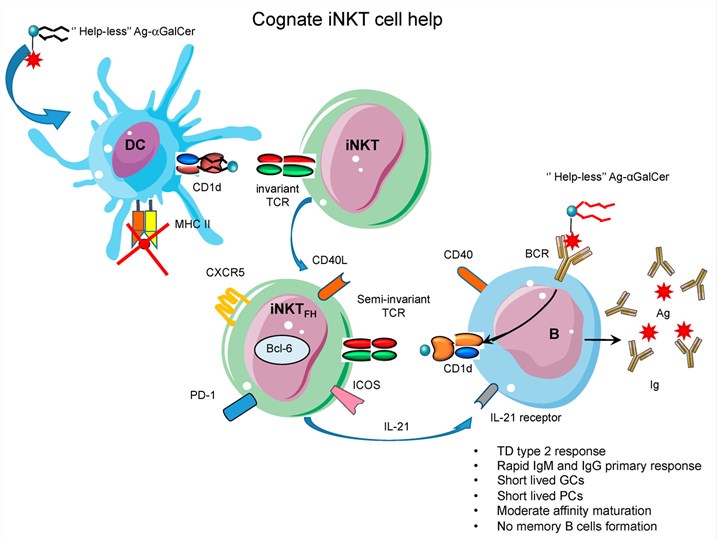 Fig.1 Cognate iNKT cell help for B-cell responses.1
CD1d is functionally diverse, involved in antigen presentation to T cells, activation of other immune cell types and metabolic regulation based on its unique structure combined with its organizational cellular permissibility as:
Creative Biolabs provides a complex portfolio of premium CD1D membrane glycoprotein products that are critical for the structural and functional study of this lipid antigen—presenting molecule. Through our proprietary Membrane Protein technology, CD1D can be expressed in a number of different formats suitable for research use. The highly validated proteins include CD1D Membrane Protein in Virus-Like Particles (MP-VLPs) and human/mouse/rat CD1D expressed in HEK293 or specialized dendritic cell-compatible systems for applications such as ELISA, antibody production and characterization, lipid loading assays, TCR binding studies, and functional investigations of iNKT cell activation. These provide researchers with the necessary tools for dissecting CD1D/glycolipid antigen, β2-microglobulin and iNKT TCR interactions. Although other CD1D preparations have been produced in mammalian systems, ours maintain not just the correct folding of α1/α2 domains but also integrity of lipid-binding grooves, allowing realistic sector-phase appropriate properties for use as a basis for immunotherapy development and assay validation.
Not finding the membrane protein product you need? Contact us to start your one-stop custom service!
CD1D basic research requires the establishment of stable cellular models. Creative Biolabs specializes in engineering stable cell lines to express high levels of target CD1D, often using proprietary methods. Such stable cell lines provide a simple and robust model system ideal for drug screen, lipid antigen presentation assays, in vitro studies of iNKT cell activation, tumor immune evasion and also high-throughput screening to unravel CD1D biology or pharmacology. We are experts in expression and cell health optimising your research pipeline. We provide CD1D-overexpressing lines for examining glycolipid loading and iNKT cell activation, as well as CD1D-knockdown lines suitable for loss-of-function studies, all confirmed by flow cytometry, Western blotting and functional α-GalCer presentation assays. Specialized reporter CD1d-iNKT TCR interaction or lipid uptake sensors installed within cell lines allow real-time monitoring of both antigen presentation and metabolic regulation that could be harnessed in CTLA4, PD-1, and PDL1 immunotherapy models in cancer or autoimmune disease treatments.
Not finding the stable cell line product you need? Contact us to start your one-stop custom service!
We offer a wide range of high-affinity recombinant antibodies to CD1D that are designed for the most stringent requirements of each application. Making the most optimized antibodies for various applications, which are more specific, sensitive & batch-to-batch reproducibility compared to older generation polyclonal antibodies using advanced recombinant technologies. Our CD1D recombinant antibodies have been rigorously characterized for their functionality (validation) in applications such as WB, ELISA, FCM, IF, ICC and IHC & IP to ensure correct detection of the signaling molecules or proteins you want along with sample types that range from dendritic cell lysates and tumor biopsy to tissue derived from intestinal epithelial cells (IECs), formalin-fixed paraffin-embedded (FFPE) tissue sections. We provide antibodies that detect unique CD1D epitopes recognize based on conformational, functional and cytoplasmic tail for the evaluation of intracellular trafficking for comprehensive monitoring of CD1D during homeostasis, disease or related research.
Not finding the recombinant antibody product you need? Contact us to start your one-stop custom service!
In addition to our catalog products, Creative Biolabs offers specialized custom services in membrane protein and antibody discovery & development. With our legacy experience and modern tools, we can help with:
No, all Creative Biolabs CD1D products and services are only for research purposes not for use in clinical diagnostic, prevention or treatment of any disease. Our CD1D tetramers and antibodies are designed and validated for research application, they could therefore help the immune monitoring but should not be used in patient care without regulatory approval nor analytical validation.
We can discuss customized cellular models for studying CD1D-mediated lipid antigen presentation and iNKT-cell responses according to specific research requirements. Where an iNKT receptor model is needed, the experimental design should incorporate an appropriate functional TCR α/β heterodimer together with the required CD3 signaling components and a suitable antigen-presentation configuration. Model composition and functional readouts can be selected based on the intended mechanistic study and supported project data.
Yes, we offer recombinant proteins and stable cell lines expressing known natural variants with changed antigen-binding specificity or deficient endosomal trafficking motifs. These materials will provide key specificity controls for dissecting functions of lipid presentation from those of invariant T-cell receptor engagement.
The protein is formulated at physiological pH in a defined buffer that maintains the native heterodimeric fold and endotoxin level. This enables instant dilution into lipid-loading reactions, tetramer conjugation workflows or amine-coupling to biosensor chips without any dialysis or buffer-exchange steps.