
Creative Biolabs is offering the most comprehensive services for antibody development projects. With strict regulation and effective execution, we are dedicated to providing the most valuable solutions to complete your projects.
HighlightsCreative Biolabs is offering the most comprehensive services for antibody development projects. With strict regulation and effective execution, we are dedicated to providing the most valuable solutions to complete your projects.
HighlightsCreative Biolabs has established a broad range of platforms for developing novel antibodies or equivalents. These cutting-edge technologies enable our scientists to meet your demands from different aspects and tailor the most appropriate solution that contributes to the success of your projects.
HighlightsWith deep understanding in antibody-related realms and extensive project experience, Creative Biolabs offers a variety of references to help you learn more about our capacities and achievements, including infographic, flyer, case study, peer-reviewed publications, and all kinds of knowledge that can assist your projects. You are also welcome to contact us directly for more specific solutions.
HighlightsGet a real taste of Creative Biolabs, one of the most professional custom service providers in the world. We are committed to providing highly customized comprehensive solutions with the best quality to advance your projects.
Highlights Loading...
All listed services and products are For Research Use Only. Do Not use in any diagnostic or therapeutic applications.
CD209 (also known as DC-SIGN) is a type II transmembrane C-type lectin receptor encoded by CD209 gene, selectively and abundantly expressed on tissue-resident dendritic cell populations within mucosal, lymphoid and peripheral organ microenvironments, dedicated to calcium-dependent recognition of high-mannose glycan epitopes displayed on enveloped viral, bacterial and fungal pathogen surface glycoproteins. The extracellular region consists of a repeated neck stalk domain that mediates receptor oligomerization and a terminal C-type lectin carbohydrate recognition domain (CRD) that coordinates Ca²⁺ ions to form high-affinity binding pockets for pathogen mannose-rich glycans, while a short cytoplasmic tail carries internalization motifs that trigger rapid endocytosis of bound pathogen particles into degradative endolysosomal compartments for antigen processing and cross-presentation to T lymphocytes. Under physiological steady-state immune surveillance, CD209 acts as a primary pathogen capture receptor enabling dendritic cells to efficiently sample extracellular microbial antigens without prior inflammatory priming, initiating adaptive immune responses against invading pathogens. Many enveloped viruses including HIV, influenza and coronaviruses exploit CD209-mediated uptake to hijack dendritic cell trafficking pathways for systemic viral dissemination, while fungal and bacterial pathogens utilize mannose glycan display to evade immediate immune clearance via CD209 binding. Distinct from other C-type lectins with narrow pathogen specificity, CD209 recognizes a broad spectrum of mannose-bearing pathogens and uniquely facilitates trans-infection of target host cells via captured virion transfer, with no other dendritic cell lectin able to fully recapitulate its broad glycan recognition and antigen cross-presentation function. Reduced CD209 expression impairs mucosal pathogen capture and blunts adaptive anti-pathogen immune responses, while excessive CD209-mediated viral uptake amplifies systemic viral spread and pathogenic immune activation, establishing CD209 as a core research target for dendritic cell lectin biology and infectious disease immunotherapy screening.
CD209 executes core pathogen capture and antigen uptake regulatory function via calcium-dependent glycan recognition at dendritic cell plasma membranes: neck domain oligomerization assembles multivalent CD209 clusters to enhance avidity for multimeric pathogen surface glycans, while CRD calcium coordination stabilizes mannose glycan binding without cross-recognition of host complex sialylated glycans. Upon pathogen glycan engagement, cytoplasmic internalization motifs recruit clathrin endocytosis machinery to internalize receptor-pathogen complexes into endosomes for proteolytic antigen processing and loading onto MHC I/II complexes for T cell cross-presentation. Conserved neck repeat sequences space the CRD carbohydrate binding domains away from the lipid bilayer to maximize accessibility to large microbial and viral glycoprotein assemblies. CD209-dependent pathogen sampling sustains balanced mucosal immune surveillance homeostasis, covering controlled antigen presentation to drive protective adaptive immunity while limiting unrestrained inflammatory activation against commensal flora. CD209 participates in a broad spectrum of infectious immune processes including mucosal pathogen detection, viral trans-infection, dendritic cell antigen cross-presentation and memory T cell priming. Dysregulated CD209 surface abundance alters pathogen capture efficiency and shifts immune output toward either insufficient anti-pathogen defense or excessive pathogen-mediated inflammatory tissue injury. Therefore, CD209 represents a pivotal research target for C-type lectin receptor study and infectious disease immune modulator discovery.
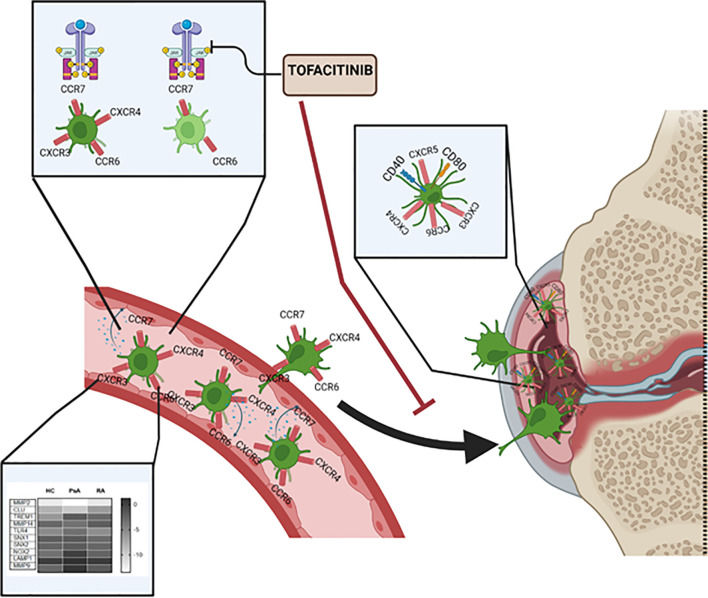 Fig. 1 A panel of chemokine receptors guides leukocyte trafficking toward arthritic lesions; tofacitinib blocks such pathological immune cell recruitment into inflamed joint tissue.1
The biological functions of CD209 are focused on multivalent mannose pathogen recognition, clathrin-mediated endocytosis and dendritic cell adaptive immune priming:
Creative Biolabs offers high-quality CD209 proteins through optimized expression systems, including full-length type II transmembrane CD209 and isolated extracellular neck/CRD domain variants. These products retain native conformational characteristics and calcium-dependent mannose glycan pathogen binding biological activity, suitable for lectin-pathogen interaction assays and infectious disease immune therapeutic screening. All CD209 proteins undergo strict quality control to ensure consistent performance and reliable application across diverse research platforms.
Not finding the membrane protein product you need? Contact us to start your one-stop custom service!
Creative Biolabs provides custom-engineered CD209 stable cell lines, including wild-type and calcium-binding CRD mutant control models. These cell lines are optimized for pathogen glycan capture profiling and dendritic cell antigen presentation functional analysis. Each cell line undergoes stringent validation to ensure stable expression profiles and consistent functional performance in diverse experimental contexts.
Not finding the stable cell line product you need? Contact us to start your one-stop custom service!
High-specificity recombinant antibodies targeting CD209 are developed via advanced antibody engineering technologies, with no cross-reactivity with other C-type lectin family receptors such as CD207/Langerin. These antibodies are validated for dendritic cell membrane localization detection and mucosal lymphoid tissue expression profiling, and can be combined with viral envelope glycoprotein detection reagents to quantify complete lectin-pathogen binding complexes in infectious immune research models.
Not finding the recombinant antibody product you need? Contact us to start your one-stop custom service!
Beyond catalog products, Creative Biolabs offers specialized custom services for CD209 research:
CD209/DC-SIGN is a dendritic cell C-type lectin receptor that binds calcium-dependent high-mannose pathogen glycans to mediate microbial uptake, endocytosis and antigen cross-presentation to T cells.
CD209 mediates both protective mucosal pathogen immunity and viral hijacking for systemic spread, serving as a key therapeutic target for broad-spectrum infectious diseases.
No, all CD209 products and services are strictly for research use only, not intended for clinical diagnosis or treatment.
Offerings include full-length transmembrane CD209 lectin proteins, domain-specific detection antibodies and custom stable cell lines for dendritic cell infectious immunology research.
CD209 proteins are validated via calcium-dependent mannose glycan pathogen binding and dendritic cell endocytosis functional testing.








