
Creative Biolabs is offering the most comprehensive services for antibody development projects. With strict regulation and effective execution, we are dedicated to providing the most valuable solutions to complete your projects.
HighlightsCreative Biolabs is offering the most comprehensive services for antibody development projects. With strict regulation and effective execution, we are dedicated to providing the most valuable solutions to complete your projects.
HighlightsCreative Biolabs has established a broad range of platforms for developing novel antibodies or equivalents. These cutting-edge technologies enable our scientists to meet your demands from different aspects and tailor the most appropriate solution that contributes to the success of your projects.
HighlightsWith deep understanding in antibody-related realms and extensive project experience, Creative Biolabs offers a variety of references to help you learn more about our capacities and achievements, including infographic, flyer, case study, peer-reviewed publications, and all kinds of knowledge that can assist your projects. You are also welcome to contact us directly for more specific solutions.
HighlightsGet a real taste of Creative Biolabs, one of the most professional custom service providers in the world. We are committed to providing highly customized comprehensive solutions with the best quality to advance your projects.
Highlights Loading...
All listed services and products are For Research Use Only. Do Not use in any diagnostic or therapeutic applications.
Endosialin (also known as CD248) is a single transmembrane glycoprotein encoded by CD248 gene, which is selectively expressed in pericytes, tumor-associated fibroblasts and activated stromal cells, but hardly expressed in normal parenchymal cells at rest. Different from the widely distributed endothelial surface markers, CD248 contains unique platelet-reactive protein and lectin-like domain, which can combine collagen, fibronectin and various angiogenic growth factors to participate in remodeling the extracellular matrix structure. In healthy resting tissues, maintaining low basal expression level of CD248 can stabilize the vascular wall structure and avoid abnormal proliferation of stromal cells. However, in the process of tumor progression or organ fibrosis, the transcription and expression of CD248 are significantly up-regulated, which activates the migration of stromal cells, promotes the deposition of extracellular matrix, and promotes pathological angiogenesis, and finally helps the lesion to continue to progress. Other adhesion glycoproteins can't compensate for the matrix-specific regulatory function of CD248. Knockout of CD248 can effectively inhibit tumor angiogenesis and alleviate tissue fibrosis and scar hyperplasia. The sustained high expression of CD248 is closely related to the invasion and malignant phenotype of various solid tumors. It is a specific matrix marker and a core research target for anti-fibrosis and targeted tumor matrix therapy screening.
CD248 is located in the lipid bilayer of peripheral cell membrane, and relies on extracellular tandem domain to bind extracellular matrix components and capture angiogenic cytokines to realize matrix remodeling and growth factor signal regulation. Its strict tissue-specific expression pattern is different from pan-endothelial markers, which endows it with unique regulatory ability of pathological matrix remodeling. The ligand interaction signal mediated by CD248 can dynamically balance the vascular homeostasis and pathological fibrosis proliferation process according to the tissue injury or malignant transformation state. This molecule is widely involved in the construction of tumor microenvironment, wound repair and fibrosis of kidney, lung and other organs. Loss of CD248 function can significantly weaken the invasive ability of stromal cells and block abnormal angiogenesis. To sum up, CD248 is a key research target in the field of matrix membrane protein mechanism research and tumor microenvironment targeted therapy.
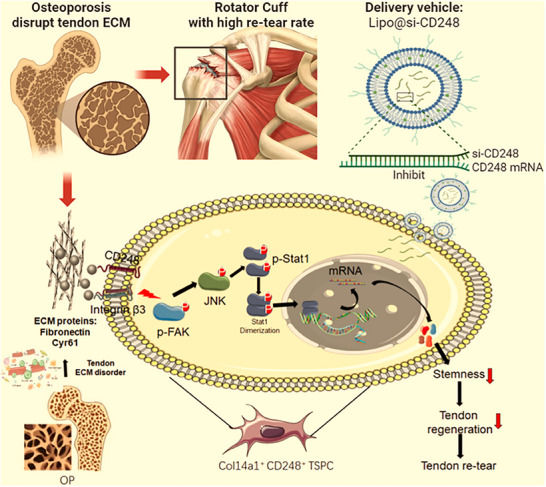 Fig. 1 Graphical Abstract Schematic of CD248-mediated TSPC stemness suppression triggering osteoporosis-associated rotator cuff retear and liposomal si-CD248 targeted intervention strategy.1
The biological functions of CD248 are focused on matrix binding and angiogenic factor sequestration:
Creative Biolabs offers high-quality CD248 proteins through optimized eukaryotic expression systems, including full-length transmembrane glycoprotein and isolated extracellular ligand-binding domain variants. These products retain native ECM and growth factor binding activity, suitable for tumor stroma interaction and anti-fibrotic compound screening assays. All CD248 proteins undergo strict quality control to ensure consistent performance and reliable application across diverse research platforms.
Not finding the membrane protein product you need? Contact us to start your one-stop custom service!
Creative Biolabs provides custom-engineered CD248 stable cell lines, including overexpression and blank control models. These cell lines are optimized for pericyte stromal protein profiling and angiogenic signal functional analysis. Each cell line undergoes stringent validation to ensure stable expression profiles during continuous cell passages.
Not finding the stable cell line product you need? Contact us to start your one-stop custom service!
High-specificity recombinant antibodies targeting CD248 are developed via advanced antibody engineering technologies. These antibodies are validated for pericyte and tumor stroma tissue immunostaining, and can be combined with vascular marker reagents to analyze stromal-vascular complexes in tumor microenvironment models.
Not finding the recombinant antibody product you need? Contact us to start your one-stop custom service!
Beyond catalog products, Creative Biolabs offers specialized custom services for CD248 research:
CD248 is a pericyte/stroma-specific transmembrane glycoprotein that binds ECM and angiogenic factors to drive tumor microenvironment remodeling and pathological fibrosis.
CD248 is a unique stromal biomarker exclusively enriched in tumor and fibrotic lesions, a promising target for stroma-targeted therapy.
No, all CD248 products and services are strictly for research use only, not intended for clinical diagnosis or treatment.
Offerings include full-length CD248 glycoproteins, isoform-specific detection antibodies and custom stable cell lines for stromal research.
CD248 proteins are validated via collagen and angiogenic ligand binding functional testing.









