Creative Biolabs is offering the most comprehensive services for antibody development projects. With strict regulation and effective execution, we are dedicated to providing the most valuable solutions to complete your projects.
HighlightsCreative Biolabs is offering the most comprehensive services for antibody development projects. With strict regulation and effective execution, we are dedicated to providing the most valuable solutions to complete your projects.
HighlightsCreative Biolabs has established a broad range of platforms for developing novel antibodies or equivalents. These cutting-edge technologies enable our scientists to meet your demands from different aspects and tailor the most appropriate solution that contributes to the success of your projects.
HighlightsWith deep understanding in antibody-related realms and extensive project experience, Creative Biolabs offers a variety of references to help you learn more about our capacities and achievements, including infographic, flyer, case study, peer-reviewed publications, and all kinds of knowledge that can assist your projects. You are also welcome to contact us directly for more specific solutions.
HighlightsGet a real taste of Creative Biolabs, one of the most professional custom service providers in the world. We are committed to providing highly customized comprehensive solutions with the best quality to advance your projects.
Highlights Loading...
All listed services and products are For Research Use Only. Do Not use in any diagnostic or therapeutic applications.
CD300e molecule (CD300E), also called IREM-2, CLM-2, or PIgR2, is a type I transmembrane glycoprotein encoded by the CD300E gene on chromosome 17q25.1. The gene contains four exons and produces a protein of about 205 amino acids with a calculated mass of roughly 23 kDa. The protein consists of a single extracellular immunoglobulin-like domain, a transmembrane region, and a short cytoplasmic tail. A charged lysine residue in the transmembrane domain allows CD300E to pair with ITAM-bearing adaptor proteins such as DAP12 and FcRγ. Expression is highest on mature monocytes, macrophages, and myeloid dendritic cells, with lower levels on other myeloid populations.
CD300E is an activating receptor. Sphingomyelin serves as a ligand for both mouse and human CD300E, and its binding stimulates cytokine production in a DAP12- and FcRγ-dependent manner. Receptor engagement triggers calcium mobilization, superoxide anion production, and secretion of pro-inflammatory cytokines in monocytes and myeloid dendritic cells. Activation also delivers survival signals that protect these cells from apoptosis and upregulates co-stimulatory molecules that enhance T cell responses. Besides its activating role, CD300E has been reported to negatively regulate T cell activation by impairing STAT1-dependent antigen presentation. In mice, CD300E deficiency worsens obesity-associated metabolic dysfunction, including increased weight gain, adipocyte hypertrophy, hepatic steatosis, and impaired glucose and insulin sensitivity. These findings link CD300E to both innate immune activation and immunometabolic regulation.
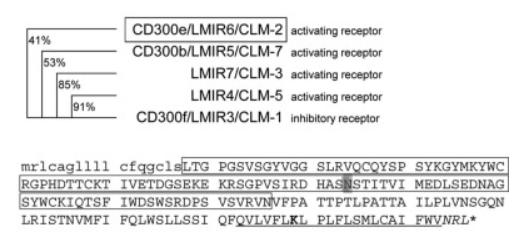 Fig. 1 Phylogeny of mouse LMIR3–LMIR7 and mCD300e domain alignment (mouse homolog data; not a depiction of human CD300E).1
CD300E serves as an activating receptor that regulates innate immune responses through ITAM-dependent signaling:
Creative Biolabs offers high-quality CD300E membrane protein products produced using optimized expression systems. These include full-length type I transmembrane protein that retains the native immunoglobulin-like extracellular domain and transmembrane lysine residue, as well as isolated extracellular domain variants. The immunoglobulin-like domain mediates ligand recognition, while the transmembrane lysine enables association with ITAM-bearing adaptor proteins, making these proteins suitable for studies of CD300E-ligand interactions, ITAM-dependent signaling, and myeloid cell activation characterization. All CD300E proteins undergo strict quality control to support consistent performance across applicable research platforms.
Not finding the protein product you need? Contact us to start your one-stop custom service!
Creative Biolabs provides custom-engineered CD300E stable cell lines, including overexpression and knockdown models. These cell lines are optimized for studies of ITAM-dependent signaling, sphingomyelin recognition, myeloid cell activation, and immunometabolic regulation. Each cell line undergoes stringent validation to ensure stable expression profiles and consistent functional performance in diverse experimental contexts.
Not finding the stable cell line product you need? Contact us to start your one-stop custom service!
High-specificity recombinant antibodies targeting CD300E are developed using antibody engineering technologies for research applications involving CD300E expression and localization. These antibodies can be used in studies of CD300E distribution on monocytes, macrophages, and myeloid dendritic cells, and may also support characterization of CD300E-adaptor complexes in combination with appropriate detection reagents.
Not finding the recombinant antibody product you need? Contact us to start your one-stop custom service!
Beyond catalog products, Creative Biolabs offers specialized custom services for CD300E research:
CD300E is an immune-activating receptor expressed on myeloid cells that associates with ITAM-bearing adaptors DAP12 and FcRγ, recognizing sphingomyelin as a ligand to trigger cytokine production, calcium mobilization, and cell survival signals.
CD300E regulates innate immune activation in monocytes, macrophages, and dendritic cells, and modulates metabolic programs in adipose tissue macrophages. Its role in immunometabolic disease and immune regulation makes it important for studies of myeloid cell biology and inflammation.
No, all CD300E products and services are strictly for research use only, not intended for clinical diagnosis or treatment.
Offerings include full-length CD300E membrane proteins, extracellular domain variants, specific detection antibodies, and custom stable cell lines for myeloid cell activation and immunometabolic research.
CD300E proteins may support studies of ligand binding and ITAM adaptor interactions, depending on protein format and experimental context.