
Creative Biolabs is offering the most comprehensive services for antibody development projects. With strict regulation and effective execution, we are dedicated to providing the most valuable solutions to complete your projects.
HighlightsCreative Biolabs is offering the most comprehensive services for antibody development projects. With strict regulation and effective execution, we are dedicated to providing the most valuable solutions to complete your projects.
HighlightsCreative Biolabs has established a broad range of platforms for developing novel antibodies or equivalents. These cutting-edge technologies enable our scientists to meet your demands from different aspects and tailor the most appropriate solution that contributes to the success of your projects.
HighlightsWith deep understanding in antibody-related realms and extensive project experience, Creative Biolabs offers a variety of references to help you learn more about our capacities and achievements, including infographic, flyer, case study, peer-reviewed publications, and all kinds of knowledge that can assist your projects. You are also welcome to contact us directly for more specific solutions.
HighlightsGet a real taste of Creative Biolabs, one of the most professional custom service providers in the world. We are committed to providing highly customized comprehensive solutions with the best quality to advance your projects.
Highlights Loading...
All listed services and products are For Research Use Only. Do Not use in any diagnostic or therapeutic applications.
CD72 is a type II transmembrane C-type lectin co-receptor encoded by CD72 gene, constitutively expressed across pre-B to mature B lymphocyte stages, gradually downregulated upon plasma cell differentiation, natural ligand being T cell surface CD100/Sema4D. Distinguished from CD22/Siglec inhibitory B cell checkpoints, CD72 bears dual cytoplasmic signaling motifs: ITIM inhibitory sequences recruiting SHP-1 phosphatase and Grb2-binding positive adaptor motif, enabling context-dependent bidirectional BCR regulation. Under physiological immune homeostasis, basal unligated CD72 recruits SHP-1 to restrain excessive BCR and TLR7 activation, suppressing autoreactive B cell expansion against nuclear self-antigens like Sm/RNP. Upon CD100 ligation during T-B crosstalk, ITIM-mediated inhibition is relieved to permit controlled B cell proliferation and antibody class switching. CD72 gene deletion or transcriptional downregulation removes self-tolerance brakes, driving robust anti-nuclear autoantibody production and lupus-like systemic autoimmune pathology. Its unique dual-signaling B cell regulatory capacity cannot be fully substituted by other ITIM-bearing B cell receptors; CD72 agonistic ligands restore B cell anergy in autoimmunity models, making CD72 an irreplaceable core research target for B cell tolerance and lupus therapeutic screening.
CD72 is a bidirectional BCR co-receptor located in the lipid bilayer of B cell membrane. It relies on the extracellular CTLD domain to specifically bind to CD100 ligand, and dynamically switches SHP-1 and Grb2 signal pathways through intracellular bifunctional motifs to realize bidirectional regulation of B cell activation. Compared with the single-function B-cell inhibitory receptor, CD72 has a unique positive-negative bidirectional regulatory framework, which can be used as a core molecular rheostat to accurately control the activation threshold of B-cells. CD72-mediated signaling pathway can balance the inhibitory effect of autoreactive B cells and the humoral immune response induced by antigen, and dynamically regulate the peripheral immune tolerance homeostasis by relying on T cell co-stimulation signals. This molecule is widely involved in the screening of B cell development, the construction of germinal center and the pathological process of systemic lupus erythematosus. Loss of CD72 function will release the constraint on self-reactive B cells and induce spontaneous overactivation of B cells and abnormal secretion of autoantibodies. Therefore, CD72 is an important core target for the study of B cell co-receptor mechanism and the exploration of targeted therapy for autoimmune diseases.
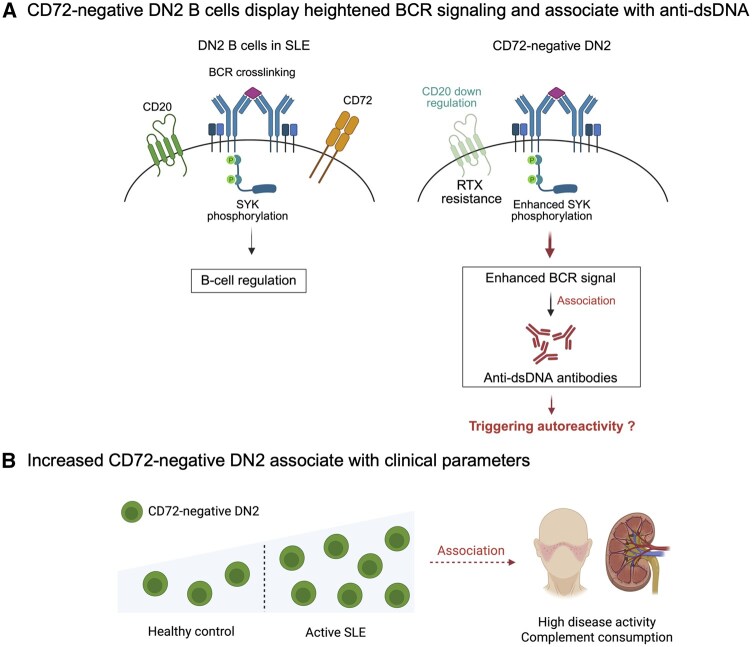 Fig. 1 Two-panel mechanistic schematic comparing BCR signaling strength and clinical correlation of CD72-positive normal DN2 B cells versus CD72-deficient autoreactive DN2 cells in systemic lupus erythematosus.1
The biological functions of type II C-type lectin CD72 co-receptor are fully focused on CD100 ligand sensing and dual BCR signal modulation:
Creative Biolabs offers high-quality CD72 proteins through optimized B lymphoid expression systems, including full-length type II receptor and isolated extracellular CTLD ligand-binding variants. These products retain native CD100 and SHP-1 dual interaction activity, suitable for lupus autoimmune modulator screening assays. All CD72 proteins undergo strict quality control to ensure consistent performance and reliable application across immunology research platforms.
Not finding the membrane protein product you need? Contact us to start your one-stop custom service!
Creative Biolabs provides custom-engineered CD72 stable cell lines, including mature B cell overexpression and blank empty vector control models. These cell lines are optimized for C-type lectin co-receptor profiling and BCR signal functional analysis. Each cell line undergoes stringent validation to ensure stable expression profiles during long-term lymphocyte co-culture, and can be widely deployed for large-scale lupus tolerance compound screening experiments.
Not finding the stable cell line product you need? Contact us to start your one-stop custom service!
High-specificity recombinant antibodies targeting CD72 are developed via advanced antibody engineering technologies. These antibodies are validated for B lymphocyte membrane localization detection and splenic tissue expression profiling, and can be combined with CD100 detection reagents to analyze complete CD72 co-receptor complexes in primary B cell models.
Not finding the recombinant antibody product you need? Contact us to start your one-stop custom service!
Beyond catalog products, Creative Biolabs offers specialized custom services for CD72 research:
CD72 is a dual-signaling B cell co-receptor that binds CD100 and toggles SHP-1/Grb2 to control autoreactive B cell tolerance.
CD72 deficiency triggers spontaneous lupus-like autoimmunity, a promising target for tolerance-restoring therapy.
No, all CD72 products and services are strictly for research use only, not intended for clinical autoimmune treatment trials.
Offerings include full-length CD72 lectin receptors, isoform-specific detection antibodies and custom stable cell lines for B cell research.
CD72 proteins are validated via CD100 and SHP-1 dual co-binding functional testing.








