
Creative Biolabs is offering the most comprehensive services for antibody development projects. With strict regulation and effective execution, we are dedicated to providing the most valuable solutions to complete your projects.
HighlightsCreative Biolabs is offering the most comprehensive services for antibody development projects. With strict regulation and effective execution, we are dedicated to providing the most valuable solutions to complete your projects.
HighlightsCreative Biolabs has established a broad range of platforms for developing novel antibodies or equivalents. These cutting-edge technologies enable our scientists to meet your demands from different aspects and tailor the most appropriate solution that contributes to the success of your projects.
HighlightsWith deep understanding in antibody-related realms and extensive project experience, Creative Biolabs offers a variety of references to help you learn more about our capacities and achievements, including infographic, flyer, case study, peer-reviewed publications, and all kinds of knowledge that can assist your projects. You are also welcome to contact us directly for more specific solutions.
HighlightsGet a real taste of Creative Biolabs, one of the most professional custom service providers in the world. We are committed to providing highly customized comprehensive solutions with the best quality to advance your projects.
Highlights Loading...
All listed services and products are For Research Use Only. Do Not use in any diagnostic or therapeutic applications.
CDP-diacylglycerol synthase 2 (CDS2), or phosphatidate cytidylyltransferase 2, is an integral membrane protein that occupies a central nodal point in the glycerol-3-phosphate pathway of phospholipid biosynthesis. CDS2 is an integral membrane protein formed by a novel fold that contains multiple transmembrane helices and features a catalytic cavity in the shape of an inverted funnel extending approximately halfway into the lipid bilayer. The cavity has two openings that accept the hydrophilic substrate CTP, and at the same time, it can also fit in a hydrophobic substrate phosphatidic acid (PA). At the base of this cavity, a pair of highly conserved aspartate residues coordinates with both Mg2+ and K+, establishing a hetero-di-metal center crucial to catalysis—the magnesium ion activates PA's phosphate head group for subsequent nucleophilic attack on CTP's α-phosphate, while potassium binds CTP β- and γ-phosphates, promoting product release. The CDS2 cytosolic N-terminal tail contains potential phosphorylation sites of interest, namely a casein kinase II site at serine residue 21 and a protein kinase G (PKG) targetable residues, thus allowing for reversible post-translational regulation of enzymatic activity in response to signals processed from the cytoplasm. In addition, CDS2 is largely associated with cytoplasmic membranes of the endoplasmic reticulum (ER), synthesizing phosphatidylinositol (PI)6, as well as located at mitochondria-associated ER membranes (MAMs), serving a function in non-vesicular lipid transport and precursors for mitochondrial-synthesized phospholipids.
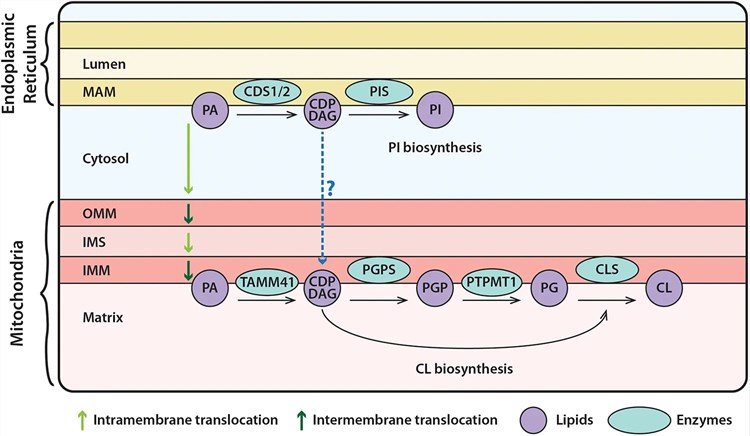 Fig.1 Synthesis of phosphatidylinositol (PI) at the ER and of cardiolipin (CL) in mitochondria.1
The functional profile of CDS2 comprises aspects relating to lipid metabolism, and disease pathogenesis:
We present you with a comprehensive suite of high-grade CDS2 membrane protein products, which are vital for structural and functional studies on this difficult integral membrane enzyme. With our proprietary technology for recombinant membrane proteins, CDS2 can be produced in mammalian (HEK293, CHO), insect cells and wheat germ cell-free expression systems as well as within bacterial hosts for soluble domain protein constructs. Given that CDS2 is an integral membrane protein, with multiple transmembrane helices for which optimal catalytic activity in the endoplasmic reticulum may depend on proper membrane insertion along with favourable topology we provide a range of constructs including full-length CDS2 as well as trimmed down versions aimed at specific applications. These can take form of detergent-solubilized preparations with GDN (glyco-diosgenin) or other mild detergents that maintain native structure and function, or nanodiscs/liposomes which create membrane-mimetic environments. Tag configurations optimized for downstream applications include N-terminal FLAG-tag, C-terminal Strep-tag to accommodate His-tags and GST tags. Co-expression and co-purification services to obtain the heteromeric assembly between AGPAT2-CDS2 functional complex, for researchers investigating their interactions Each batch is thoroughly tested for quality via SDS-PAGE, Western blot, SEC-HPLC and enzymatic activity that measures the synthesis of CDP-DAG from PA & CTP to maintain optimal performance in your research applications.
Not finding the membrane protein product you need? Contact us to start your one-stop custom service!
Due to the prominent function that CDS2 plays in phospholipid metabolism and its rapidly increasing importance as a cancer research target, establishing stable cellular models for investigating CDS2 will be key moving forward. Custom CDS2 stable cell lines that stably express target constructs at a high level, including wild-type CDS2 as well as catalytically inactive mutant and phosphorylation-deficient variants. These stable lines are suited for screening research, lipidomic profiling, phosphoinositide signaling assays and studies of triglyceride compartmentalization using fluorescence protein reporters with both monitoring of cellular dynamics in single-cells by microscopy or high-throughput small-molecule screens. The cell line development platform covers multiple host backgrounds, including HEK293, CHO-K1, HeLa and Huh7 cells with alternative selectable inducible or constitutive expression system. Taking advantage of the method to introduce knockdown, we have generated lines with doxycycline inducible CDS2 Knock down for synthetic lethality studies; lines overexpressing CDS2 for lipid droplet suppression assays and stabilized depletion of CDS2 (to study PA accumulation phenotypes). Flow cytometry, Western blot and immunofluorescence localization assays together with functional enzymatic activity readouts are performed on each stable cell line for propagation being validated across passages to ensure consistent, homogeneous expression.
Not finding the stable cell line product you need? Contact us to start your one-stop custom service!
We offer a complete listing of at least 30 high-affinity recombinant antibodies against CDS2, confirmed by specific test measures with proper feature. Generated using innovative recombinant technologies, these antibodies have improved specificity and sensitivity as well as batch-to-batch consistency compared to hybridoma-derived ones. Importantly, the 51 kDa full-length CD5 protein is detected using our anti-CDS2 antibodies raised against epitopes selected from its N-terminal cytosolic tail as well as transmembrane and C-terminal domains. Applications that have been validated include Western blot (confirmed as detectable in both HepG2 and A549 cell lysates), immunohistochemistry (IHC) from liver cancer tissue sections, the subcellular localization of ER and MAM with IF, along with flow cytometry/ELISA. Monoclonal and polyclonal formats are available, conjugated to fluorescent dyes (PE, FITC, Alexa Fluor), enzymes (HRP or AP) followed by a substrate offering flexibility tailored to your experimental workflow. Moreover, our matched antibody pairs are also validated for cytometric bead array and can be used to detect CDS2 levels in complex biological samples.
Not finding the recombinant antibody product you need? Contact us to start your one-stop custom service!
We also provide tailored custom services for discoveries & developments of membrane protein and antibody beyond catalog product. Using our extensive experience and best-in-class platforms, we can help you with:
No, all reagents and services offered are only qualified for research use; not intended for diagnostic tests or therapeutic processes.
Yes, we have created stable lines that express high level of CDS2 expression verified by immunoblotting and confocal. Persistent anecdotal observations suggest that the combination is more productive than other approaches for acquiring mechanistic insights in long-term perspectives, whereas every batch comes with documentation of CDP-diacylglycerol production capacity and downstream phosphatidylinositol synthesis which appeared to provide a standardized cellular platform without repetitive transient transfection.
Yes, for those clones selected they have been validated on fixed and permeabilized cells with reticular and punctate staining patterns co-localizing with known ER markers as well other proteins at the mitochondrial contact site. Peptide competition and CDS2-knockdown controls in validation for epitope specificity.
Yes, we provide recombinant proteins and stable cell lines expressing engineered variants in which the CTP-binding motifs or transmembrane spans have been disrupted. Such materials represent essential tools in decoupling catalytic activity from structural scaffolding roles for maintaining membrane lipid homeostasis.









