
Creative Biolabs is offering the most comprehensive services for antibody development projects. With strict regulation and effective execution, we are dedicated to providing the most valuable solutions to complete your projects.
HighlightsCreative Biolabs is offering the most comprehensive services for antibody development projects. With strict regulation and effective execution, we are dedicated to providing the most valuable solutions to complete your projects.
HighlightsCreative Biolabs has established a broad range of platforms for developing novel antibodies or equivalents. These cutting-edge technologies enable our scientists to meet your demands from different aspects and tailor the most appropriate solution that contributes to the success of your projects.
HighlightsWith deep understanding in antibody-related realms and extensive project experience, Creative Biolabs offers a variety of references to help you learn more about our capacities and achievements, including infographic, flyer, case study, peer-reviewed publications, and all kinds of knowledge that can assist your projects. You are also welcome to contact us directly for more specific solutions.
HighlightsGet a real taste of Creative Biolabs, one of the most professional custom service providers in the world. We are committed to providing highly customized comprehensive solutions with the best quality to advance your projects.
Highlights Loading...
All listed services and products are For Research Use Only. Do Not use in any diagnostic or therapeutic applications.
Charged multivesicular body protein 7 (CHMP7), also known as MGC29816, is encoded by the CHMP7 gene on chromosome 8p21.3. The gene produces a 453-amino-acid protein with a calculated molecular mass of approximately 51 kDa, belonging to the SNF7 family of ESCRT-III-related proteins. CHMP7 contains a C-terminal SNF7 domain with two coiled-coil regions and an extended N-terminal region comprising tandem Winged-Helix domains that function as a membrane-binding module. This N-terminal module allows CHMP7 to bind to the endoplasmic reticulum (ER), an organelle continuous with the nuclear envelope. CHMP7 localizes to the ER, the nuclear envelope, and the cytoplasm, where it displays a diffuse cytoplasmic staining pattern with accumulation in the perinuclear area.
CHMP7 functions as an early-acting factor in the ESCRT-III pathway that mediates nuclear envelope reformation and nuclear pore quality control. During mitotic exit, CHMP7 is recruited to the reforming nuclear envelope through interaction with the inner nuclear membrane protein LEM2, where it serves as the nucleating factor for downstream ESCRT-III components including CHMP4B, CHMP2A, CHMP3, and IST1. This ESCRT-III assembly seals holes in the reforming nuclear envelope and establishes post-mitotic nucleo-cytoplasmic compartmentalization. Beyond mitosis, CHMP7 surveils the integrity of the nuclear pore complex; it is actively transported out of the intact nucleus and recruited to nuclear envelope lesions. In certain ALS samples and experimental models, nuclear CHMP7 accumulation has been implicated in nuclear pore injury and associated TDP-43 dysfunction. CHMP7 also associates with CHMP4B and functions in the endosomal sorting pathway, and roles in mitochondrial dynamics and ER–mitochondria interactions have been reported in specific experimental models.
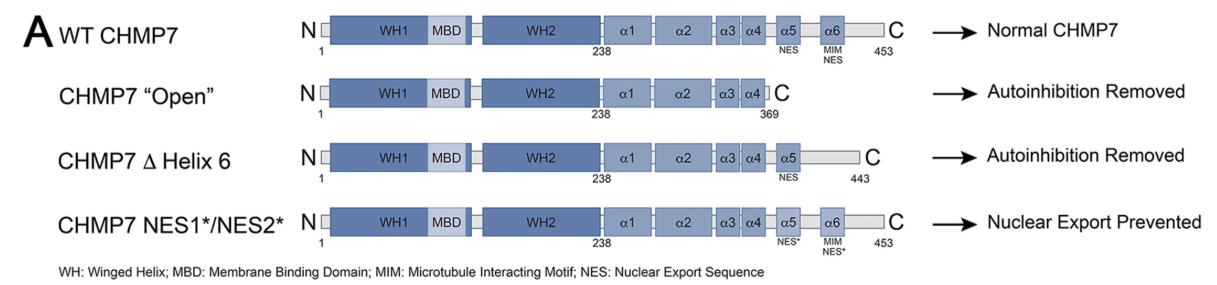 Fig. 1 Graphical depiction of CHMP7 mutants and their resulting functional consequences.1
CHMP7, encoded by the CHMP7 gene, functions as an ESCRT-III-related protein that regulates nuclear envelope integrity and endosomal sorting:
Creative Biolabs provides CHMP7 proteins produced using optimized expression systems. These include full-length recombinant CHMP7 protein that retains the native N-terminal Winged-Helix membrane-binding module and C-terminal SNF7 domain, as well as isolated domain variants. The N-terminal Winged-Helix domains mediate membrane binding and ER localization, while the C-terminal SNF7 domain mediates CHMP4B interaction and ESCRT-III assembly, making these proteins suitable for studies of ESCRT-III nucleation, membrane remodeling, and nuclear envelope reformation characterization. All CHMP7 proteins undergo strict quality control to support consistent performance across applicable research platforms.
Not finding the protein product you need? Contact us to start your one-stop custom service!
Creative Biolabs provides custom-engineered CHMP7 stable cell lines, including overexpression and knockdown models. These cell lines are optimized for studies of ESCRT-III assembly, nuclear envelope reformation, nuclear pore surveillance, and CHMP7-associated ALS mechanisms. Each cell line undergoes stringent validation to ensure stable expression profiles and consistent functional performance in diverse experimental contexts.
Not finding the stable cell line product you need? Contact us to start your one-stop custom service!
High-specificity recombinant antibodies targeting CHMP7 are developed using antibody engineering techniques for research applications involving CHMP7 expression and localization. These antibodies can be used in studies of CHMP7 distribution in the ER, nuclear envelope, and cytoplasm and may also support characterization of CHMP7-containing ESCRT-III complexes in combination with appropriate detection reagents.
Not finding the recombinant antibody product you need? Contact us to start your one-stop custom service!
Beyond catalog products, Creative Biolabs offers specialized custom services for CHMP7 research:
CHMP7 is an ESCRT-III-related protein that mediates nuclear envelope reformation during mitotic exit and surveils nuclear pore integrity, functioning as an early-acting factor for ESCRT-III assembly at the nuclear envelope.
CHMP7 is essential for nuclear envelope integrity and nuclear pore quality control, and its nuclear accumulation initiates nuclear pore complex injury and TDP-43 dysfunction in ALS, making it important for studies of ESCRT-III biology, nuclear envelope dynamics, and neurodegenerative disease mechanisms.
No, all CHMP7 products and services are strictly for research use only, not intended for clinical diagnosis or treatment.
Offerings include recombinant CHMP7 proteins, domain variants, specific detection antibodies, and custom stable cell lines for ESCRT-III and nuclear envelope research.
CHMP7 proteins may support research on membrane binding and CHMP4B interaction, depending on protein format and experimental context.









