
Creative Biolabs is offering the most comprehensive services for antibody development projects. With strict regulation and effective execution, we are dedicated to providing the most valuable solutions to complete your projects.
HighlightsCreative Biolabs is offering the most comprehensive services for antibody development projects. With strict regulation and effective execution, we are dedicated to providing the most valuable solutions to complete your projects.
HighlightsCreative Biolabs has established a broad range of platforms for developing novel antibodies or equivalents. These cutting-edge technologies enable our scientists to meet your demands from different aspects and tailor the most appropriate solution that contributes to the success of your projects.
HighlightsWith deep understanding in antibody-related realms and extensive project experience, Creative Biolabs offers a variety of references to help you learn more about our capacities and achievements, including infographic, flyer, case study, peer-reviewed publications, and all kinds of knowledge that can assist your projects. You are also welcome to contact us directly for more specific solutions.
HighlightsGet a real taste of Creative Biolabs, one of the most professional custom service providers in the world. We are committed to providing highly customized comprehensive solutions with the best quality to advance your projects.
Highlights Loading...
All listed services and products are For Research Use Only. Do Not use in any diagnostic or therapeutic applications.
CHRM2 encodes the M2 muscarinic acetylcholine receptor. The gene is located on chromosome 7q33, spans about 152 kb, and has two exons. The receptor is a class A GPCR with 466 amino acids, seven transmembrane helices, an extracellular N-terminus with three N-glycosylation sites, and an intracellular C-terminus. It mainly couples to Gi/Go proteins such as GNAI1 and GNAO1 and inhibits adenylyl cyclase. CHRM2 is widely expressed in the brain and is also found at high levels in the heart, where it controls heart rate through the parasympathetic nervous system.
In the heart, CHRM2 activation opens GIRK channels and slows heart rate. In the nervous system, it inhibits adenylyl cyclase and regulates ion channels, affecting neuronal excitability and synaptic transmission. Crystal structures of CHRM2 with an antagonist have shown the orthosteric pocket and an allosteric site nearby. Cryo-EM structures with β-arrestin-1 have revealed how the receptor is desensitized and internalized. These features make CHRM2 an important research target for studies of muscarinic receptor pharmacology, G protein signaling, and the cholinergic regulation of cardiac and neuronal function.
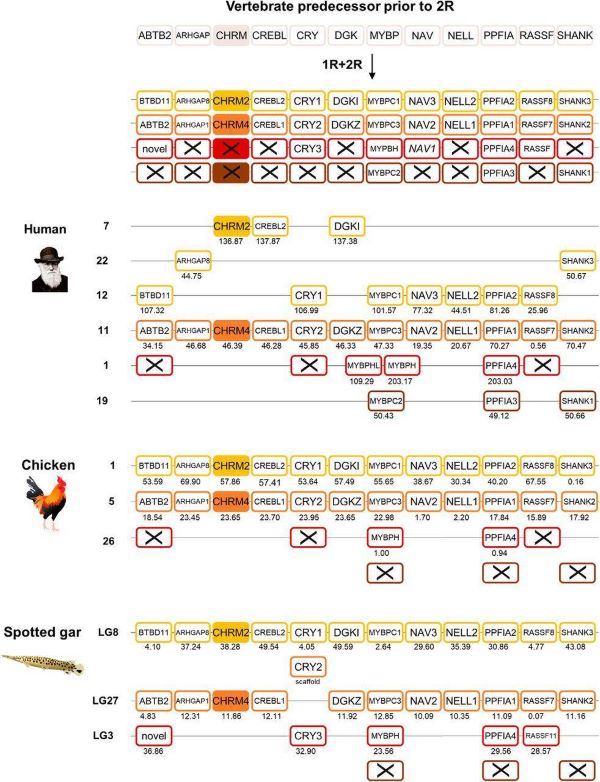 Fig. 1 The evolutionary history and analysis of chromosomal regions and conserved synteny of the CHRM2 and CHRM4 genes and their neighboring gene families.1
CHRM2 is a Gi/Go-coupled GPCR that mediates acetylcholine signaling:
Creative Biolabs provides CHRM2 membrane protein products using optimized expression systems. These include full-length multi-pass transmembrane protein that keeps the native seven-transmembrane structure and ligand-binding pocket, as well as isolated receptor domain variants. The seven-transmembrane region and intracellular domains mediate G protein coupling and downstream signaling. These proteins are suitable for studying muscarinic receptor pharmacology, G protein signaling, and receptor-ligand interactions. All products are quality-controlled for consistent performance.
Not finding the protein product you need? Contact us to start your one-stop custom service!
Creative Biolabs provides custom-engineered CHRM2 stable cell lines, including overexpression and knockdown models. These cell lines are optimized for studies of muscarinic signaling, G protein coupling, receptor desensitization, and downstream effector modulation. Each cell line undergoes stringent validation to ensure stable expression profiles and consistent functional performance in diverse experimental contexts.
Not finding the stable cell line product you need? Contact us to start your one-stop custom service!
High-specificity recombinant antibodies targeting CHRM2 are developed using antibody engineering technologies for research applications involving CHRM2 expression and localization. These antibodies can be used in studies of CHRM2 distribution in neuronal and cardiac tissues and may also support characterization of CHRM2-containing receptor complexes in combination with appropriate detection reagents.
Not finding the recombinant antibody product you need? Contact us to start your one-stop custom service!
Beyond catalog products, Creative Biolabs offers specialized custom services for CHRM2 research:
CHRM2 is a G protein-coupled receptor for acetylcholine that couples to G(i)/G(o) proteins, inhibiting adenylyl cyclase activity to regulate cardiac rhythm, neuronal excitability, and synaptic transmission.
CHRM2 is a key mediator of parasympathetic control of heart rate and cholinergic signaling in the brain. Its dysfunction has been implicated in mood disorders, cognitive impairment, and cancer progression, making it important for studies of muscarinic signaling and related pathologies.
No, all CHRM2 products and services are strictly for research use only, not intended for clinical diagnosis or treatment.
Offerings include full-length CHRM2 membrane proteins, receptor domain variants, specific detection antibodies, and custom stable cell lines for muscarinic signaling and G protein research.
CHRM2 proteins may support studies of ligand binding and G protein coupling, depending on protein format and experimental context.









