
Creative Biolabs is offering the most comprehensive services for antibody development projects. With strict regulation and effective execution, we are dedicated to providing the most valuable solutions to complete your projects.
HighlightsCreative Biolabs is offering the most comprehensive services for antibody development projects. With strict regulation and effective execution, we are dedicated to providing the most valuable solutions to complete your projects.
HighlightsCreative Biolabs has established a broad range of platforms for developing novel antibodies or equivalents. These cutting-edge technologies enable our scientists to meet your demands from different aspects and tailor the most appropriate solution that contributes to the success of your projects.
HighlightsWith deep understanding in antibody-related realms and extensive project experience, Creative Biolabs offers a variety of references to help you learn more about our capacities and achievements, including infographic, flyer, case study, peer-reviewed publications, and all kinds of knowledge that can assist your projects. You are also welcome to contact us directly for more specific solutions.
HighlightsGet a real taste of Creative Biolabs, one of the most professional custom service providers in the world. We are committed to providing highly customized comprehensive solutions with the best quality to advance your projects.
Highlights Loading...
All listed services and products are For Research Use Only. Do Not use in any diagnostic or therapeutic applications.
Chloride channel CLIC like 1 (CLCC1), also known as MCLC (Mid-1-related chloride channel) or KIAA0761, is encoded by the CLCC1 gene on chromosome 1p13.3. The gene produces a 551-amino-acid multi-pass membrane protein of approximately 62 kDa that belongs to the chloride channel MCLC family. CLCC1 has been reported to exhibit homomultimeric ER anion-channel activity that is inhibited by luminal Ca²⁺ and facilitated by phosphatidylinositol 4,5-bisphosphate (PIP2); conserved residues D25 and D181 in the N-terminus mediate Ca²⁺ binding, while K298 in the intraluminal loop functions as the PIP2-sensing residue. CLCC1 localizes to the endoplasmic reticulum (ER), Golgi apparatus, and nuclear envelope, and is expressed in lung, brain, muscle, liver, and testis. Alternative splicing generates four isoforms, designated hMCLC-1 through hMCLC-4.
CLCC1 has been reported to contribute to ER anion conductance and ion homeostasis, although its direct channel function remains under investigation alongside reported membrane-remodeling roles. In proposed channel models, chloride movement across the ER membrane may help balance ionic changes during Ca²⁺ release; the flux direction depends on the experimental conditions. CLCC1 has been implicated in ER ionic balance and may regulate ER Ca²⁺ homeostasis, including internal Ca²⁺ release and steady-state ER Ca²⁺ levels. Beyond ion transport, CLCC1 has also been implicated in ER bilayer equilibration, membrane remodeling and lipid transport in specific experimental models. Rare variants of CLCC1 are associated with amyotrophic lateral sclerosis (ALS)-like pathologies, and ALS-associated mutations impair channel conductance and ER Ca²⁺ homeostasis. A homozygous missense alteration (c.75C>A, p.D25E) in CLCC1 has also been associated with autosomal recessive retinitis pigmentosa.
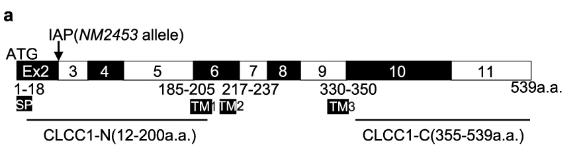 Fig. 1 Early predicted topology of mouse CLCC1 (mCLCC1, NM_145543.2), with an SP and three TMs.1
CLCC1, encoded by the CLCC1 gene, functions as an ER-resident anion channel that regulates ion homeostasis, lipid metabolism, and nuclear envelope dynamics:
Creative Biolabs provides CLCC1 membrane protein products produced using optimized expression systems. These include full-length multi-pass transmembrane protein that retains the native MCLC domain architecture and ion-conducting pore, as well as isolated membrane domain variants. The multi-transmembrane architecture forms the anion-conducting pore and mediates ER membrane integration, making these proteins suitable for studies of ER anion channel activity, ion transport mechanisms, and membrane protein structure-function characterization. All CLCC1 proteins undergo strict quality control to support consistent performance across applicable research platforms.
Not finding the protein product you need? Contact us to start your one-stop custom service!
Creative Biolabs provides custom-engineered CLCC1 stable cell lines, including overexpression and knockout models. These cell lines are optimized for studies of ER ion homeostasis, lipid metabolism, nuclear pore complex assembly, and CLCC1-associated ALS and retinal degeneration mechanisms. Each cell line undergoes stringent validation to ensure stable expression profiles and consistent functional performance in diverse experimental contexts.
Not finding the stable cell line product you need? Contact us to start your one-stop custom service!
High-specificity recombinant antibodies targeting CLCC1 are developed using antibody engineering techniques for research applications involving CLCC1 expression and localization. These antibodies can be used in studies of CLCC1 distribution in the ER, Golgi apparatus, and nuclear envelope and may also support characterization of CLCC1-containing channel complexes in combination with appropriate detection reagents.
Not finding the recombinant antibody product you need? Contact us to start your one-stop custom service!
Beyond catalog products, Creative Biolabs offers specialized custom services for CLCC1 research:
CLCC1 is a pore-forming ER anion channel that maintains ER chloride and potassium homeostasis and regulates ER Ca²⁺ dynamics and lipid bilayer equilibration.
CLCC1 is essential for ER ion homeostasis and lipid metabolism, and its variants are associated with ALS-like pathologies and autosomal recessive retinitis pigmentosa. It also functions in nuclear pore complex assembly, making it important for studies of ER biology and neurodegenerative disease mechanisms.
No, all CLCC1 products and services are strictly for research use only, not intended for clinical diagnosis or treatment.
Offerings include full-length CLCC1 membrane proteins, membrane domain variants, specific detection antibodies, and custom stable cell lines for ER ion homeostasis and lipid metabolism research.
CLCC1 proteins may support research on anion channel activity and ER ion concentration measurements, depending on protein format and experimental context.









