Creative Biolabs is offering the most comprehensive services for antibody development projects. With strict regulation and effective execution, we are dedicated to providing the most valuable solutions to complete your projects.
HighlightsCreative Biolabs is offering the most comprehensive services for antibody development projects. With strict regulation and effective execution, we are dedicated to providing the most valuable solutions to complete your projects.
HighlightsCreative Biolabs has established a broad range of platforms for developing novel antibodies or equivalents. These cutting-edge technologies enable our scientists to meet your demands from different aspects and tailor the most appropriate solution that contributes to the success of your projects.
HighlightsWith deep understanding in antibody-related realms and extensive project experience, Creative Biolabs offers a variety of references to help you learn more about our capacities and achievements, including infographic, flyer, case study, peer-reviewed publications, and all kinds of knowledge that can assist your projects. You are also welcome to contact us directly for more specific solutions.
HighlightsGet a real taste of Creative Biolabs, one of the most professional custom service providers in the world. We are committed to providing highly customized comprehensive solutions with the best quality to advance your projects.
Highlights Loading...
All listed services and products are For Research Use Only. Do Not use in any diagnostic or therapeutic applications.
C-type lectin domain family 12 member A (CLEC12A) is a single transmembrane myeloid cell surface receptor encoded by CLEC12A gene, which is specifically expressed on the cell membrane surfaces of monocytes and granulocytes. Compared with soluble cytoplasmic sugar-binding protein without transmembrane anchoring structure, CLEC12A contains a single transmembrane fragment, and the extracellular domain has a typical C-type lectin folding structure, which can specifically recognize glycosyl ligands and provide a structural basis for ligand binding and signal transduction. CLEC12A, as a cell membrane inhibitory signal receptor, can negatively regulate the activation level of myeloid cells after recognizing glycosyl ligands, inhibit the overactivation of myeloid cells, and maintain the basic immune homeostasis. When the suppression signal mediated by CLEC12A is absent, the immune response of myeloid cells will be in an uncontrolled activation state, which will induce excessive amplification of inflammatory response. CLEC12A can accurately regulate the activation intensity of white blood cells and stabilize the functional state of immune cells in different tissue microenvironment by appropriately responding to ligand stimulation and starting downstream inhibition signals. Different tissue-resident myeloid cells can contact differentiated cell membrane glycosyl ligands, and rely on the specific expression and functional synergy of CLEC12A, which can effectively restrain the abnormal hyperfunction of myeloid cells and avoid the imbalance of immune response. CLEC12A located in cell membrane can combine with extracellular glycosyl structure, further activate intracellular inhibitory kinase signaling pathway, terminate or weaken the continuous activation cycle of white blood cells, and avoid chronic immune activation. At the same time, the highly conserved calcium binding residues in the lectin domain can mediate the reversible recognition and binding of glycosyl ligands on the cell membrane surface, ensure the dynamic and specificity of CLEC12A ligand recognition, and realize accurate and reversible regulation of the immune activity of myeloid cells.
CLEC12A may form homotypic oligomers upon multivalent glycan binding to amplify downstream inhibitory signal strength. Sequence variants within the CLEC12A gene alter glycan ligand binding affinity and correlate with unbalanced myeloid activation states. No other C-type lectin transmembrane receptor fully recapitulates CLEC12A’s dual capacity for extracellular glycan sensing and cytoplasmic inhibitory signal transmission. Fluctuations in CLEC12A expression levels likely correspond to tissue inflammatory baseline requirements, rendering the receptor a suitable research target for myeloid lectin receptor structural analysis. CLEC12A localizes exclusively to outer plasma leaflets without internalizing into organelle lumens. Its integral membrane topology separates it from soluble glycan-binding lectins, holding dual potential roles in dampening leukocyte effector activity and maintaining tissue immune steady state. Reduced functional CLEC12A weakens glycan-triggered inhibitory signaling, elevating spontaneous myeloid activation levels, making CLEC12A a research subject for inhibitory C-type lectin receptor studies.
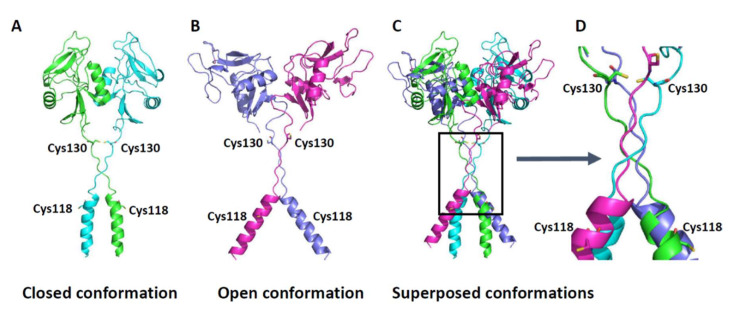 Fig. 1 Structural models of dimeric human CLEC12A extracellular region, illustrating alternative spatial arrangements of stalk segments and C‑type lectin‑like domains.1
The biological functions of integral membrane CLEC12A C-type lectin receptor are focused on calcium-dependent glycan binding and cytoplasmic inhibitory kinase signaling:
Creative Biolabs offers purified CLEC12A membrane protein samples produced under unified preparation workflows, including full-length CLEC12A constructs and isolated extracellular lectin domain variants. Truncated fragments cannot support complete calcium-dependent glycan recognition and inhibitory signal coupling activity, while full-length constructs fit myeloid lectin receptor research. All batches receive uniform quality screening. Functional assessments may only be performed under simulated lipid bilayer microenvironment setups. Lectin domain glycan binding pocket integrity is retained across batches for comparative carbohydrate interaction testing. Full-length CLEC12A membrane samples preserve intact calcium coordination surfaces post-purification, enabling reliable detection of transient glycan-receptor complexes in functional comparative analysis.
Not finding the Membrane Protein product you need? Contact us to start your one-stop custom service!
Creative Biolabs provides cell research models with adjustable CLEC12A expression levels, suitable for structural observation of myeloid C-type lectin receptors and glycan ligand interaction research. Sample assessment covers sustained membrane receptor detection and carbohydrate binding analysis, enabling side-by-side comparison of inhibitory signal output under varying receptor abundances. These cell models can be paired with leukocyte activation detection schemes to track inflammatory baseline shifts linked to CLEC12A dosage.
Not finding the stable cell line product you need? Contact us to start your one-stop custom service!
Anti-CLEC12A recombinant antibodies are generated via standardized workflows, compatible with myeloid cell membrane localization mapping and glycan-receptor complex identification. The antibody series supports multi-dimensional visualization of receptor distribution within leukocyte tissue populations.
Not finding the recombinant antibody product you need? Contact us to start your one-stop custom service!
Beyond catalog products, Creative Biolabs offers specialized custom services for CLEC12A research:
CLEC12A may act as an integral transmembrane C-type lectin receptor to bind extracellular glycans and propagate cytoplasmic inhibitory signals limiting myeloid cell activation.
CLEC12A expression status may modulate leukocyte effector responsiveness, serving as a key mediator of tissue myeloid immune homeostasis biological processes.
No, all CLEC12A related products and services are strictly for research use only, and cannot be applied in clinical workflows. All material design and functional screening are optimized exclusively for basic laboratory research, without meeting clinical application criteria.
Offerings include full-length CLEC12A membrane protein, target-specific recombinant antibodies and tunable expression cell research models, supporting research on calcium-dependent glycan binding and inhibitory immune signal transduction.
Laboratory analysis schemes may include carbohydrate ligand binding assays to assess calcium-dependent glycan recognition capacity under simulated lipid bilayer environments.