Creative Biolabs is offering the most comprehensive services for antibody development projects. With strict regulation and effective execution, we are dedicated to providing the most valuable solutions to complete your projects.
HighlightsCreative Biolabs is offering the most comprehensive services for antibody development projects. With strict regulation and effective execution, we are dedicated to providing the most valuable solutions to complete your projects.
HighlightsCreative Biolabs has established a broad range of platforms for developing novel antibodies or equivalents. These cutting-edge technologies enable our scientists to meet your demands from different aspects and tailor the most appropriate solution that contributes to the success of your projects.
HighlightsWith deep understanding in antibody-related realms and extensive project experience, Creative Biolabs offers a variety of references to help you learn more about our capacities and achievements, including infographic, flyer, case study, peer-reviewed publications, and all kinds of knowledge that can assist your projects. You are also welcome to contact us directly for more specific solutions.
HighlightsGet a real taste of Creative Biolabs, one of the most professional custom service providers in the world. We are committed to providing highly customized comprehensive solutions with the best quality to advance your projects.
Highlights Loading...
All listed services and products are For Research Use Only. Do Not use in any diagnostic or therapeutic applications.
CLN3 (battenin) is a multi-pass endolysosomal transmembrane protein encoded by CLN3 gene, widely expressed in central nervous system neurons and epithelial tissues, forming lipid-permeable transmembrane pores to export undigested fatty acid and lipopigment intermediates out of lysosomal lumens. Pathogenic loss-of-function CLN3 mutations block lipid efflux and lead to massive lipofuscin pigment accumulation within neuronal lysosomes, which is the primary pathological driver of juvenile neuronal ceroid lipofuscinosis (Batten disease).
CLN3 exerts lipid homeostatic effects via conserved transmembrane helices that assemble into small lipid efflux channels, transporting hydrophobic degradative waste across the lysosomal limiting membrane into cytoplasmic clearance pathways. Unlike other lysosomal transporters with narrow substrate spectra, CLN3 mediates broad-spectrum efflux of diverse lipopigment precursors; loss of channel activity traps lipid aggregates inside degradative organelles, uncoupling lysosomal lipid breakdown from cellular waste elimination. This regulatory balance sustains neuronal survival under physiological conditions, while CLN3 truncation or missense mutations trigger progressive neurodegeneration. CLN3 participates in lysosomal lipid turnover, neuronal homeostasis and inherited childhood neurodegenerative storage disorders, making it a pivotal research marker for lipodystrophy and neurolysosomal disease study.
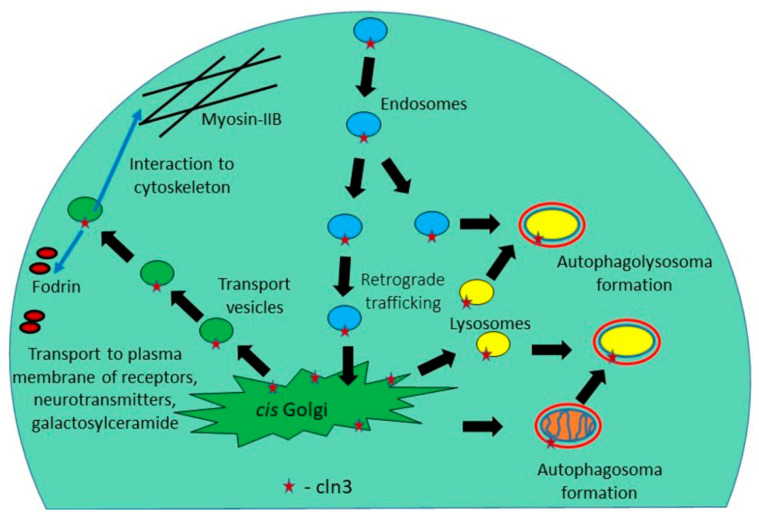 Fig. 1 CLN3 (marked by red asterisks) distributes across cis-Golgi, transport vesicles, endosomes and lysosomes; it regulates retrograde trafficking, autophagolysosome maturation, and cytoskeleton-coupled delivery of signaling molecules to neuronal plasma membrane.1
The biological functions of CLN3 are focused on endolysosomal lipid transmembrane efflux channel formation:
Creative Biolabs offers high-quality CLN3 proteins through optimized heterologous expression systems, including full-length multi-pass wild-type and channel-defective mutant variants with modified transmembrane helix topology. These products retain native lipid efflux pore activity, suitable for lysosomal lipid metabolism research and anti-lipofuscin neuroprotective compound screening workflows. All CLN3 batches undergo strict quality control to ensure consistent performance and reliable application across neuronal research platforms.
Not finding the membrane protein product you need? Contact us to start your one-stop custom service!
Creative Biolabs provides custom-engineered CLN3 stable cell lines, including wild-type and disease mutant neuronal research models. These cell lines are optimized for lysosomal lipid efflux mechanistic investigation and Batten disease therapeutic compound potency testing. Each cell line undergoes stringent validation to ensure stable transmembrane protein expression profiles and consistent lipid clearance functional performance in diverse experimental contexts.
Not finding the stable cell line product you need? Contact us to start your one-stop custom service!
High-specificity recombinant antibodies targeting CLN3 are developed via advanced antibody engineering technologies, with no cross-reactivity to other CLN family lysosomal transporters. These antibodies are validated for multiple applications, including neuronal lysosome immunofluorescence localization detection, Western blot expression quantification and co-immunoprecipitation analysis of CLN3 lipid channel complexes, enabling precise characterization of CLN3 expression levels and lysosomal membrane distribution under healthy and disease-mutant cellular conditions.
Not finding the recombinant antibody product you need? Contact us to start your one-stop custom service!
Beyond catalog products, Creative Biolabs offers specialized custom services for CLN3 research:
CLN3 is an endolysosomal lipid efflux channel protein that exports lipopigment precursors out of lysosomes, fine-tunes neuronal lipid waste clearance dynamics, and prevents toxic intralysosomal aggregate buildup.
CLN3 pathogenic mutations are the leading cause of juvenile Batten neurodegenerative storage disease. It is a critical core research target for lysosomal lipid and pediatric neurobiology.
No, all CLN3 products and services are strictly for research use only, not intended for clinical diagnosis or treatment.
Offerings include full-length multi-pass CLN3 proteins, high-specificity recombinant antibodies, and custom lipid clearance reporter neuronal cell lines, supporting Batten disease research projects.
CLN3 proteins are validated via lysosomal lipid efflux cell-based assays to retain native lipopigment clearance regulatory function.