
Creative Biolabs is offering the most comprehensive services for antibody development projects. With strict regulation and effective execution, we are dedicated to providing the most valuable solutions to complete your projects.
HighlightsCreative Biolabs is offering the most comprehensive services for antibody development projects. With strict regulation and effective execution, we are dedicated to providing the most valuable solutions to complete your projects.
HighlightsCreative Biolabs has established a broad range of platforms for developing novel antibodies or equivalents. These cutting-edge technologies enable our scientists to meet your demands from different aspects and tailor the most appropriate solution that contributes to the success of your projects.
HighlightsWith deep understanding in antibody-related realms and extensive project experience, Creative Biolabs offers a variety of references to help you learn more about our capacities and achievements, including infographic, flyer, case study, peer-reviewed publications, and all kinds of knowledge that can assist your projects. You are also welcome to contact us directly for more specific solutions.
HighlightsGet a real taste of Creative Biolabs, one of the most professional custom service providers in the world. We are committed to providing highly customized comprehensive solutions with the best quality to advance your projects.
Highlights Loading...
All listed services and products are For Research Use Only. Do Not use in any diagnostic or therapeutic applications.
Chemerin chemokine-like receptor 1 (CMKLR1), also known as ChemR23 or DEZ, is encoded by the CMKLR1 gene on chromosome 12q23.3. The gene spans approximately 33 kb and produces multiple transcript variants through alternative splicing. CMKLR1 is a member of the class A (rhodopsin-like) family of G protein-coupled receptors (GPCRs) and is closely related to the chemokine receptor subfamily, though it lacks the typical chemokine receptor DRY motif. The protein comprises approximately 373 amino acids with seven transmembrane helices, an extracellular N-terminus, and an intracellular C-terminal tail. CMKLR1 couples primarily to G(i)/G(o) proteins and signals through intracellular calcium mobilization, ERK1/2 phosphorylation, and NF-κB activation. The receptor is expressed on innate immune cells including macrophages, dendritic cells, and natural killer cells, and is also found in adipose tissue, pancreatic β-cells, and the nervous system. The crystal structure of CMKLR1 in complex with a chemerin-derived agonist has been determined, revealing the molecular basis of ligand recognition and receptor activation.
CMKLR1 functions as the primary signaling receptor for chemerin (encoded by RARRES2) and also binds the pro-resolving mediator Resolvin E1. Chemerin is secreted as a pro-precursor that undergoes C-terminal proteolytic processing by plasmin, elastase, and cathepsin G to generate active isoforms, with chemerin9 being the most potent agonist for CMKLR1. CMKLR1 signaling is context-dependent: chemerin acts as a potent chemoattractant for macrophages, dendritic cells, and NK cells through CMKLR1, driving pro-inflammatory cell recruitment, whereas the chemerin-derived peptide chemerin9 and Resolvin E1 signal through CMKLR1 to promote pro-resolving macrophage phenotypes and suppress inflammation. In the context of metabolism, CMKLR1 senses chemerin and Resolvin E1 to control adipose thermogenesis and modulate metabolic homeostasis. CMKLR1-deficient mice exhibit altered body weight regulation and central responses to chemerin, and the receptor has been implicated in obesity-associated neuroinflammation. CMKLR1 signaling in placental trophoblasts regulates spiral artery remodeling during early pregnancy, and the chemerin-CMKLR1 axis has been associated with gestational complications. In addition, CMKLR1 functions as a receptor for amyloid-β peptide, linking the chemerin system to Alzheimer's disease pathology. These features make CMKLR1 an important research target for studies of chemerin biology, innate immune cell recruitment, inflammation resolution, and metabolic regulation.
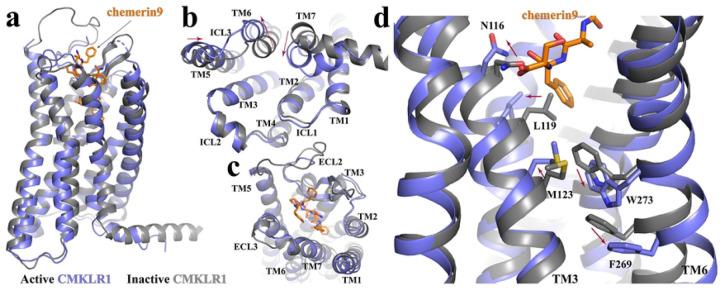 Fig. 1 CMKLR1 activation.1
CMKLR1, encoded by the CMKLR1 gene, functions as a G protein-coupled receptor that mediates chemerin and Resolvin E1 signaling in innate immunity and metabolism:
Creative Biolabs offers high-quality CMKLR1 membrane protein products produced using optimized expression systems. These include full-length multi-pass transmembrane protein that retains the native seven-transmembrane architecture and ligand-binding pocket, as well as isolated receptor domain variants. The seven-transmembrane architecture and intracellular domains mediate G protein coupling and downstream signaling, making these proteins suitable for studies of chemerin receptor pharmacology, G protein signaling, and ligand-receptor interaction characterization. All CMKLR1 proteins undergo strict quality control to support consistent performance across applicable research platforms.
Not finding the protein product you need? Contact us to start your one-stop custom service!
Creative Biolabs provides custom-engineered CMKLR1 stable cell lines, including overexpression and knockdown models. These cell lines are optimized for studies of chemerin signaling, innate immune cell chemotaxis, inflammation resolution, and metabolic regulation. Each cell line undergoes stringent validation to ensure stable expression profiles and consistent functional performance in diverse experimental contexts.
Not finding the stable cell line product you need? Contact us to start your one-stop custom service!
High-specificity recombinant antibodies targeting CMKLR1 are developed using antibody engineering technologies for research applications involving CMKLR1 expression and localization. These antibodies can be used in studies of CMKLR1 distribution on innate immune cells and in metabolic tissues, and may also support characterization of CMKLR1-containing receptor complexes in combination with appropriate detection reagents.
Not finding the recombinant antibody product you need? Contact us to start your one-stop custom service!
Beyond catalog products, Creative Biolabs offers specialized custom services for CMKLR1 research:
CMKLR1 is a G protein-coupled receptor for chemerin and Resolvin E1 that mediates innate immune cell chemotaxis and regulates inflammation and metabolism.
CMKLR1 mediates chemerin signaling in immune cell recruitment and inflammation resolution, and regulates adipose thermogenesis and metabolic homeostasis, making it important for studies of immunometabolism and inflammatory disease.
No, all CMKLR1 products and services are strictly for research use only, not intended for clinical diagnosis or treatment.
Offerings include full-length CMKLR1 membrane proteins, receptor domain variants, specific detection antibodies, and custom stable cell lines for chemerin signaling and immunometabolic research.
CMKLR1 proteins may support studies of ligand binding and G protein coupling, depending on protein format and experimental context.









