Creative Biolabs is offering the most comprehensive services for antibody development projects. With strict regulation and effective execution, we are dedicated to providing the most valuable solutions to complete your projects.
HighlightsCreative Biolabs is offering the most comprehensive services for antibody development projects. With strict regulation and effective execution, we are dedicated to providing the most valuable solutions to complete your projects.
HighlightsCreative Biolabs has established a broad range of platforms for developing novel antibodies or equivalents. These cutting-edge technologies enable our scientists to meet your demands from different aspects and tailor the most appropriate solution that contributes to the success of your projects.
HighlightsWith deep understanding in antibody-related realms and extensive project experience, Creative Biolabs offers a variety of references to help you learn more about our capacities and achievements, including infographic, flyer, case study, peer-reviewed publications, and all kinds of knowledge that can assist your projects. You are also welcome to contact us directly for more specific solutions.
HighlightsGet a real taste of Creative Biolabs, one of the most professional custom service providers in the world. We are committed to providing highly customized comprehensive solutions with the best quality to advance your projects.
Highlights Loading...
All listed services and products are For Research Use Only. Do Not use in any diagnostic or therapeutic applications.
CNST, also known as consortin or connexin sorting protein is a 673-amino acid single-pass transmembrane protein with an estimated size of 70 kDa coded by the human chromosomal location 1q44. CNST has ubiquitous expression in human tissues, with high (RPKM 10.5), moderate (brain: RPKM 9.5) and low levels of RNA across all other tested tissue types from the same individuals, exceeding genome-wide average values through a total of at least 25 human normal adult/male-tissue comparisons consistent with its universal significance in cellular protein trafficking. Localization studies at the subcellular level revealed that CNST is enriched in tubulovesicular transport organelles, mostly found within the trans-Golgi network (TGN), and at or near plasma membrane sites of anterograde trafficking to cell surface locations where it serves as a cargo receptor for TMD-containing proteins exported from the Golgi complex. Originally discovered as a connexin binding partner, CNST was later identified to be the first TGN cargo receptor with specificity in targeting transmembrane proteins towards the plasma membrane. This interacts directly with an essential group of clathrin adaptors, the GGA1 and 2 proteins that serve to connect connexin-containing vesicles placed in a secure point between AP-1/clathrin coat machinery involved in regulating transport from the TGN to plasma membrane. In addition to its canonical role in connexin trafficking, burgeoning evidence has also implicated CNST in various disease processes including acute myeloid leukemia (AML), where increased levels of expression are representative of a leukemic stem cell phenotype and correlate with an unfavorable clinical outcome; inherited non-syndromic hearing loss (DFNB1); regulation of bone mass deposition; as well as depolarization from TGF-β1 stimulation-induced cardiac fibroblasts.
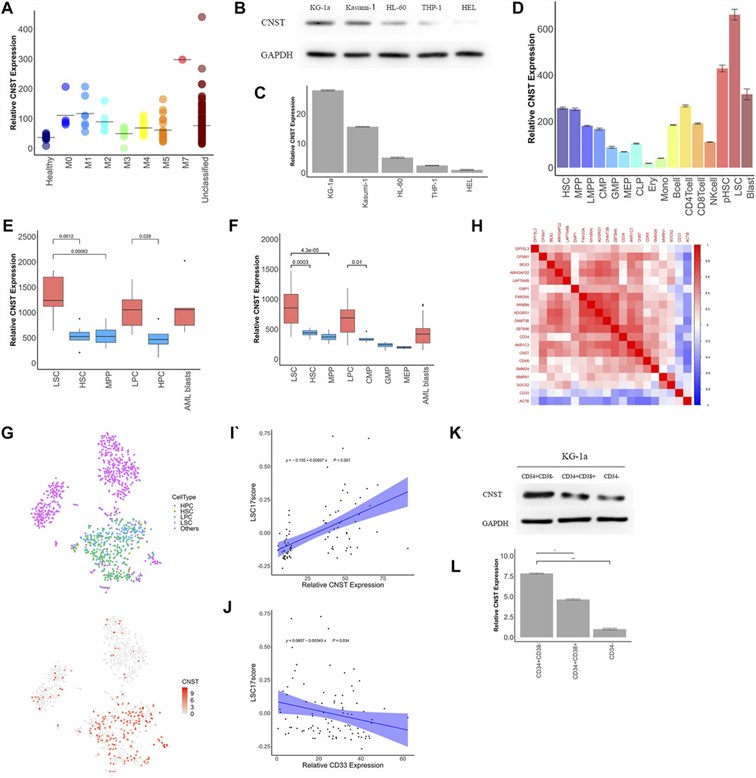 Fig.1 CNST expression correlates with poor differentiation of the hematopoietic system.1
Because of its versatile molecular interactions, the functional repertoire of CNST encompasses membrane protein trafficking, gap junction assembly and cellular communication:
Creative Biolabs provides a flexible range of high-quality CNST membrane protein products to support structural and functional studies of this trans-Golgi network cargo receptor. Our membrane protein platform can provide CNST constructs and preparations suitable for a range of research applications, including antibody development and characterization, binding assays, GGA1/GGA2 interaction studies, and investigations of connexin trafficking and TGN sorting mechanisms. These products can serve as research tools for studying CNST interactions with connexins, clathrin adaptors, and related trafficking machinery. Available formats and construct designs may vary according to specific experimental requirements.
Not finding the membrane protein product you need? Contact us to start your one-stop custom service!
Establishing stable cellular models is essential in the CNST field. Designed from the ground up, Creative Biolabs provides custom-engineered CNST membrane protein stable cell lines working with target CNST-expressing cells at high levels consistently. These stable cell lines would be suitable for screening assays, connexin trafficking assays, studies of gap junction plaque formation / turnover and endocytic recycling as well high-throughput screening providing a reproducible tool-kit by which to probe CNST biology & pharmacology. We help you get the most expression with healthy cells, which drives efficiency in your research pipeline. This includes CNST-overexpressing lines for studying connexin targeting and GGA adaptor recruitment, as well as CNST-knockdown lines to study loss of function; expression is validated by flow cytometry (top), Western blotting (bottom left) or functional CCX surface delivery assays (lower right). Connexin-GFP-fusion based specialized-reporter cell lines allow real-time imaging of gap junction plaque dynamics, establishing important tools for high-throughput-mechanistic-dissection-screening in cardiac ischemia and neuropathy models.
Not finding the stable cell line product you need? Contact us to start your one-stop custom service!
We are at the forefront of producing high-affinity recombinant antibodies targeting CNST tailored to meet the most challenging and technically demanding requirements of your research applications. These recombinant antibodies are more specific, sensitive and consistent from batch-to-batch compared to conventional polyclonal. Our CNST recombinant antibodies are tested for WB, ELISA, FCM, IF (Immunofluorescence), ICC (Immunocytochemistry), IHC(Immunohistochemistry) and IP(Immunoprecipitation) validation to enable reliable detection of the target protein from cardiac tissue homogenates; cochlear extracts; tumor biopsies; cell lysate. We provide antibodies against unique CNST epitopes, including the N-terminal intrinsically disordered region for interaction studies with connexins, the DXXLL motif for GGA adaptor binding sites identification and mapping in cellular context, a transmembrane domain to assess membrane integration potentials, C terminal tail domains which enables localisation between target organelles.
Not finding the recombinant antibody product you need? Contact us to start your one-stop custom service!
Apart from our catalog products, Creative Biolabs also provides specific custom services for membrane protein and antibody discovery & development. With the extensive experience and best-in-class platforms we offer, specifically focus on helping you in:
No. All Creative Biolabs CNST products and services are for research use only, not clinical diagnosis or therapy of any disease(s) prevention treatment or cure.
Absolutely. Our custom protein engineering services accommodate a wide range of modifications. Our scientific team collaborates closely with clients to design constructs optimized for trafficking studies, structural biology, GGA adaptor interaction mapping, and screening research applications.
Yes, we offer conformation-dependent antibodies that recognize CNST conformational epitopes exposed by the binding of either cx26 or cx30 C-terminal. These reagents allow for co-immunoprecipitation and immunofluorescence visualization of the intact ER-resident assembly complex in fixed cells or membrane preparations while generating minimal signal against unpartnered monomeric species dispersed throughout the cytosol.
Yes, we have created pairs of dual-stable lines where both full-length CNST and a pair of selected connexin partners are constitutively expressed from independent loci. Each batch comes with a documented gap junction plaque density (GJPD) and dye-coupling efficiency, which allows to use well-annotated standardized cellular platform for continuous mechanistic studies without the need of transient transfection.