
Creative Biolabs is offering the most comprehensive services for antibody development projects. With strict regulation and effective execution, we are dedicated to providing the most valuable solutions to complete your projects.
HighlightsCreative Biolabs is offering the most comprehensive services for antibody development projects. With strict regulation and effective execution, we are dedicated to providing the most valuable solutions to complete your projects.
HighlightsCreative Biolabs has established a broad range of platforms for developing novel antibodies or equivalents. These cutting-edge technologies enable our scientists to meet your demands from different aspects and tailor the most appropriate solution that contributes to the success of your projects.
HighlightsWith deep understanding in antibody-related realms and extensive project experience, Creative Biolabs offers a variety of references to help you learn more about our capacities and achievements, including infographic, flyer, case study, peer-reviewed publications, and all kinds of knowledge that can assist your projects. You are also welcome to contact us directly for more specific solutions.
HighlightsGet a real taste of Creative Biolabs, one of the most professional custom service providers in the world. We are committed to providing highly customized comprehensive solutions with the best quality to advance your projects.
Highlights Loading...
All listed services and products are For Research Use Only. Do Not use in any diagnostic or therapeutic applications.
Ciliary neurotrophic factor (CNTF), a member of the interleukin-6 family of helical cytokines, which CNTF transmits signals once presented on the outside of cells by first binding to its receptor in a process that involves an alpha (CNTFRα) subunit. It activates Janus kinase (JAK) and signal transducer and activator of transcription (STAT)-dependent pathways, including STAT3, mitogen-activated protein kinase (MAPK), and phosphoinositide 3–kinase/AKT survival cascades. Biologically, CNTF is one of the strongest known motor neuron survival FACTORs showing protective efficacy in animal models for amyotrophic lateral sclerosis (ALS) and increased Axonal Regeneration. It has also been demonstrated to promote retinal ganglion cell survival in the eye; drive oligodendrocyte precursor differentiation and remyelination in the brain stem and spinal cord, or act within hypothalamic feeding circuits impacting energy balance by decreasing food intake and reducing adiposity. The combination of this neuroprotective and metabolic profile continues to generate considerable drug development interest, as rCNTF or its engineered analogs have advanced along the pipeline from preclinical through clinical studies for ocular gene therapy use in treating neurodegeneration or modulation of metabolic syndrome.
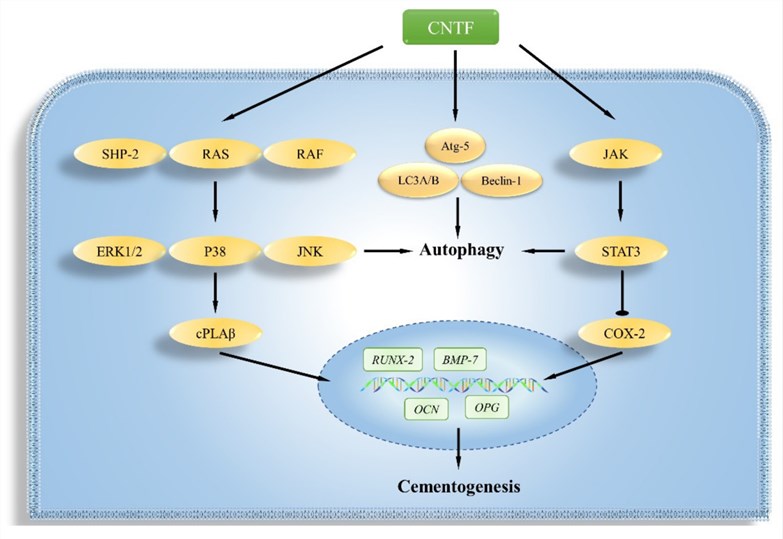 Fig.1 The scheme summarizes the possible mechanisms of CNTF on the autophagy and cementogenesis regulation of cementoblasts.1
CNTF regulates multiple physiological programs beyond its canonical role as a motor neuron survival factor:
We offer high-quality recombinant CNTF proteins designed to support neurobiology, cytokine signaling, and related functional studies. CNTF adopts a characteristic four-helix cytokine fold and exerts its biological effects through interaction with CNTFRα and the gp130/LIFR receptor complex, making appropriate protein folding and receptor-binding properties important for relevant research applications. Our recombinant CNTF products can support studies of receptor interaction, downstream signaling, neuronal biology, and other CNTF-related mechanisms. Available protein formats and construct options may vary according to specific research requirements, with appropriate quality assessment applied based on the intended research use.
Not finding the protein product you need? Contact us to start your one-stop custom service!
To enable dissection of the neuroprotective mechanisms and facilitate drug discovery, culturing cellular platforms that mimic CNTF secretion kinetics as well its receptor signaling is desirable. We combine lentiviral transduction with transposon-mediated genomic integration to produce a comprehensive portfolio of CNTF stable cell lines that retain pharmacologically relevant expression levels, genuine non-conventional secretory characteristics, and functional response capacities to glial activation stimuli. Our library is not limited to constitutive wild-type expression and includes tetracycline-inducible systems that allow for precise temporal control of endogenous cytokine release, the axokine versions of these proteins to facilitate increased potency studies, or co-expression constructs designed such that CNTF could be expressed with each corresponding obligate receptor subunit (CNTFRα, gp130 &LIFRβ) from a single cellular background. In order to facilitate mechanistic dissection of CNTF-driven neuroprotection, we generated reporter-coupled lines by inserting luciferase cassettes downstream of STAT3, SRE or neuronal differentiation response elements which enable real-time quantification after stimulation with CNTF or following antibody blockade. For rescue experiments and for synthetic lethality screening, complementary loss-of-function models—through shRNA-mediated knockdown or dominant-negative receptor expression—are at your disposal. There are several key points about this manuscript that must be highlighted: All the cell lines undergo strict authentication via genomic integration mapping, secretion rate profiling by ELISA and functional assays including neurite outgrowths in post-mitotic neurons, oligodendrocyte differentiation and electrophysiological characterization of hypothalamic neuron firing which has been fully validated.
Not finding the stable cell line product you need? Contact us to start your one-stop custom service!
Further your CNTF studies through our rigorously optimized mixture of sequence-validated, high-affinity monoclonal antibodies customized for the structural complexity and pleiotropic biology driven by this neurotrophic cytokine. Compared to the associated IL-6 family members, including leukemia inhibitory factor (LIF), cardiotrophin-1 (CT-1) and oncostatin M (OSM), our antibodies demonstrate only minimal cross-reactivity against any of these closely related factors while recognizing specific native properly folded CNTF. They detect all monomeric and aggregation-prone conformation, distinguish between the wild-type protein form and engineered axokine variants in cellular or serum environment, are cross-reactive with human/murine/rat orthologs, which enables further mechanistic insights through animal studies. These reagents have been subjected to comprehensive pre-validation concerning quantitative Western blotting under reducing and non-reducing conditions, direct/sandwich-ELISA configurations for cytosolic detection in cell culture supernatants, cerebrospinal fluid, ocular vitreous; flow-cytometric assessment of intracellular CNTF levels in permeabilized astrocyte-Schwann-cell populations via immunofluorescence (IF) microscopy (high-resolution immunostaining & confocal imaging); compatibility with potent neutralization studies blocking CNTF-induced phosphorylation of STAT3 signaling pathways.
Not finding the recombinant antibody product you need? Contact us to start your one-stop custom service!
Far beyond our standard product catalogue, we offer fully designed discovery and manufacturing services specifically engineered to meet sophisticated needs in CNTF-targeted research development:
Absolutely. Our monoclonal antibodies have been raised against unique epitopes within the CNTF D-helix and AB loop regions that exhibit minimal sequence homology. Extensive cross-reactivity testing by Western blot, ELISA, and cell-based neutralization confirms exquisite specificity, rendering them suitable for related research.
Yes. Combined with proprietary refolding protocols, our bacterial expression systems ensure the topology of four-helix bundle as well as proper disulfide pairing required for CNTFRα engagement. Before being released, each batch is analysed by circular dichroism spectroscopy and non-reducing SDS-PAGE as well as bioactivity assays based on either TF-1 cell proliferation or primary motor neuron survival to ensure the functional integrity of all batches.
Yes. We have created new tricistronic and multi-promoter expression systems that allow for the simultaneous expression of CNTF together with its high-affinity receptor components: CNTFRα, gp130, and LIFRβ from a single stable cell line. They are validated functions for ligand-dependent phosphorylation of STAT3, neuronal differentiation and antibody neutralization which can be translated into ready-to-use cellular substrates providing therapeutic screening platforms and mechanistic insights towards the assembly of neurotrophic receptors.
Certainly. We generate, on a routine basis, the axokine variant with increased neurotrophic activity, cysteine-to-serine substitutions which minimize oxidative aggregation and increase serum half-life in vivo and N-terminally-modified analogs designed to reduce immunogenicity. These custom constructs are provided as either purified recombinant proteins or genetically stable cell lines, supported by sequence verification, mass spectrometric identity confirmation and functional monitoring through STAT3 reporter and motor neuron survival assays.








