Creative Biolabs is offering the most comprehensive services for antibody development projects. With strict regulation and effective execution, we are dedicated to providing the most valuable solutions to complete your projects.
HighlightsCreative Biolabs is offering the most comprehensive services for antibody development projects. With strict regulation and effective execution, we are dedicated to providing the most valuable solutions to complete your projects.
HighlightsCreative Biolabs has established a broad range of platforms for developing novel antibodies or equivalents. These cutting-edge technologies enable our scientists to meet your demands from different aspects and tailor the most appropriate solution that contributes to the success of your projects.
HighlightsWith deep understanding in antibody-related realms and extensive project experience, Creative Biolabs offers a variety of references to help you learn more about our capacities and achievements, including infographic, flyer, case study, peer-reviewed publications, and all kinds of knowledge that can assist your projects. You are also welcome to contact us directly for more specific solutions.
HighlightsGet a real taste of Creative Biolabs, one of the most professional custom service providers in the world. We are committed to providing highly customized comprehensive solutions with the best quality to advance your projects.
Highlights Loading...
All listed services and products are For Research Use Only. Do Not use in any diagnostic or therapeutic applications.
Collagen type VI alpha 3 chain (COL6A3) is a large secreted extracellular matrix polypeptide encoded by the COL6A3 gene, synthesized within endoplasmic reticulum compartments and subsequently deposited into connective-tissue extracellular spaces. Distinct from integral transmembrane effectors, COL6A3 lacks lipid-embedded transmembrane segments and membrane-anchoring motifs, and is confirmed to function as a secreted matrix component that assembles together with additional collagen-VI subunits under basal physiological conditions. Incomplete matrix supramolecular assemblies readily accumulate without sufficient subunit supply, and COL6A3 tends to deliver moderate structural buffering to sustain balanced microfibril turnover across diverse connective-tissue microenvironments. Different tissue niches produce distinct mixtures of matrix binding partners, requiring diversified collagen-VI subunit pools to maintain overall extracellular matrix structural equilibrium within interstitial systems. Freely secreted COL6A3 might continuously participate in heterotrimer formation to restrain aberrant unassembled subunit accumulation and preserve steady interstitial matrix balance.
Variants of the COL6A3 gene might alter subunit interaction affinity and correlate with disorganized extracellular matrix architectures, and no other collagen-VI paralog fully reproduces the dual capacity of COL6A3 for heterotrimer assembly and microfibril maturation. Shifts in COL6A3 expression levels likely align with connective-tissue remodeling status, rendering it a suitable research subject for secreted matrix subunit and collagen-VI supramolecular-assembly analysis. COL6A3 enters extracellular compartments after intracellular biosynthesis and associates with other collagen-VI chains without initiating transmembrane signaling cascades; its fully secreted extracellular localization separates it from membrane-bound proteins, carrying dual potential to stabilize interstitial matrix architecture and support beaded microfibril construction. Diminished functional COL6A3 could trigger defective collagen-VI supramolecular formation and weaken connective-tissue matrix structural resilience, further validating its research significance for fundamental secreted collagen subunit studies.
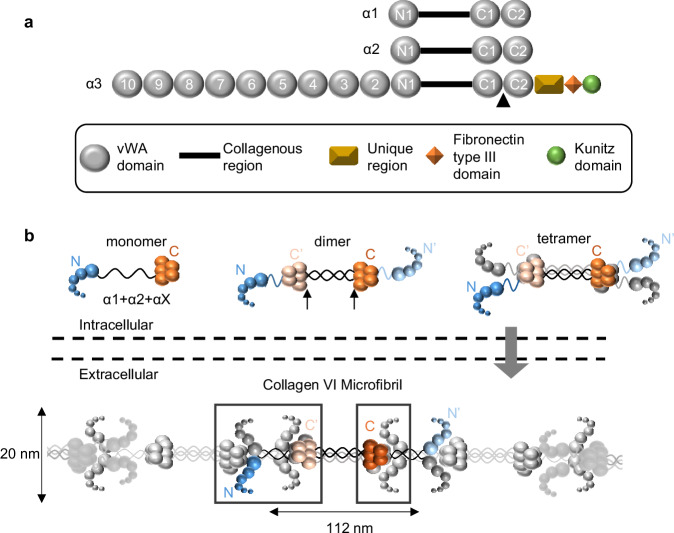 Fig. 1 Domain organization and hierarchical assembly of collagen‑VI complex. (a) Domain arrangement of collagen‑VI α1, α2 and α3 (COL6A3) subunits. (b) Intracellular heterotrimer assembly, secretion and extracellular polymerization into beaded microfibrils.1
The biological functions of secreted COL6A3 collagen polypeptide are focused on sustained heterotrimer subunit assembly and interstitial matrix structural coordination:
Creative Biolabs offers purified COL6A3 protein samples produced under unified preparation workflows, including full-length COL6A3 constructs and isolated globular-domain variants. Truncated domain fragments cannot support complete heterotrimer assembly behaviors, while full-length constructs suit research focused on collagen-VI subunit association and extracellular matrix supramolecular observation. All batches receive uniform quality screening. Functional relevant observation may only be carried out with full-length samples under simulated extracellular microenvironment setups. Consistent structural features are preserved across batches to support comparative laboratory analysis across separate test groups. Full-length COL6A3 samples retain intact subunit-interaction motif conformation after standardized purification, which supports reliable detection of weak and transient polypeptide-partner contacts for comparative functional analysis.
Not finding the potein product you need? Contact us to start your one-stop custom service!
Creative Biolabs provides adjustable COL6A3 expression cell research models with varied expression levels, applicable to structural observation of secreted matrix polypeptides and research into collagen-VI subunit interaction. Sample evaluation includes sustained target expression detection and preliminary partner-interaction observation, enabling side-by-side comparison of polypeptide oligomerization behaviors under differing expression abundances. These cell systems can pair with diverse laboratory analysis schemes to track changes in subunit-assembly efficiency alongside shifting target protein levels.
Not finding the stable cell line product you need? Contact us to start your one-stop custom service!
Anti-COL6A3 recombinant antibodies are generated via standardized protein preparation workflows, compatible with routine laboratory detection techniques for extracellular matrix localization mapping and identification of collagen-VI multi-subunit molecular complexes. The antibody series can work alongside common laboratory detection reagents to realize multi-dimensional observation of target distribution within connective-tissue samples.
Not finding the recombinant antibody product you need? Contact us to start your one-stop custom service!
Beyond catalog products, Creative Biolabs offers specialized custom services for COL6A3 research:
COL6A3 might act as a secreted extracellular matrix polypeptide and participate in heterotrimer subunit assembly to support collagen-VI microfibril formation.
COL6A3 expression status could alter collagen-VI supramolecular assembly efficiency and interstitial matrix structural resilience, serving as a major regulatory mediator of connective-tissue matrix biological processes.
No, all COL6A3 related products and services are strictly for research use only, and cannot be applied in clinical workflows. All material designs and functional tests are optimized exclusively for basic laboratory research scenarios, without matching clinical application standards.
Offerings include full-length COL6A3 soluble protein, target-specific recombinant antibodies and tunable expression cell research models, supporting research on extracellular matrix homeostasis and collagen-VI microfibril biogenesis.
Laboratory observation schemes may include polypeptide-partner interaction related tests to analyze oligomer-associated behaviors under simulated extracellular environments.