Creative Biolabs is offering the most comprehensive services for antibody development projects. With strict regulation and effective execution, we are dedicated to providing the most valuable solutions to complete your projects.
HighlightsCreative Biolabs is offering the most comprehensive services for antibody development projects. With strict regulation and effective execution, we are dedicated to providing the most valuable solutions to complete your projects.
HighlightsCreative Biolabs has established a broad range of platforms for developing novel antibodies or equivalents. These cutting-edge technologies enable our scientists to meet your demands from different aspects and tailor the most appropriate solution that contributes to the success of your projects.
HighlightsWith deep understanding in antibody-related realms and extensive project experience, Creative Biolabs offers a variety of references to help you learn more about our capacities and achievements, including infographic, flyer, case study, peer-reviewed publications, and all kinds of knowledge that can assist your projects. You are also welcome to contact us directly for more specific solutions.
HighlightsGet a real taste of Creative Biolabs, one of the most professional custom service providers in the world. We are committed to providing highly customized comprehensive solutions with the best quality to advance your projects.
Highlights Loading...
All listed services and products are For Research Use Only. Do Not use in any diagnostic or therapeutic applications.
cAMP responsive element binding protein 1 (CREB1) is a soluble nuclear‑shuttling polypeptide encoded by the CREB1 gene, distributing between cytoplasmic pools and nuclear compartments in response to upstream intracellular signaling fluctuations. Its domain architecture consists of an N‑terminal trans‑activation segment, a centrally located regulatory phosphorylation region, and a C‑terminal basic leucine‑zipper fold that governs dimer assembly and DNA recognition. No transmembrane hydrophobic stretches exist within its primary sequence, consistent with its function as an intracellular signal integrator rather than a surface‑anchored receptor. Upon receiving upstream kinase inputs, site‑specific residue modification alters the surface electrostatic profile of CREB1, promoting nuclear accumulation and facilitating physical contacts with co‑activator assemblies anchored at target gene regulatory regions. Unbalanced modification status disturbs the timing of transcriptional output when upstream chemical cues fluctuate, and gradual shifts in CREB1 nuclear occupancy establish graded transcriptional responses instead of sharp on‑off switching. Many tissue types maintain basal cytoplasmic CREB1 reservoirs ready for translocation upon stimulus arrival; leucine‑zipper mediated homodimer formation represents a prerequisite for stable docking onto cAMP‑responsive DNA motifs, and subtle changes in dimer interface geometry can reshape the preference for distinct genomic binding sites. Electrostatic surface features shaped by phosphorylation events adjust the strength of protein‑protein contacts between CREB1 and its transcriptional co‑partners.
Naturally occurring sequence alterations within CREB1’s leucine‑zipper or regulatory segments may impair homodimer stability or reduce the efficiency of stimulus‑triggered nuclear redistribution, which could desensitize transcriptional programs to incoming intracellular signaling inputs within biological model systems. Other bZIP‑class transcription factors can occupy partially overlapping genomic loci, yet they cannot fully recapitulate CREB1‑coupled responsiveness to kinase‑driven intracellular signaling gradients. CREB1 undergoes continuous nucleocytoplasmic shuttling rather than permanent confinement inside nuclei, enabling rapid resetting of transcriptional readouts once triggering signals subside. This shuttling property grants dual operational capacity: collecting kinase‑derived information from cytoplasmic compartments and executing sequence‑directed gene regulation within chromatin environments. Diminished capacity for stimulus‑driven nuclear translocation blunts the dynamic range of target gene modulation, rendering CREB1 a meaningful molecular target for investigating signal‑coupled transcriptional adaptation across multiple tissue contexts.
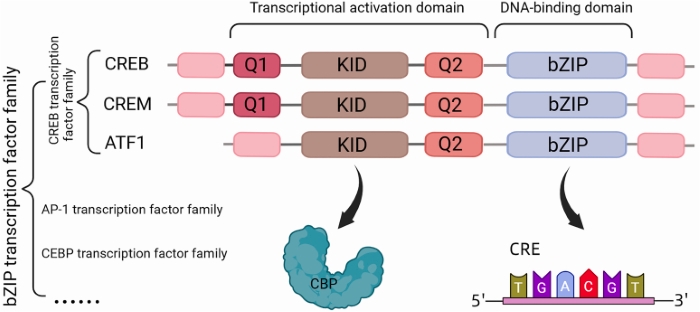 Fig. 1 Schematic domain organization of human CREB1, showing N‑terminal Q1, central KID regulatory region, Q2 segment and C‑terminal bZIP DNA‑binding domain.1
The biological functions of soluble shuttling CREB1 transcription factor center on phosphorylation‑regulated dimer assembly and chromatin‑associated co‑factor recruitment:
Creative Biolabs offers purified CREB1 protein samples produced under unified preparation workflows, including full‑length CREB1 constructs and isolated bZIP domain variants. Truncated polypeptide fragments cannot support complete homodimer formation and target‑motif binding activity, while full‑length forms suit signal‑coupled transcription research. All batches receive uniform quality screening. Functional assessments may only be performed under simulated intranuclear aqueous microenvironment setups. Conserved bZIP dimer‑interface structural features are preserved across batches to support comparative DNA‑binding analysis between experimental groups. Full‑length CREB1 samples retain intact dimerization and DNA‑contact surfaces post‑purification, supporting reliable detection of transient transcription‑factor‑DNA complexes in comparative functional analysis.
Not finding the Protein product you need? Contact us to start your one-stop custom service!
Creative Biolabs provides cell research models with adjustable CREB1 expression levels, suitable for observation of nucleocytoplasmic shuttling transcription factors and stimulus‑coupled transcriptional studies. Sample assessment covers intracellular protein redistribution quantification and chromatin co‑binding analysis, enabling side‑by‑side comparison of transcriptional responsiveness under varying CREB1 abundances. These cell models can be paired with downstream gene‑readout detection schemes to track transcriptional shifts linked to altered CREB1 dosage.
Not finding the stable cell line product you need? Contact us to start your one-stop custom service!
Anti CREB1 recombinant antibodies are generated via standardized workflows, compatible with subcellular compartment localization mapping and chromatin resident complex identification. The antibody series supports multi dimensional observation of CREB1 distribution across cytoplasmic and nuclear compartments.
Not finding the recombinant antibody product you need? Contact us to start your one-stop custom service!
Beyond catalog products, Creative Biolabs offers specialized custom services for CREB1 research:
CREB1 may serve as a shuttling nuclear transcription factor that forms homodimers to recognize cAMP‑responsive DNA motifs and relays upstream intracellular signaling into adjusted target‑gene transcription.
Altered CREB1 abundance or modification status might reshape stimulus‑coupled transcriptional responses, serving as a key mediator of tissue transcriptional adaptation processes.
No, all CREB1 related products and services are strictly for research use only, and cannot be applied in clinical workflows. All material design and functional screening are optimized exclusively for basic laboratory research, without meeting clinical application criteria.
Offerings include full‑length CREB1 protein, target‑specific recombinant antibodies and tunable‑expression cell research models, supporting research on signal‑dependent transcriptional regulation.
Laboratory analysis schemes may include regulatory‑motif co‑binding assays to evaluate dimer‑driven sequence‑recognition capacity under simulated intranuclear environments.