
Creative Biolabs is offering the most comprehensive services for antibody development projects. With strict regulation and effective execution, we are dedicated to providing the most valuable solutions to complete your projects.
HighlightsCreative Biolabs is offering the most comprehensive services for antibody development projects. With strict regulation and effective execution, we are dedicated to providing the most valuable solutions to complete your projects.
HighlightsCreative Biolabs has established a broad range of platforms for developing novel antibodies or equivalents. These cutting-edge technologies enable our scientists to meet your demands from different aspects and tailor the most appropriate solution that contributes to the success of your projects.
HighlightsWith deep understanding in antibody-related realms and extensive project experience, Creative Biolabs offers a variety of references to help you learn more about our capacities and achievements, including infographic, flyer, case study, peer-reviewed publications, and all kinds of knowledge that can assist your projects. You are also welcome to contact us directly for more specific solutions.
HighlightsGet a real taste of Creative Biolabs, one of the most professional custom service providers in the world. We are committed to providing highly customized comprehensive solutions with the best quality to advance your projects.
Highlights Loading...
All listed services and products are For Research Use Only. Do Not use in any diagnostic or therapeutic applications.
The CRK-like proto-oncogene, adaptor protein (CRKL) is a small type of signal adaptor protein with a molecular weight of approximately 39 kilodaltons, and it is one of the most functionally diverse molecular linking tools within cells. Its structure is simple: one SH2 domain, with one SH3 domain linked to each of its two sides. CRKL itself has no catalytic activity—it cannot initiate or catalyze biochemical reactions on its own like many functional proteins in cells do, and all its functions stem from its ability to "link": it relies on its SH2 domain to bind tyrosine sequences with phosphorylation modifications, while using its two SH3 domains to bind proline-rich sequences. This allows it to assemble different signaling molecules into complexes at precise times and locations within cells, converting the activity of upstream kinases into coordinated, orderly downstream cellular instructions that regulate cell proliferation, migration, cytoskeleton remodeling, and survival. Simply put, an upstream kinase only emits an initiation signal; that signal needs a carrier to deliver it to the correct location and activate the downstream molecules that need to perform their tasks, and CRKL is exactly the messenger and connector that carries out this work. In this process, it acts as a core signaling hub: signals from growth factors, cell adhesion signals, and outputs from oncogenic kinases all converge here, before being redistributed to every corner of the cell, ultimately working together to determine how the cell responds to its surrounding environment. To date, reliable, fully validated Research on CRKL tools—well-defined protein products, tested detection reagents, and gene-edited cell models—are all essential for research, yet they are often very difficult to source. Our team has integrated platforms for protein production, cell line development, and antibody preparation, specifically targeting these gaps in the niche field of preclinical signal research to provide corresponding solutions.
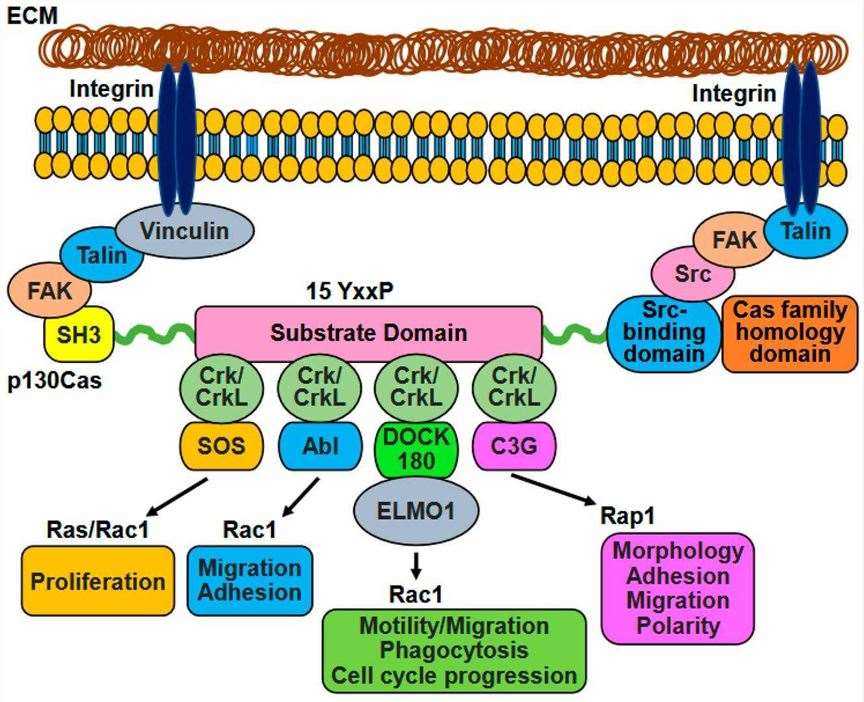 Fig.1 Interactions between p130Cas and Crk/CrkL lead to various complex formation and functions.1
Research on CRKL continues to progress along several interlocking lines:
Our CRKL protein product has a straightforward core design logic: the value of an adaptor protein hinges entirely on whether it can bind normally to its partner proteins, just as it would in a native cellular environment. In other words, only when CRKL’s state is completely consistent with its naturally occurring state in cells can it accurately dock with the proteins it is meant to bind, and fulfill its intended function — this is the starting point for all our product development. Based on these requirements, the CRKL protein preparations we provide are full-length, completely consistent with the native sequence, produced using a specially optimized expression platform, with its phosphorylation state strictly controlled throughout the process to ensure it can bind partner proteins normally, with no risk of failed pairing due to improper state. Every batch of product undergoes verification against multiple quality metrics, and is only released after all metrics meet standards.
Not finding the membrane protein product you need? Contact us to start your one-stop custom service!
Cell platforms for CRKL research must meet two mandatory requirements: first, they must be able to control CRKL’s expression level, and second, they must produce stable, reliable responses to upstream kinase signals. This is because for adaptor proteins, phosphorylation status is just as important as expression level, and both directly impact function. Any issue with either factor may lead to inaccurate research conclusions. We can provide customized, high-expression CRKL stable cell lines, developed using sequence-optimized stable integration technology — this means the CRKL gene is stably inserted into the cell’s genome, and will not be lost after several passages, ensuring that under a reproducible cellular background, CRKL can be expressed continuously, stably, and uniformly, with no scenario where one batch of cells has a high expression level that drops sharply in the next batch, or where some cells in the same batch express high levels while others barely express any at all. Our cell line product portfolio includes strains that stably express wild-type CRKL, with multiple expression tiers to meet different research requirements for protein expression levels, as well as a full suite of CRKL variant cell lines for research in other directions. Every cell clone undergoes comprehensive phenotypic validation, and is only delivered to customers after all metrics are confirmed to meet requirements.
Not finding the stable cell line product you need? Contact us to start your one-stop custom service!
You can advance your CRKL research projects with our validated recombinant antibody panel. This panel is specifically designed for the complex experimental workflows of adaptor protein research, guaranteeing recognition specificity and quantitative accuracy, and can withstand even the most stringent experiments. These high-affinity monoclonal and recombinant antibody clones are all generated against specific epitopes of CRKL, enabling stable, specific recognition of CRKL without cross-reactivity with other proteins that would introduce interfering data into experiments. Every antibody clone has undergone sequence verification and is produced from a fixed recombinant construct, so even for long-term research spanning months or years, the antibody used in every experiment is identical, and the consistency of experimental results can be maintained indefinitely, with no data fluctuations caused by differences between antibody batches. Antibody validation also covers all the most common experimental scenarios used by CRKL researchers; no matter which conventional method you use for your experiments, this antibody panel is fully compatible.
Not finding the recombinant antibody product you need? Contact us to start your one-stop custom service!
In addition to our catalog products, Creative Biolabs specializes in custom services for membrane protein and antibody discovery & development. Using our deep knowledge and sophisticated platforms we can support you with:
All CRKL products and services are provided strictly for preclinical research. They are not designed, validated, or authorized for any use involving human subjects.
Both constitutive and inducible formats are available. Each clone ships with measured expression data, so expression tier can be matched precisely to your experimental design.
We do. Custom constructs carrying substitutions in either domain can be produced under the same quality framework as wild-type material.
Yes. Phospho-defined preparations can be supplied with characterization of the relevant modification sites.









