
Creative Biolabs is offering the most comprehensive services for antibody development projects. With strict regulation and effective execution, we are dedicated to providing the most valuable solutions to complete your projects.
HighlightsCreative Biolabs is offering the most comprehensive services for antibody development projects. With strict regulation and effective execution, we are dedicated to providing the most valuable solutions to complete your projects.
HighlightsCreative Biolabs has established a broad range of platforms for developing novel antibodies or equivalents. These cutting-edge technologies enable our scientists to meet your demands from different aspects and tailor the most appropriate solution that contributes to the success of your projects.
HighlightsWith deep understanding in antibody-related realms and extensive project experience, Creative Biolabs offers a variety of references to help you learn more about our capacities and achievements, including infographic, flyer, case study, peer-reviewed publications, and all kinds of knowledge that can assist your projects. You are also welcome to contact us directly for more specific solutions.
HighlightsGet a real taste of Creative Biolabs, one of the most professional custom service providers in the world. We are committed to providing highly customized comprehensive solutions with the best quality to advance your projects.
Highlights Loading...
All listed services and products are For Research Use Only. Do Not use in any diagnostic or therapeutic applications.
Chondroitin sulfate proteoglycan 4 (CSPG4, also known as NG2/MCSP) is a large single-pass transmembrane proteoglycan encoded by CSPG4 gene, featuring abundant extracellular chondroitin sulfate glycosaminoglycan modification chains, selectively expressed on oligodendrocyte precursor cells, vascular pericytes and multiple malignant tumor cells including melanoma, glioblastoma and sarcoma, localized to cell outer lipid bilayer surfaces. Distinguished from ubiquitous basement membrane proteoglycans with housekeeping adhesion roles, CSPG combines ECM crosslinking and growth factor sequestration dual functions, its extracellular LNS domains binding collagen, laminin while negatively charged glycan chains trap PDGF, FGF signaling cytokines to sustain cell migratory and proliferative signals. Under normal quiescent tissues, CSPG expression is strictly restricted to vascular mural cells and glial progenitors to support physiological angiogenesis and myelin development; upon malignant transformation, transcriptional overexpression of CSPG4 drastically strengthens tumor cell-matrix adhesion and sustains persistent pro-migratory growth factor signaling, facilitating local invasion and distant organ metastasis. CSPG4's tumor-enriched expression signature cannot be functionally substituted by other proteoglycan subtypes, making it a well-recognized specific biomarker for solid malignancies and promising antibody-drug conjugate target. The decreased expression level of CSPG4 can weaken the invasion ability of tumor cells and inhibit the angiogenesis in tumor microenvironment, which proves that CSPG4 is the core target for studying the biological mechanism of tumor proteoglycan and screening anti-tumor targeted drugs.
As a multifunctional proteoglycan scaffold molecule on the cell surface, CSPG4 can interact with extracellular growth factors and matrix components through its extended extracellular region and chondroitin sulfate chains, while cooperating with integrins to regulate cell adhesion and signaling. CSPG4 is not tumor-specific; it is normally expressed in cell populations such as oligodendrocyte precursor cells and pericytes, but is also highly expressed in selected cancers as a tumor-associated antigen. CSPG4-mediated matrix and signaling interactions contribute to vascular development, cell migration, and tumor progression in a context-dependent manner. CSPG4 participates in oligodendrocyte development, pericyte function, angiogenesis, and progression of several solid tumors. Altered CSPG4 expression can affect tumor cell migration and vascular-associated signaling. Therefore, CSPG4 represents an important research target for tumor-associated surface biomarker and cell signaling studies.
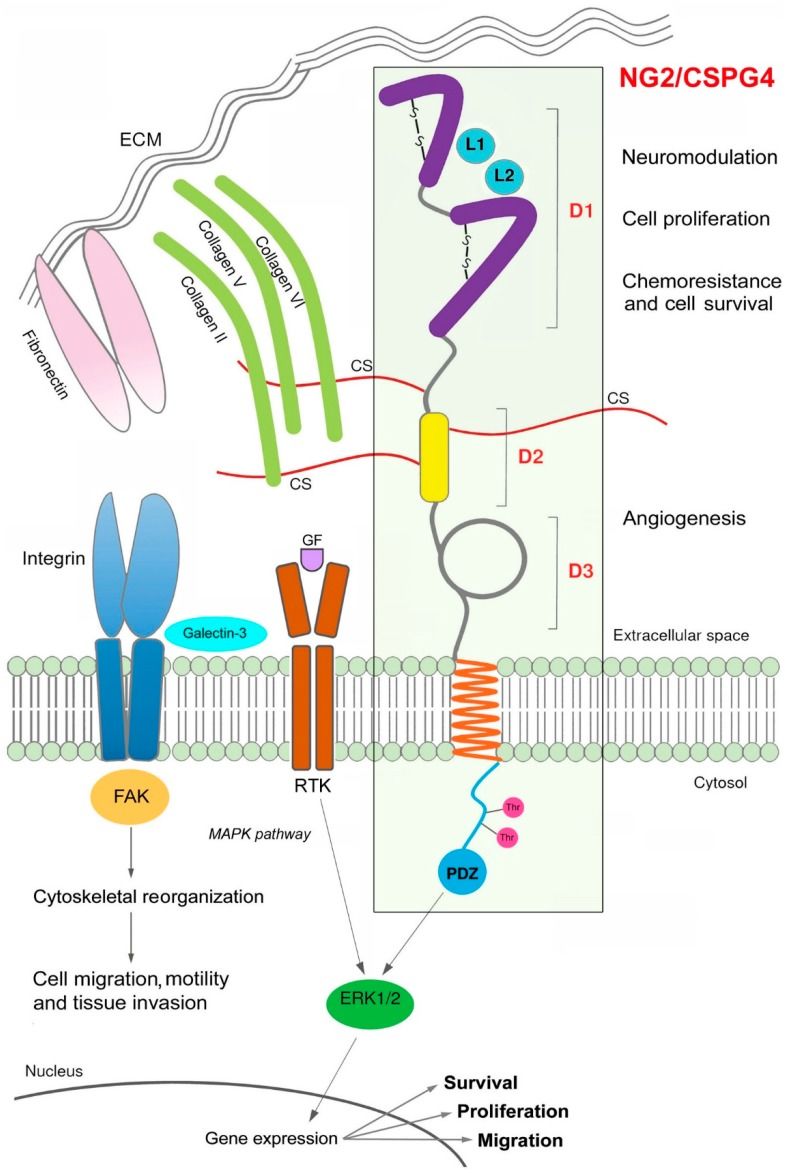 Fig. 1 Schematic of NG2/CSPG4 multi-domain structure and dual FAK/MAPK-ERK signaling cascades driving tumor proliferation, migration, angiogenesis and chemoresistance.1
The biological functions of CSPG4 are focused on ECM binding and growth factor sequestration:
Creative Biolabs offers high-quality CSPG4 proteins through optimized eukaryotic expression systems, including full-length transmembrane proteoglycan and isolated extracellular domain variants. These products retain native chondroitin sulfate modification and matrix binding activity, suitable for tumor adhesion and ADC ligand screening assays. All CSPG4 proteins undergo strict quality control to ensure consistent performance across diverse research platforms.
Not finding the membrane protein product you need? Contact us to start your one-stop custom service!
Creative Biolabs provides custom-engineered CSPG4 stable cell lines, including overexpression and blank control models. These cell lines are optimized for tumor proteoglycan profiling and migratory signal functional analysis. Each cell line undergoes stringent validation to ensure stable expression profiles during continuous cell passages.
Not finding the stable cell line product you need? Contact us to start your one-stop custom service!
High-specificity recombinant antibodies targeting CSPG4 are developed via advanced antibody engineering technologies. These antibodies are validated for tumor/pericyte membrane immunostaining, and can be combined with PDGF detection reagents to analyze CSPG4-growth factor signaling complexes in glioma cell models.
Not finding the recombinant antibody product you need? Contact us to start your one-stop custom service!
Beyond catalog products, Creative Biolabs offers specialized custom services for CSPG4 research:
CSPG4 is a cell-surface chondroitin sulfate proteoglycan that binds ECM and PDGF to promote tumor cell migration and angiogenesis.
Tumor-restricted CSPG4 is a well-validated biomarker and high-potential target for antibody-drug conjugate therapeutics.
No, all CSPG4 products and services are strictly for research use only, not intended for clinical diagnosis or treatment.
Offerings include full-length CSPG4 proteoglycans, isoform-specific antibodies and custom stable cell lines for tumor metastasis research.
CSPG4 proteins are validated via collagen and PDGF binding functional testing.








