Creative Biolabs is offering the most comprehensive services for antibody development projects. With strict regulation and effective execution, we are dedicated to providing the most valuable solutions to complete your projects.
HighlightsCreative Biolabs is offering the most comprehensive services for antibody development projects. With strict regulation and effective execution, we are dedicated to providing the most valuable solutions to complete your projects.
HighlightsCreative Biolabs has established a broad range of platforms for developing novel antibodies or equivalents. These cutting-edge technologies enable our scientists to meet your demands from different aspects and tailor the most appropriate solution that contributes to the success of your projects.
HighlightsWith deep understanding in antibody-related realms and extensive project experience, Creative Biolabs offers a variety of references to help you learn more about our capacities and achievements, including infographic, flyer, case study, peer-reviewed publications, and all kinds of knowledge that can assist your projects. You are also welcome to contact us directly for more specific solutions.
HighlightsGet a real taste of Creative Biolabs, one of the most professional custom service providers in the world. We are committed to providing highly customized comprehensive solutions with the best quality to advance your projects.
Highlights Loading...
All listed services and products are For Research Use Only. Do Not use in any diagnostic or therapeutic applications.
Cystatin C (CST3), also known as gamma-trace, post-gamma-globulin or neuroendocrine basic polypeptide is a secreted protein of approximately 13 kDa and the most abundant extracellular cysteine protease inhibitor. CST3 is secretomed in all nucleated cells, and released into biological fluids at concentrations determined by the equilibrium between its biosynthesis and renal clearance. The serum concentration of cystatin C, unlike creatinine, does not depend upon muscle mass and is unaffected by age, sex, race and dietary protein intake; thus it reflects a better endogenous marker of GFR. The protein is freely filtered at the glomerulus and then catabolized by proximal tubular cells, with little return to the circulation. In excess of renal physiology, CST3 is particularly highly enriched in cerebrospinal fluid—its concentrations are roughly five-fold higher than plasma highlight.
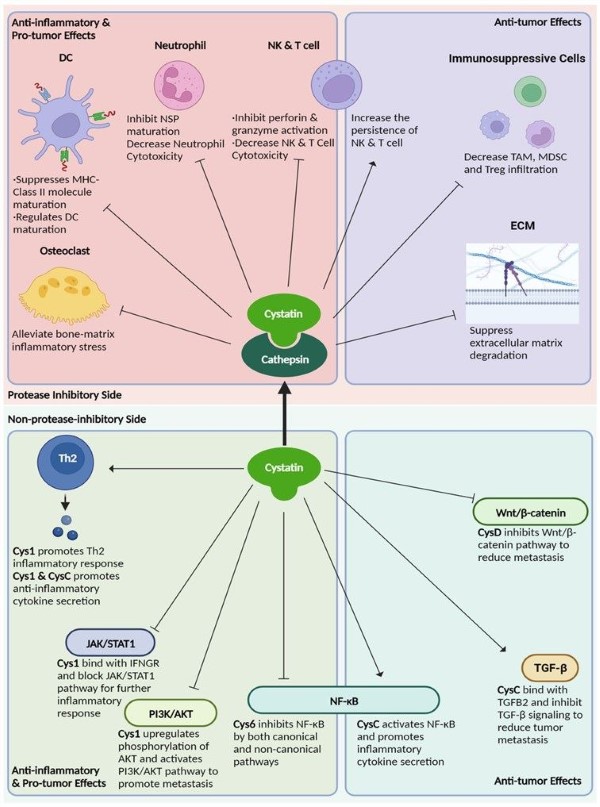 Fig.1 The overview of type 2 cystatins' role on immune regulation and cancer development.1
CST3 functional portfolio is large enough to cover multiple physiological and pathological systems:
Expand your mechanistic and studies with catalog of our highly characterized recombinant CST3 protein. CST3, a typical secreted cysteine protease inhibitor rather than a membranous anchored receptor, still relies upon correct folding of disulfide bonds and protease-binding in order to produce reproducible results. Mammalian HEK293 cells and E. coli expression systems are utilized for the generation of fully active, endotoxin-free CST3 preparations that retain native cathepsin B inhibitory potency and Aβ-binding capabilities. We provide the wild-type human and mouse CST3, disease-associated L68Q variant and aggregated oligomeric forms to support studies of the pathological mechanisms. Each batch is subjected to stringent quality control such as SDS-PAGE, analytical size-exclusion chromatography, mass spectrometry and cathepsin B activity assays verifying their suitability for enzyme kinetics, ligand binding studies and antibody screening.
Not finding the protein product you need? Contact us to start your one-stop custom service!
Robust cellular models are essential for dissecting CST3-driven biology and evaluating candidates. Stable cell lines: Cell lines that express human, mouse or rat CST3 (constitutively or inducibly) and with knocked-down endogenous expression for loss-of-function studies These platforms also serve as a consistent and reproducible foundation for studies of CST3-mediated pathology and pharmacology, making them suitable for high-throughput compound screening (cathepsin activity assays), studies to inhibit Aβ aggregation, as well as GFR biomarker validation.
Not finding the stable cell line product you need? Contact us to start your one-stop custom service!
CST3 High affinity recombinant antibodies targeting CST3 are included in our portfolio to support the rigorous needs of different research applications. Our recombinant CST3 antibody are more sensitive, specific, and consistent across lots compared with conventional polyclonal antibodies. Additionally, all these CST3 recombinant antibodies are validated for Western Blotting (WB), ELISA, Flow Cytometry (FCM), Immunofluorescence (IF),Immunocytochemistry(ICC) and Imunohistochemistry(IHC) etc., ensuring precise detection and quantification of CST3 in serum, plasma, cerebrospinal fluid, etc.
Not finding the recombinant antibody product you need? Contact us to start your one-stop custom service!
In addition to our catalog products, we have specific custom proteins and antibody discovery and development services. Drawing on our robust experience with both protease biology and neurodegenerative diseases research, we can help you with:
No, all CST3 products and services are for research use only and not intended for human clinical diagnosis, prevention, treatment or cure.
Absolutely. The cell engineering team regularly creates tetracycline-inducible systems and lines with co-expression of CST3 with cathepsin B, Aβ or autophagy reporter constructs collectively for pathway analysis. We would really appreciate ardent conversations around what the expression architecture and phenotypic needs are for this product that we can build.
Yes, we have quaternary-structure-selective antibodies, which are designed to bind preferentially to epitopes located within the dimer interface that is formed by intermolecular disulfide linkage. These clones provide highly specific signal with an oxidized secreted dimer in western blot and immunofluorescence, but minimal recognition of the reduced monomeric species or ER-resident precursor: allowing for both detailed tracking of secretion status and extracellular accumulation.
Yes, we established stable autocrine lines which secrete correctly processed CST3 into serum-free conditioned medium. In addition, each batch is qualified by quantifying the titer of secreted proteins using an ELISA and evaluated for bioactivity using a standardized cathepsin inhibition assay to maintain a continuous cellular platform for mechanistic studies over time without the need for transient transfections.