
Creative Biolabs is offering the most comprehensive services for antibody development projects. With strict regulation and effective execution, we are dedicated to providing the most valuable solutions to complete your projects.
HighlightsCreative Biolabs is offering the most comprehensive services for antibody development projects. With strict regulation and effective execution, we are dedicated to providing the most valuable solutions to complete your projects.
HighlightsCreative Biolabs has established a broad range of platforms for developing novel antibodies or equivalents. These cutting-edge technologies enable our scientists to meet your demands from different aspects and tailor the most appropriate solution that contributes to the success of your projects.
HighlightsWith deep understanding in antibody-related realms and extensive project experience, Creative Biolabs offers a variety of references to help you learn more about our capacities and achievements, including infographic, flyer, case study, peer-reviewed publications, and all kinds of knowledge that can assist your projects. You are also welcome to contact us directly for more specific solutions.
HighlightsGet a real taste of Creative Biolabs, one of the most professional custom service providers in the world. We are committed to providing highly customized comprehensive solutions with the best quality to advance your projects.
Highlights Loading...
All listed services and products are For Research Use Only. Do Not use in any diagnostic or therapeutic applications.
C-X-C motif chemokine ligand 14 (CXCL14), widely regarded as stem cell-induced factor, breast and kidney-expressed chemokine (BRAK) or macrophage-inflammatory protein-2 gamma (MIP-2γ), is a human non-elastin-related CXC cause with an avidity molecular weight of approximately 9.4 kDa due to its original gene sequence the mature; This generation will eventually ultimately lead in mRNA expression that has been previously circulating mainly by platelets from endothelial cells. CXCL14 is a unique CXC chemokine due to its homeostatic nature and lack of coupling with any classic G protein-coupled receptors, constitutively expressed across the remarkably broad tissue spectrum that includes skin epithelium; mammary gland; kidney, lung for metabolic tissues such as adipose depots. Instead of signalling through classical seven-transmembrane receptors, CXCL14 uses atypical chemokine receptor 2 (ACKR2, also known as D6) and may bind to glycosaminoglycan-rich extracellular matrix elements in order to create tissue-specific patterns of localised attraction. Its cellular targets span from immature dendritic cells to monocytes, natural killer cells and tissue-resident memory T lymphocyte subsets that shepherd these populations into epithelial- and stroma-localized niches in the steady-state immune surveillance context. CXCL14 has a remarkable dual function in disease, showing both strong antiangiogenic properties by antagonizing VEGF signaling and inhibiting endothelial tube formation as well as cancer-suppressive characteristics in prostate breast and non-small cell lung carcinomas (NSCLC), mainly related to the infiltration of immune cells along with direct structural remodelling.
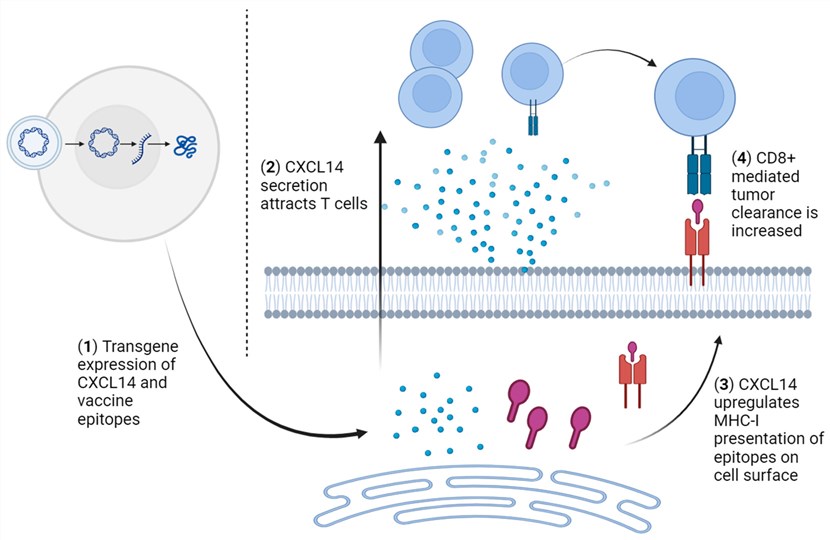 Fig.1 Schematic strategy for activating antitumor CD8+ T-cell responses using CXCL14 combined with therapeutic HPV vaccines.1
CXCL14 coordinates diverse physiological programs that transcend its classical categorization as a simple chemotactic factor:
We have a rigorously validated library of bioactive and correctly folded CXCL14 proteins produced to the exacting standards required for chemokine biology, immuno-oncology, and metabolic drug discovery. Since true tertiary topology, retention of the non-ELR CXC motif and intact glycosaminoglycan-binding activity are essential for biological function, our production platforms focus on bacterial expression systems that deliver high intracellular solubility in conjunction with proprietary refolding processes to ensure correct disulfide pairing. We also provide optimized yeast and mammalian secretion systems, for example, applications requiring typical eukaryotic post-translational modifications or isotopes enrichment to be used in structural nuclear magnetic resonance studies. We previously established a Cartesian catalog that includes both wild-type human CXCL14, N-terminally truncated variants modeling physiological proteolytic processing and cysteine-to-serine mutants for interrogation of dimerization requirements. All preparations are made with the most stringent administration and purification requirements from endotoxin-free buffers. Quality control metrics include reversed-phase HPLC for purity, heparin-affinity chromatography to assess DQ binding integrity, intact mass spectrometry (MS) to confirm molecular weight and bioactivity testing using analytic assays such as primary monocyte chemotaxis assays and tube formation inhibition in endothelial cells.
Not finding the protein product you need? Contact us to start your one-stop custom service!
Creation of cellular systems that truly recapitulate the CXCL14 secretion dynamics and receptor-mediated signaling will be pivotal to understand its contributions on maintaining tissue homeostasis and will help expedite the identification of therapeutic targets. Employing lentiviral transduction and transposon-mediated genomic integration allows us to create an extensive panel of CXCL14 stable cell lines with physiologically relevant expression levels, real-time secretory kinetics, and functional responsivity reflected in CRISPR-Cas9 genetic targeting upon metabolic or inflammatory stimulation. We now offer readily searchable technologies beyond essentially native expression systems to also include tetracycline-inducible systems allowing for tightly controlled delivery of the chemokine over time, naturally occurring coding variants associated with disease susceptibility and co-experience platforms where CXCL14 is heterologously expressed alongside its atypical receptor ACKR2 in a shared cellular framework. For mechanistic dissection of CXCL14-driven biology, we drove the engineering of reporter-coupled lines containing luciferase cassettes downstream from NF-κB, STAT or Hypoxia responsive promoter elements, allowing for real-time assessment and quantification in pathway activation over time following stimulation with CXCL14 versus antibody neutralization against its cognate receptors. Rescue experiments and synthetic lethality screening are also supported by the generation of complementary loss-of-function models via shRNA-mediated knockdown or expression of dominant-negative receptors.
Not finding the stable cell line product you need? Contact us to start your one-stop custom service!
Optimize your CXCL14 research with our expertly engineered suite of sequence-defined, high-affinity monoclonal antibodies specifically designed to the subtle structural variances and pleiotropic biology associated with this homeostatic chemokine. Our antibodies are specific for the native, correctly folded CXCL14 and do not cross-react with closely-related chemokines, including CXCL12 (SDF-1), as well as non-ELR CXC receptors such as RET or VCAM. They identify monomeric and dimeric quaternary assemblies, differentiate human CXCL14 from its ortholog in mice, and recognize conformations bound to glycosaminoglycan for investigating extracellular matrix. These reagents have been extensively pre-validated for: quantitative Western blotting under reducing and non-reducing conditions, direct & sandwich ELISA assay formats with high sensitivity in cell culture supernatants and biological fluids, flow cytometry of intracellular CXCL14 expression from permeabilized fibroblast versus epithelial cell populations; immunofluorescence as well as confocal microscopy imaging on multiple gradients/tissue/cartilage/reactive pericellular deposition profiles-immunohistochemistry (IHC)-on formalin-fixed paraffin embedded human tissues including skin breast adipose tissue -and functional readouts-neutralization blocking cxcl14-induced monocyte chemotaxis/recruitment-rescue EC tube formation cellular adhesion inhibition assays.
Not finding the recombinant antibody product you need? Contact us to start your one-stop custom service!
We provide far beyond our usual catalog, delivering custom tailored discovery and manufacturing services designed for your highly specific CXCL14 research development needs:
Yes. Bacteria expression systems, matched with proprietary refolding protocols allow for correct formation of the conserved disulfide bonds necessary for chemokine folding and structure and are essential in producing genuine non-ELR CXC motif. Prior to release, each batch is analytically verified as follows; Non-reducing SDS-PAGE, intact mass spectrometry and biopotency are quantified using primary monocyte chemotaxus or endothelial tube formation inhibition assays for functional integrity validation.
Certainly. This includes cysteine-to-serine substitutions that disrupt dimerization, basic residue mutations that reduce glycosaminoglycan affinity and N-terminally truncated variants to model physiological proteolytic processing. The custom constructs are provided as soluble, purified recombinant proteins or stably-transduced cell lines along with complete sequence verification, mass-spectrometric identity confirmation and function (bioactivity) characterization via chemotaxis in the presence of heparin-affinity assays.
Absolutely. We raise our monoclonal antibodies against non-overlapping or other unique epitopes in the CXCL14 N-terminal and 40s loop regions with very little sequence homology to any of the following agents:CXCL12, CXCL4, KC/CXCR11,CXCL10 or CXL16. The exquisite specificity that these antibodies afford has been validated by extensive cross-reactivity testing using Western blot, ELISA and cell-based neutralization qualifying them as being suitable for quantitative diagnostic applications in complex biological matrices including wound exudates, adipose tissue lysates and tumor homogenates.
Yes. We have constructed novel bicistronic and dual-promoter expression systems that allow for co-expression of CXCL14 with ACKR2 or classical chemokine receptors within a single stable cell line. They are smell-functional validation in receptor recycle from an aggregation of the antibody for lymphangomyesthesia and fixity.








