
Creative Biolabs is offering the most comprehensive services for antibody development projects. With strict regulation and effective execution, we are dedicated to providing the most valuable solutions to complete your projects.
HighlightsCreative Biolabs is offering the most comprehensive services for antibody development projects. With strict regulation and effective execution, we are dedicated to providing the most valuable solutions to complete your projects.
HighlightsCreative Biolabs has established a broad range of platforms for developing novel antibodies or equivalents. These cutting-edge technologies enable our scientists to meet your demands from different aspects and tailor the most appropriate solution that contributes to the success of your projects.
HighlightsWith deep understanding in antibody-related realms and extensive project experience, Creative Biolabs offers a variety of references to help you learn more about our capacities and achievements, including infographic, flyer, case study, peer-reviewed publications, and all kinds of knowledge that can assist your projects. You are also welcome to contact us directly for more specific solutions.
HighlightsGet a real taste of Creative Biolabs, one of the most professional custom service providers in the world. We are committed to providing highly customized comprehensive solutions with the best quality to advance your projects.
Highlights Loading...
All listed services and products are For Research Use Only. Do Not use in any diagnostic or therapeutic applications.
C-X-C motif chemokine ligand 16 (CXCL16) is a unique bifunctional type I transmembrane chemokine encoded by CXCL16 gene, expressed on dendritic cells, endothelial cells, epithelial cells and multiple tumor cell populations, combining membrane-bound scavenger receptor activity and proteolytically released soluble chemokine signaling functions. The extracellular region consists of a conserved N-terminal CXCL chemokine domain, a mucin-rich stalk region and a scavenger receptor cysteine-rich domain capable of binding oxidized low-density lipoproteins and bacterial pathogen lipids, while a short cytoplasmic tail mediates intracellular trafficking and signal transduction upon ligand engagement. Under physiological homeostatic conditions, membrane-tethered CXCL16 acts as a cell-surface adhesion molecule capturing CXCR6-expressing T lymphocytes, NK cells and NKT cells to facilitate tissue immune surveillance at mucosal and vascular barrier sites. Upon inflammatory or oncogenic stimulation, ADAM family metalloproteases cleave the mucin stalk to release soluble CXCL16 fragments that diffuse through tissue microenvironments to establish chemotactic gradients guiding CXCR6-positive immune cell migration toward inflamed or malignant lesions. Distinct from secreted-only CXC chemokines, CXCL16 alone integrates scavenger lipid clearance, cell-surface immune tethering and gradient chemotaxis in one polypeptide, with no other chemokine paralog able to fully recapitulate its dual immune-metabolic regulatory spectrum. Reduced CXCL16 expression impairs tissue resident immune cell recruitment and weakens anti-pathogen defense, while sustained CXCL16 overexpression drives chronic inflammatory leukocyte infiltration and fosters immune-suppressive tumor microenvironments, establishing CXCL16 as a core research target for bifunctional chemokine biology and inflammatory/tumor therapeutic screening.
CXCL16 executes dual regulatory function anchored to cell plasma membranes: its scavenger receptor domain mediates uptake of modified lipids and microbial lipid antigens for antigen presentation, while the N-terminal chemokine motif mediates high-affinity binding to CXCR6 receptors on circulating immune cells to form stable cell-cell immune synapses. Proteolytic shedding by ADAM10 generates soluble CXCL16 that acts as a diffusible chemoattractant to drive directional immune cell migration along concentration gradients. Conserved mucin spacer sequences extend the chemokine domain away from the lipid bilayer to maximize ligand accessibility for CXCR6 binding, while cytoplasmic intracellular motifs control CXCL16 membrane recycling and surface abundance in response to inflammatory cytokines. CXCL16-dependent immune chemotaxis sustains balanced tissue immune homeostasis, covering controlled mucosal immune surveillance and restrained chronic vascular inflammatory infiltration. CXCL16 participates in a broad spectrum of physiological and pathological processes including peripheral lymphocyte trafficking, lipid scavenging homeostasis, atherosclerotic lesion formation and tumor immune cell infiltration. Dysregulated CXCL16 shedding and surface expression amplify persistent inflammatory pathology and remodel tumor immune landscapes to favor malignant progression. Therefore, CXCL16 represents a pivotal research target for transmembrane chemokine study and inflammation-targeted modulator discovery.
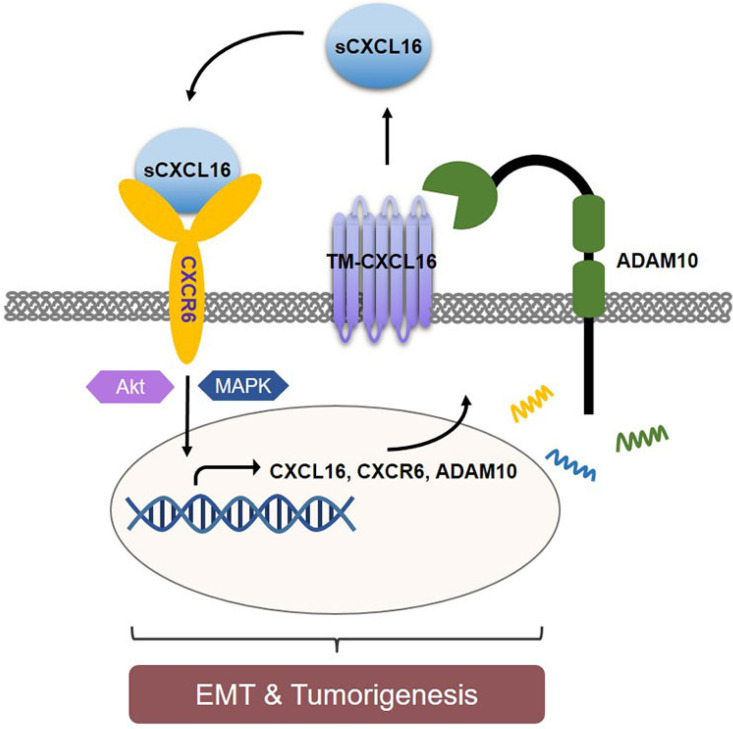 Fig. 1 ADAM10 cleaves transmembrane CXCL16 to produce soluble ligand, which binds CXCR6 to activate Akt/MAPK signaling and promote EMT along with tumor progression.1
The biological functions of CXCL16 are focused on dual scavenger-chemokine activity, immune cell recruitment and tissue inflammatory remodeling:
Creative Biolabs offers high-quality CXCL16 proteins through optimized expression systems, including full-length transmembrane CXCL16 and isolated soluble chemokine/scavenger domain variants. These products retain native conformational characteristics and CXCR6 binding plus lipid scavenger biological activity, suitable for chemokine receptor interaction assays and inflammatory tumor immunomodulator screening. All CXCL16 proteins undergo strict quality control to ensure consistent performance and reliable application across diverse research platforms.
Not finding the membrane protein product you need? Contact us to start your one-stop custom service!
Creative Biolabs provides custom-engineered CXCL16 stable cell lines, including wild-type and cleavage-resistant mutant control models. These cell lines are optimized for immune chemotaxis profiling and lipid scavenger uptake functional analysis. Each cell line undergoes stringent validation to ensure stable expression profiles and consistent functional performance in diverse experimental contexts.
Not finding the stable cell line product you need? Contact us to start your one-stop custom service!
High-specificity recombinant antibodies targeting CXCL16 are developed via advanced antibody engineering technologies, with no cross-reactivity with other CXC chemokine family members. These antibodies are validated for endothelial/tumor cell membrane localization detection and inflamed tissue expression profiling, and can be combined with CXCR6 detection reagents to analyze complete chemokine-receptor immune interaction complexes in vascular and tumor research models.
Not finding the recombinant antibody product you need? Contact us to start your one-stop custom service!
Beyond catalog products, Creative Biolabs offers specialized custom services for CXCL16 research:
CXCL16 is a transmembrane bifunctional chemokine that acts as a surface scavenger receptor and ADAM-sheddable chemoattractant to recruit CXCR6-positive immune cells to inflamed and tumor tissues.
Its unique dual lipid-scavenger and chemokine activity links vascular lipid metabolism, chronic inflammation and tumor immune infiltration, making it a multi-pathology therapeutic target.
No, all CXCL16 products and services are strictly for research use only, not intended for clinical diagnosis or treatment.
Offerings include full-length membrane CXCL16 proteins, domain-specific detection antibodies and custom stable cell lines for inflammation and tumor immunology research.
CXCL16 proteins are validated via CXCR6 immune cell chemotaxis and oxidized lipid scavenger binding functional testing.








