
Creative Biolabs is offering the most comprehensive services for antibody development projects. With strict regulation and effective execution, we are dedicated to providing the most valuable solutions to complete your projects.
HighlightsCreative Biolabs is offering the most comprehensive services for antibody development projects. With strict regulation and effective execution, we are dedicated to providing the most valuable solutions to complete your projects.
HighlightsCreative Biolabs has established a broad range of platforms for developing novel antibodies or equivalents. These cutting-edge technologies enable our scientists to meet your demands from different aspects and tailor the most appropriate solution that contributes to the success of your projects.
HighlightsWith deep understanding in antibody-related realms and extensive project experience, Creative Biolabs offers a variety of references to help you learn more about our capacities and achievements, including infographic, flyer, case study, peer-reviewed publications, and all kinds of knowledge that can assist your projects. You are also welcome to contact us directly for more specific solutions.
HighlightsGet a real taste of Creative Biolabs, one of the most professional custom service providers in the world. We are committed to providing highly customized comprehensive solutions with the best quality to advance your projects.
Highlights Loading...
All listed services and products are For Research Use Only. Do Not use in any diagnostic or therapeutic applications.
The membrane-bound and redox-active core of the phagocyte NADPH oxidase complex is cytochrome b-245 beta chain (CYBB), better known as gp91phox or NADPH oxidase 2 (NOX2). This protein is a heavily glycosylated, approximately 91 kDa protein comprising six transmembrane alpha-helices surrounding two non-identical heme groups coordinated by strictly conserved histidine residues in the third and fifth membrane-spanning segments. The cytosolic C-terminal tail contains specific binding sites for flavin adenine dinucleotide (FAD) and NADPH, completing an electron transport chain that transfers reducing equivalents from cytosolic NADPH across the membrane to molecular oxygen, producing superoxide anion as the end product. Within the lipid bilayer, CYBB stoichiometrically associates with p22phox to form the stable heterodimeric flavocytochrome b558, the essential membrane scaffold for regulated assembly with cytosolic oxidase components and Rac GTPases following cell stimulation by microbial pathogens or inflammatory stimuli. This multi-subunit assembly constitutes a major microbicidal mechanism by which neutrophils, monocytes, and macrophages generate a respiratory burst to kill bacterial or fungal pathogens. Apart from its well-established role in host defense, reactive oxygen species (ROS) produced by CYBB also act as second messengers that modulate intracellular signaling pathways affecting inflammatory gene expression, angiogenic programs, and cellular senescence.
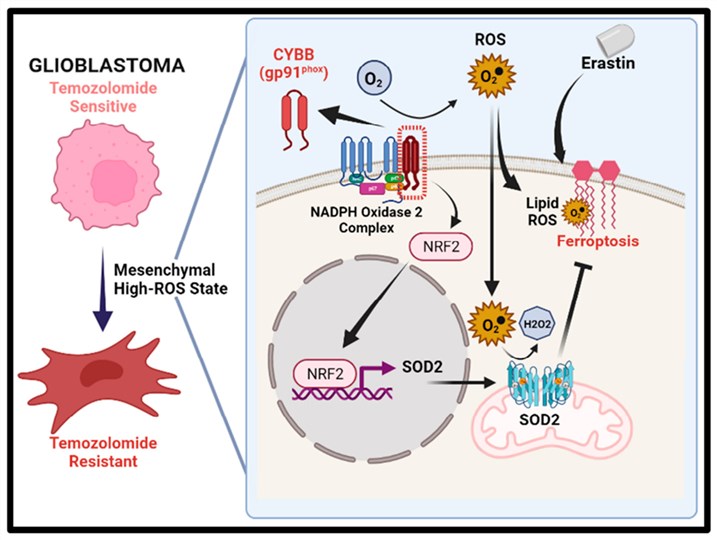 Fig.1 Schematic illustration of how CYBB contributes to temozolomide resistance and ferroptosis resilience in mesenchymal glioblastoma.1
CYBB regulates various physiological programs, which far exceed its classical role as a microbial killing machine:
We have developed a range of CYBB membrane protein formats to address the technical challenges associated with studying this multi-pass oxidase component. Because native NOX2 activity depends on coordinated assembly of CYBB with p22phox, cytosolic regulatory subunits, and Rac GTPases, isolated CYBB preparations should not be considered independently sufficient for complete electron transport and superoxide-generating activity. Our production strategies are designed to provide appropriate membrane-associated CYBB forms that preserve key structural features of the six-transmembrane protein and can support studies of its organization, interaction with p22phox, and redox-related biology. These protein preparations can be used in structural characterization, complex-assembly studies, biochemical assays, and screening workflows investigating NADPH oxidase regulation or ligand interactions. Appropriate biochemical and biophysical characterization methods can be selected according to the specific protein format and intended application, with relevant quality attributes assessed on a project-specific basis. Whether CYBB proteins are required for structural studies, ROS-related assay development, interaction analysis, or investigation of inhibitor binding, suitable membrane protein formats can be selected according to the experimental objective. Our CYBB offerings are intended to provide experimentally useful materials for investigating NOX2 structure, assembly, and redox function while recognizing the multi-component nature of the functional phagocyte NADPH oxidase complex.
Not finding the membrane protein product you need? Contact us to start your one-stop custom service!
Physiologically representative approaches to cellular modelling are essential for understanding the mechanisms and research potential of CYBB-mediated redox signalling. We develop custom CYBB stable cell models designed to support studies of plasma membrane localization, interaction or co-expression with p22phox, and NADPH oxidase-related cellular responses. Depending on project requirements, these models can incorporate selected CYBB constructs or disease-associated variants relevant to chronic granulomatous disease, as well as reporter systems for monitoring ROS-related responses. Co-expression strategies involving CYBB, p22phox, or selected cytosolic regulatory components can also be evaluated according to the specific experimental objective and technical feasibility. Appropriate characterization methods are selected for each cell model and may include confirmation of construct expression or integration, protein localization, interaction analysis, and functional readouts related to ROS generation. These scalable cellular resources can support studies of CYBB-associated immunodeficiency mechanisms, screening of compounds affecting redox or inflammatory pathways, and evaluation of research candidates targeting components of the NADPH oxidase complex.
Not finding the stable cell line product you need? Contact us to start your one-stop custom service!
Explore CYBB is encoded by a multilobed membrane oxidase advance your Getac in the intervening periods thoughtfully developed portfolio of sequence-defined high-affinity monoclonal antibodies accurately engineered to traverse this torturous topology. Specifically, our antibodies differentiate the latent form with resting conformation from that in activated state ever made cytosolic-factor engaged cyto-some structure of CYBB; recognize glycosylation-dependent epitopes within its extracellular loops and conformational determinants across C-terminal extended tail available to engage specific interacting partners in both monomeric/rest-state and collect-involving/activated states; distinguish human's intentional dweller-human-no paralogs NoX2 homolog(s) Paralogs expressed by top other species. These reagents were extensively pre-validated for quantitative Western blotting, both under reducing and non-reducing conditions (to monitor heterodimeric assembly of the oxidase) direct and competitive ELISA formats suitable to investigate soluble domain interactions; flow cytometric analyses of fixed or permeabilized neutrophil and macrophage populations, high-resolution immunofluoresence / confocal microscopy examination into phagosome & plasma membrane compartments at single-cell resolution; when applicable in conjunction with other available functional blocking studies that inhibit oxidase complex association as well block superoxide generation. This thorough validation enables researchers to confidently assess CYBB expression throughout different immune cell populations, monitor the assembly dynamics of oxidase relative to phagocytosis, and develop therapeutic antibody candidates targeting inflammatory imbalances associated with immunodeficiencies.
Not finding the recombinant antibody product you need? Contact us to start your one-stop custom service!
In addition, outside our catalog products we offer complete protein design and engineering services based on the specific needs of challenging membrane oxidases such as CYBB:
Yes. Our native CYBB membrane proteins are produced in stochiometric amount with p22phox, which is essential to provide the correct heme incorporation, proper transmembrane targeting and structural stability. Our standard preparation is of the heterodimeric flavocytochrome b558, with co-reconstitution in response to requests for cytosolic regulatory factors.
Our products will include everything needed for glycosylation and proper disulfide bond formation to maintain correct folding, membrane insertion, recognition by conformation-sensitive antibodies. These modifications are explicitly validated by quality control and only released.
Our products will provide glycosylation kit and disulfide bond formation to ensure correct folding and recognition of ligands.
No, all provided reagents and services are for research use only (RUO) & not intended for diagnostic or therapeutic purposes.









