Creative Biolabs is offering the most comprehensive services for antibody development projects. With strict regulation and effective execution, we are dedicated to providing the most valuable solutions to complete your projects.
HighlightsCreative Biolabs is offering the most comprehensive services for antibody development projects. With strict regulation and effective execution, we are dedicated to providing the most valuable solutions to complete your projects.
HighlightsCreative Biolabs has established a broad range of platforms for developing novel antibodies or equivalents. These cutting-edge technologies enable our scientists to meet your demands from different aspects and tailor the most appropriate solution that contributes to the success of your projects.
HighlightsWith deep understanding in antibody-related realms and extensive project experience, Creative Biolabs offers a variety of references to help you learn more about our capacities and achievements, including infographic, flyer, case study, peer-reviewed publications, and all kinds of knowledge that can assist your projects. You are also welcome to contact us directly for more specific solutions.
HighlightsGet a real taste of Creative Biolabs, one of the most professional custom service providers in the world. We are committed to providing highly customized comprehensive solutions with the best quality to advance your projects.
Highlights Loading...
All listed services and products are For Research Use Only. Do Not use in any diagnostic or therapeutic applications.
Cytochrome P450 family 2 subfamily C member 8 (CYP2C8) discusses the most important super-family of enzymes discovered in drug metabolism research, all heme-thiolate monooxygenases determining with which small-molecule compound found by human body they interact. One corner of that landscape is anchored by CYP2C8. Stably lodged in the membrane of an organ dedicated to detoxification, this enzyme uses a buried heme cofactor as well as electrons transferred from a specific reductase partner to catalyze oxidative reactions on substrates encompassing many marketed drugs and endogenous lipids. This expression, along with its secondary presence in several high calorie-exposed extrahepatic tissues makes it a defining characteristic of hepatic metabolic identity. The workload of that enzyme is split into two tasks, which hardly ever get the PR treatment together. To one side of the picture is xenobiotic metabolism, where CYP2C8 takes on a wide array of metabolites and this action may determine half-life for that compound along with its metabolite profile as well as how it will behave in the human being. On one side stands an endogenous chemistry that almost nobody foresaw—that of arachidonic acid epoxygenation. Under this wiring, CYP2C8 biotransforms a widely occurring membrane-resident fatty acid to epoxide metabolites that serve as local signalling molecules with regulatory roles in vascular tonus, inflammation and tissue responses. Two worlds apart, the same enzyme: different job description. Genetics adds a further layer. These common sequence variants decrease the activity of CYP2C8 to different degrees, resulting in an inter-individual spectrum of metabolic capacity which is reflected directly by differential processing of the same compound among study subjects. This natural variation has rendered the enzyme both a workhorse of pharmacogenetic research and an evergreen caveat at preclinical programs with metabolism built-in from the beginning. Although sources of dependable CYP2C8 reagents remain scarcer than the enzyme's prominence would suggest: heme occupancy must be confirmed, reductase partnership honored, membrane association preserved where critical and antibody selectivity ensured across a subfamily with many closely related members. These are exactly the problems on which the protein, cell line and antibody platforms discussed here were designed.
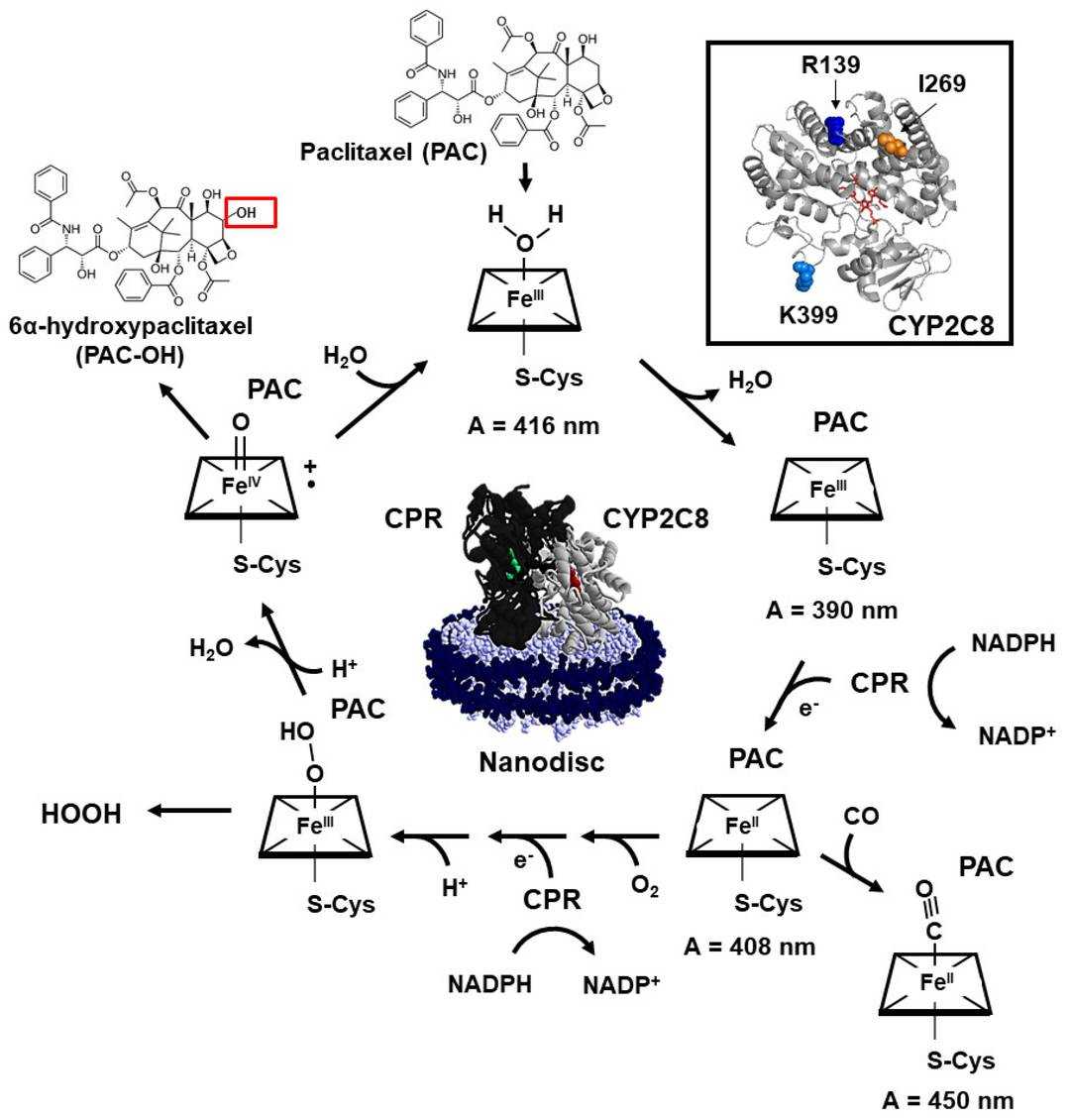 Fig.1 Schematic of the CYP catalytic cycle.1
Several research themes keep drawing investigators back to this enzyme:
To conduct repeatable, consistently reliable functional studies of CYP2C8, the first step is to produce qualified recombinant enzyme. When preparing the enzyme, heme must first be treated as an indispensable, non-negotiable core component; without it, all subsequent research will lack a valid foundation. In addition to heme, a class of substances called cofactors must also be properly handled: they must be fully integrated into the enzyme's structure and positioned at the correct sites. Once these steps are complete, comprehensive verification must be carried out—if only an apoprotein lacking cofactors is obtained, it is impossible to understand the true catalytic capacity of this enzyme in its native state, and all experimental data derived from this sample will have no practical significance. Furthermore, CYP2C8 must be paired with cytochrome P450 reductase; electron transfer is never an insignificant minor detail, but rather the core driving force required for every round of catalytic reaction. If this driving force is interrupted, the enzyme cannot function normally. Intact full-length CYP2C8 preparations must be produced from an optimized, dedicated expression system. This expression system must retain the enzyme's native post-translational modifications—that is, the additional functional modifications added to the protein after it is generated—as well as the enzyme's natural folding state, preventing denaturation and distortion. If the physiological binding of the enzyme to cell membranes affects its activity, this binding state must be preserved throughout all preparation procedures and must not be arbitrarily disrupted. Before the preparation is shipped to researchers, a strict set of release tests must be conducted: SDS-PAGE is used to assess protein purity and confirm the absence of extraneousheterologous proteins.
Not finding the membrane protein product you need? Contact us to start your one-stop custom service!
When using cell models to study CYP2C8, there is one non-negotiable mandatory requirement: the steady-state enzyme content within cells must be measured. Why is this standard enforced so strictly? Because the production level of metabolites changes synchronously with protein expression levels: more enzyme leads to more metabolites produced, and less enzyme leads to a corresponding drop in metabolite quantity. If the enzyme's expression density is not measured, it is impossible to distinguish whether changes in metabolites in an experiment are caused by the experimental treatment or by inherently different baseline enzyme levels in the cells. Subsequent interpretation of experimental results will fall into complete disarray, and no reliable conclusions can be drawn. Wild-type overexpressing cell lines can generate clear, gradient-adjustable enzyme level ranges, providing a stable reference for research; genetically engineered sequence variants can help researchers precisely locate the region on the enzyme responsible for substrate recognition and clarify the enzyme's mechanism of action. Before any clonal cell line is used in any experiment, a complete set of characterization tests must be performed: first, measure and calibrate its enzyme expression level; then record its subcellular localization to confirm it resides in the correct position within the cell; finally, verify its catalytic capacity. This ensures that before the first experiment begins, the metabolic output characteristics of this cell line are fully understood, so research is not initiated with unknown variables.
Not finding the stable cell line product you need? Contact us to start your one-stop custom service!
Our panel of recombinant antibody clones has been specifically screened to specifically recognize CYP2C8 with high fidelity, without cross-reactivity with other family members, eliminating the risk of cross-reactivity at its source. After screening, the antibodies have been validated in three commonly used experimental workflows: quantitative assays with cell lysates, distribution and localization studies on fixed samples, and imaging-based detection processes, ensuring they perform reliably in routine research scenarios. They are compatible with the two most widely used sample types: whole cells and cell lysates. Every clone has undergone performance testing in the sample types researchers use on a daily basis, eliminating the risk that a laboratory will receive antibodies that are unusable for their work. All antibodies are produced from fixed, defined sequences, ensuring completely consistent performance across every batch, with no instances of one batch working well and the next encountering problems—this is a mandatory requirement for long-term metabolic research spanning multiple years, because the comparability of data from different time points is the core foundation for rigorous, reproducible research. Without this, years of research would be wasted.
Not finding the recombinant antibody product you need? Contact us to start your one-stop custom service!
Extending well beyond our standard catalog, we deliver fully customizable discovery and manufacturing solutions meticulously tailored to the sophisticated demands of CYP2C8-targeted research and precompound development:
Every lot is released against agreed specifications covering identity, purity, monodispersity, and defined functional attributes, with results documented and shipped alongside the material.
All CYP2C8 products and services are provided strictly for preclinical research. They are not designed, validated, or authorized for any use involving human subjects.
Yes. Custom formats and integrated multi-component engagements are routine, with unified quality frameworks keeping specifications aligned across components.
Catalog items work well for standard detection or activity workflows. Custom production makes sense when constructs, formats, or quality attributes step beyond routine specifications. A short consultation is usually enough to decide.