
Creative Biolabs is offering the most comprehensive services for antibody development projects. With strict regulation and effective execution, we are dedicated to providing the most valuable solutions to complete your projects.
HighlightsCreative Biolabs is offering the most comprehensive services for antibody development projects. With strict regulation and effective execution, we are dedicated to providing the most valuable solutions to complete your projects.
HighlightsCreative Biolabs has established a broad range of platforms for developing novel antibodies or equivalents. These cutting-edge technologies enable our scientists to meet your demands from different aspects and tailor the most appropriate solution that contributes to the success of your projects.
HighlightsWith deep understanding in antibody-related realms and extensive project experience, Creative Biolabs offers a variety of references to help you learn more about our capacities and achievements, including infographic, flyer, case study, peer-reviewed publications, and all kinds of knowledge that can assist your projects. You are also welcome to contact us directly for more specific solutions.
HighlightsGet a real taste of Creative Biolabs, one of the most professional custom service providers in the world. We are committed to providing highly customized comprehensive solutions with the best quality to advance your projects.
Highlights Loading...
All listed services and products are For Research Use Only. Do Not use in any diagnostic or therapeutic applications.
Dystroglycan 1 (DAG1), encoded by the DAG1 gene on chromosome 3p21.31 and also known as dystrophin-associated glycoprotein 1, is a central component of the dystrophin-glycoprotein complex (DGC) that links the extracellular matrix to the actin cytoskeleton. The DAG1 gene encodes a single precursor protein that undergoes post-translational autoproteolytic cleavage into two non-covalently associated subunits: α-dystroglycan and β-dystroglycan. α-Dystroglycan is a heavily glycosylated extracellular peripheral membrane protein that binds to laminin-α2 (merosin), agrin, and perlecan in the basement membrane. β-Dystroglycan is a transmembrane protein whose intracellular domain binds to the cysteine-rich C-terminal domain of dystrophin, while its extracellular domain interacts with α-dystroglycan. DAG1 is widely expressed, with particularly high levels in skeletal muscle, heart, and brain, and is also found in epithelial and neural tissues.
DAG1 functions as the axis of the DGC, stabilizing the plasma membrane by tightly linking the extracellular matrix to the cytoskeleton. The α-dystroglycan subunit requires extensive O-mannosyl glycosylation for high-affinity binding to laminin and other extracellular matrix ligands; defects in this glycosylation pathway cause a group of muscular dystrophies collectively known as dystroglycanopathies. Through its interaction with dystrophin, β-dystroglycan connects the DGC to the actin cytoskeleton, and disruption of this linkage leads to sarcolemmal fragility and muscle degeneration. Striated muscle-specific deletion of DAG1 results in loss of the DGC in differentiated muscle and a mild form of muscular dystrophy, and impairs skeletal muscle regeneration. Beyond muscle, DAG1 is also involved in basement membrane assembly, epithelial development, and synaptic organization in the nervous system. Mutations in DAG1 have been identified in patients with neuromuscular dystrophies ranging from mild to severe phenotypes, and hypoglycosylation of α-dystroglycan is associated with several congenital muscular dystrophies. These properties make DAG1 an important research target for studies of dystrophin-glycoprotein complex assembly, sarcolemmal stability, laminin binding, and the molecular mechanisms underlying dystroglycanopathies.
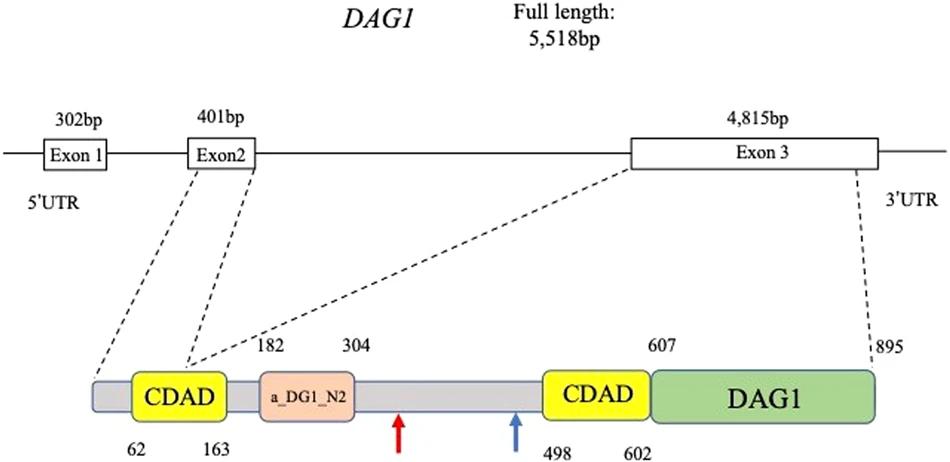 Fig. 1 Genomic structure of the DAG1 gene with domains and important functional regions of the DAG1 protein.1
DAG1, encoded by the DAG1 gene, functions as a central component of the dystrophin-glycoprotein complex that mediates linkage between the extracellular matrix and the cytoskeleton:
Creative Biolabs offers high-quality DAG1 membrane protein products produced using optimized expression systems. These include full-length β-dystroglycan transmembrane protein that retains the native membrane-spanning domain and cytoplasmic tail, as well as isolated extracellular domain variants containing the α-dystroglycan subunit or the β-dystroglycan ectodomain. The extracellular domain mediates laminin binding and α-β subunit interaction, making these proteins suitable for studies of DGC assembly, laminin-dystroglycan interactions, and membrane protein complex characterization. All DAG1 proteins undergo strict quality control to support consistent performance across applicable research platforms.
Not finding the protein product you need? Contact us to start your one-stop custom service!
Creative Biolabs provides custom-engineered DAG1 stable cell lines, including overexpression and knockdown models. These cell lines are optimized for studies of DGC assembly, sarcolemmal stability, laminin binding, and dystroglycan glycosylation. Each cell line undergoes stringent validation to ensure stable expression profiles and consistent functional performance in diverse experimental contexts.
Not finding the stable cell line product you need? Contact us to start your one-stop custom service!
High-specificity recombinant antibodies targeting DAG1 are developed using antibody engineering technologies for research applications involving DAG1 expression and localization. These antibodies can be used in studies of DAG1 distribution in muscle and neuronal tissues and may also support characterization of DAG1-containing DGC complexes in combination with appropriate detection reagents.
Not finding the recombinant antibody product you need? Contact us to start your one-stop custom service!
Beyond catalog products, Creative Biolabs offers specialized custom services for DAG1 research:
DAG1 is the central component of the dystrophin-glycoprotein complex that links the extracellular matrix to the actin cytoskeleton, stabilizing the sarcolemma and maintaining muscle membrane integrity.
DAG1 is essential for sarcolemmal stability and muscle function. Its mutations and glycosylation defects cause dystroglycanopathies, making it important for studies of DGC assembly, laminin binding, and muscular dystrophy mechanisms.
No, all DAG1 products and services are strictly for research use only, not intended for clinical diagnosis or treatment.
Offerings include full-length DAG1 membrane proteins, extracellular domain variants, specific detection antibodies, and custom stable cell lines for DGC and sarcolemmal stability research.
DAG1 proteins are validated via laminin binding assays, protein-protein interaction assays, and relevant functional characterization in applicable research platforms.









