
Creative Biolabs is offering the most comprehensive services for antibody development projects. With strict regulation and effective execution, we are dedicated to providing the most valuable solutions to complete your projects.
HighlightsCreative Biolabs is offering the most comprehensive services for antibody development projects. With strict regulation and effective execution, we are dedicated to providing the most valuable solutions to complete your projects.
HighlightsCreative Biolabs has established a broad range of platforms for developing novel antibodies or equivalents. These cutting-edge technologies enable our scientists to meet your demands from different aspects and tailor the most appropriate solution that contributes to the success of your projects.
HighlightsWith deep understanding in antibody-related realms and extensive project experience, Creative Biolabs offers a variety of references to help you learn more about our capacities and achievements, including infographic, flyer, case study, peer-reviewed publications, and all kinds of knowledge that can assist your projects. You are also welcome to contact us directly for more specific solutions.
HighlightsGet a real taste of Creative Biolabs, one of the most professional custom service providers in the world. We are committed to providing highly customized comprehensive solutions with the best quality to advance your projects.
Highlights Loading...
All listed services and products are For Research Use Only. Do Not use in any diagnostic or therapeutic applications.
DEAD/H-box helicase 11 (DDX11), also known as ChlR1, CHL1, or KRG-2, is encoded by the DDX11 gene on chromosome 12p11.21. The gene encodes an SF2 Fe–S DNA helicase (ChlR1/Chl1 family) with ATP-dependent 5′→3′ DNA unwinding activity, distinct from canonical DEAD-box RNA helicases. DDX11 is a nuclear protein that localizes to the nucleus and associates with the replisome during S phase. It is one of four human Fe-S helicases, alongside XPD, FANCJ, and RTEL1, all of which are linked to genetic disorders characterized by defects in DNA repair mechanisms.
DDX11 functions as a 5′-3′ directed DNA helicase that unwinds duplex DNA in an ATP-dependent manner, with a preference for substrates containing a 5′ single-stranded region. Its substrates include forked duplexes, 5′ flap structures relevant to Okazaki fragment processing, three-stranded D-loops that are early homologous recombination intermediates, and anti-parallel G-quadruplexes (G4s) that may form in G-rich DNA stretches. DDX11 is specifically required for the establishment of sister chromatid cohesion during DNA replication (S phase), in coordination with the replication and cohesin machinery. It interacts physically with multiple components of the replication machinery, including PCNA, WDHD1, POL δ, FEN1, and the RFC^CTF18 complex, which stimulates its helicase activity. Biallelic mutations in DDX11 cause Warsaw breakage syndrome (WABS), a rare autosomal recessive cohesinopathy characterized by severe congenital microcephaly, growth restriction, sensorineural hearing loss, and abnormal skin pigmentation. Cells derived from WABS research samples exhibit excessive chromosomal breakage upon exposure to DNA cross-linking agents and show sister chromatid cohesion defects. DDX11 is also essential for genome maintenance and may act as a tumor suppressor, and its altered expression has been found in hepatocellular carcinoma, osteosarcoma, and melanoma.
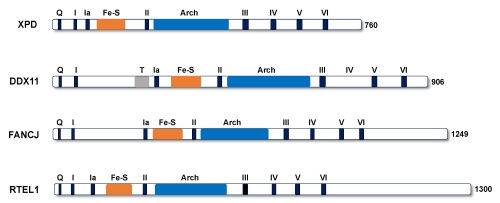 Fig. 1 A schematic representation of the polypeptide chain of human super-family 2 DNA helicases containing an Fe–S cluster is reported.1
DDX11, encoded by the DDX11 gene, functions as an Fe-S cluster DNA helicase that regulates sister chromatid cohesion and genome stability:
Creative Biolabs provides DDX11 proteins produced using optimized expression systems. These include full-length recombinant DDX11 protein that retains the native Fe-S cluster-binding domain, ATPase/helicase core, and C-terminal domain, as well as isolated domain variants. The helicase core mediates ATP-dependent DNA unwinding, while the Fe-S cluster domain is required for catalytic activity and structural stability, making these proteins suitable for studies of DNA helicase mechanisms, G-quadruplex resolution, and sister chromatid cohesion characterization. All DDX11 proteins undergo strict quality control to support consistent performance across applicable research platforms.
Not finding the protein product you need? Contact us to start your one-stop custom service!
Creative Biolabs provides custom-engineered DDX11 stable cell lines, including overexpression and knockout models. These cell lines are optimized for studies of DNA helicase activity, sister chromatid cohesion, G-quadruplex resolution, and DDX11-associated Warsaw breakage syndrome mechanisms. Each cell line undergoes stringent validation to ensure stable expression profiles and consistent functional performance in diverse experimental contexts.
Not finding the stable cell line product you need? Contact us to start your one-stop custom service!
High-specificity recombinant antibodies targeting DDX11 are developed using antibody engineering techniques for research applications involving DDX11 expression and localization. These antibodies can be used in studies of DDX11 distribution in the nucleus and replicating chromatin and may also support characterization of DDX11-containing replication complexes in combination with appropriate detection reagents.
Not finding the recombinant antibody product you need? Contact us to start your one-stop custom service!
Beyond catalog products, Creative Biolabs offers specialized custom services for DDX11 research:
DDX11 is an Fe-S cluster DNA helicase that unwinds duplex DNA with 5′-3′ directionality and is required for the establishment of sister chromatid cohesion during mitosis, maintaining genome stability.
DDX11 is essential for sister chromatid cohesion and genome maintenance, and its mutations cause Warsaw breakage syndrome, a rare cohesinopathy with chromosomal instability. It is also implicated in cancer, making it important for studies of DNA helicase biology and genome stability.
No, all DDX11 products and services are strictly for research use only, not intended for clinical diagnosis or treatment.
Offerings include recombinant DDX11 proteins, domain variants, specific detection antibodies, and custom stable cell lines for DNA helicase and genome stability research.
DDX11 proteins may support research on DNA helicase activity and ATPase activity, depending on protein format and experimental context.









