Creative Biolabs is offering the most comprehensive services for antibody development projects. With strict regulation and effective execution, we are dedicated to providing the most valuable solutions to complete your projects.
HighlightsCreative Biolabs is offering the most comprehensive services for antibody development projects. With strict regulation and effective execution, we are dedicated to providing the most valuable solutions to complete your projects.
HighlightsCreative Biolabs has established a broad range of platforms for developing novel antibodies or equivalents. These cutting-edge technologies enable our scientists to meet your demands from different aspects and tailor the most appropriate solution that contributes to the success of your projects.
HighlightsWith deep understanding in antibody-related realms and extensive project experience, Creative Biolabs offers a variety of references to help you learn more about our capacities and achievements, including infographic, flyer, case study, peer-reviewed publications, and all kinds of knowledge that can assist your projects. You are also welcome to contact us directly for more specific solutions.
HighlightsGet a real taste of Creative Biolabs, one of the most professional custom service providers in the world. We are committed to providing highly customized comprehensive solutions with the best quality to advance your projects.
Highlights Loading...
All listed services and products are For Research Use Only. Do Not use in any diagnostic or therapeutic applications.
Delta 4-desaturase, sphingolipid 1 (DEGS1), also known as DES1, MLD, or degenerative spermatocyte homolog 1, is encoded by the DEGS1 gene on chromosome 1q42.11. The gene contains 5 exons and encodes a 323-amino-acid multi-pass membrane protein of the fatty acid desaturase family. DEGS1 contains three conserved histidine-containing consensus motifs that are characteristic of membrane fatty acid desaturases, including a His128 residue and a Glu232 residue that coordinate the polar head group of the dihydroceramide substrate at the end of a substrate-binding tunnel. DEGS1 is localized to the endoplasmic reticulum membrane, with recent evidence demonstrating significant enrichment in mitochondria-associated endoplasmic reticulum membranes (MAMs), refining earlier reports that placed the enzyme exclusively at the ER. The protein is ubiquitously expressed, with broad expression in skin and placenta.
DEGS1 functions as the C4-dihydroceramide desaturase that catalyzes the conversion of dihydroceramide (dhCer) to ceramide (Cer) by inserting a C4-C5 trans double bond (4E) into the sphingoid backbone, the final step of the de novo sphingolipid biosynthesis pathway. This reaction introduces the essential 4,5-trans double bond that distinguishes ceramide from its saturated precursor and is required for the structural and signaling functions of ceramide. In addition to this canonical enzymatic role, In studied DEGS1-deficient models, altered mitochondria-associated membrane organization has been observed: DEGS1 deficiency in fibroblast research models disrupts MAM core functions including mitochondrial dynamics (hyperfused networks with decreased DRP1 activation), cholesterol metabolism (impaired SOAT activity and decreased cholesteryl esters), phospholipid metabolism (increased phosphatidic acid and phosphatidylserine, decreased phosphatidylethanolamine), and lipid droplet biogenesis. Increased mitochondrial superoxide production and impaired mitochondrial respiration are also observed in DEGS1-deficient cells and muscle-derived research samples. Biallelic loss-of-function variants in DEGS1 cause hypomyelinating leukodystrophy-18 (HLD18), an autosomal recessive neurodegenerative disorder reported in reported cases, characterized by developmental delay, spasticity, dystonia, seizures, diffuse hypomyelination, and cerebellar atrophy on brain MRI. These features make DEGS1 an important research target for studies of sphingolipid metabolism, ceramide biosynthesis, MAM function, and hypomyelinating leukodystrophy mechanisms.
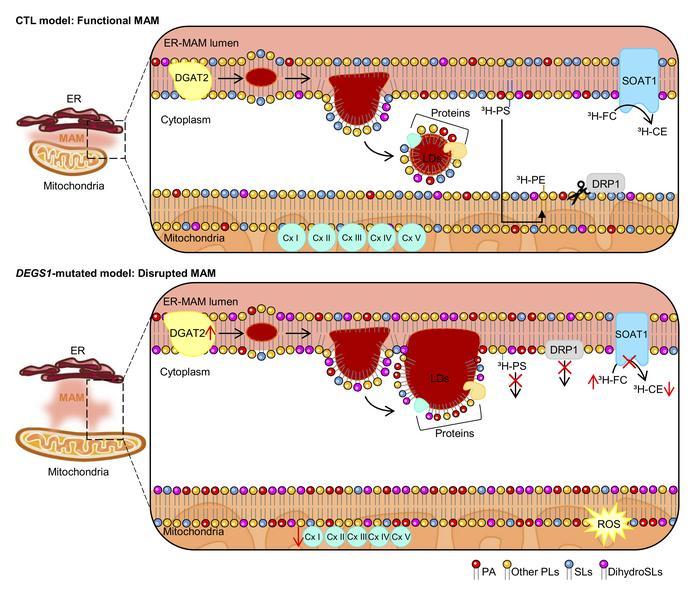 Fig. 1 Schematic representation of the pivotal role of DEGS1 in the regulation of MAM and mitochondria function.1
DEGS1, encoded by the DEGS1 gene, functions as a C4-dihydroceramide desaturase that catalyzes the final step of de novo ceramide biosynthesis and maintains MAM function:
Creative Biolabs provides DEGS1 membrane protein products produced using optimized expression systems. These include full-length multi-pass transmembrane protein that retains the native histidine-containing consensus motifs and substrate-binding tunnel, as well as isolated desaturase domain variants for structural or interaction studies, where available. The conserved His128 and Glu232 residues mediate substrate recognition and catalysis, while the multi-transmembrane architecture mediates ER and MAM membrane integration, with full-length membrane-integrated constructs preferred for catalytic studies; enzyme activity cannot be presumed for isolated domains. All DEGS1 proteins undergo strict quality control to support consistent performance across applicable research platforms.
Not finding the protein product you need? Contact us to start your one-stop custom service!
Creative Biolabs provides custom-engineered DEGS1 stable cell lines, including overexpression and knockout models. These cell lines are optimized for studies of ceramide biosynthesis, sphingolipid metabolism, MAM function, and DEGS1-associated hypomyelinating leukodystrophy mechanisms. Each cell line undergoes stringent validation to ensure stable expression profiles and consistent functional performance in diverse experimental contexts.
Not finding the stable cell line product you need? Contact us to start your one-stop custom service!
High-specificity recombinant antibodies targeting DEGS1 are developed using antibody engineering techniques for research applications involving DEGS1 expression and localization. These antibodies can be used in studies of DEGS1 distribution in ER and MAM fractions and may also support characterization of DEGS1-containing sphingolipid enzyme complexes in combination with appropriate detection reagents.
Not finding the recombinant antibody product you need? Contact us to start your one-stop custom service!
Beyond catalog products, Creative Biolabs offers specialized custom services for DEGS1 research:
DEGS1 is a C4-dihydroceramide desaturase that catalyzes the conversion of dihydroceramide to ceramide by inserting a C4-C5 trans double bond, the final step of de novo ceramide biosynthesis.
DEGS1 is essential for ceramide biosynthesis and mitochondria-associated membrane integrity, and its loss-of-function mutations cause hypomyelinating leukodystrophy-18, making it important for studies of sphingolipid metabolism and MAM function.
No, all DEGS1 products and services are strictly for research use only, not intended for clinical diagnosis or treatment.
Offerings include full-length DEGS1 membrane proteins, desaturase domain variants, specific detection antibodies, and custom stable cell lines for sphingolipid metabolism and MAM research.
DEGS1 proteins are validated via desaturase activity assays, substrate binding assays, and relevant functional characterization in applicable research platforms.