Creative Biolabs is offering the most comprehensive services for antibody development projects. With strict regulation and effective execution, we are dedicated to providing the most valuable solutions to complete your projects.
HighlightsCreative Biolabs is offering the most comprehensive services for antibody development projects. With strict regulation and effective execution, we are dedicated to providing the most valuable solutions to complete your projects.
HighlightsCreative Biolabs has established a broad range of platforms for developing novel antibodies or equivalents. These cutting-edge technologies enable our scientists to meet your demands from different aspects and tailor the most appropriate solution that contributes to the success of your projects.
HighlightsWith deep understanding in antibody-related realms and extensive project experience, Creative Biolabs offers a variety of references to help you learn more about our capacities and achievements, including infographic, flyer, case study, peer-reviewed publications, and all kinds of knowledge that can assist your projects. You are also welcome to contact us directly for more specific solutions.
HighlightsGet a real taste of Creative Biolabs, one of the most professional custom service providers in the world. We are committed to providing highly customized comprehensive solutions with the best quality to advance your projects.
Highlights Loading...
All listed services and products are For Research Use Only. Do Not use in any diagnostic or therapeutic applications.
Diacylglycerol O- acyltransferase 1(DGAT1) is a transmembrane endoplasmic reticulum acyltransferase of MBOAT superfamily. It is encoded by DGAT1 gene and located firmly in lipid bilayer of endoplasmic reticulum. It is widely and highly expressed in intestinal absorptive epithelium, white fat, liver parenchyma and breast tissue. The enzyme has obvious functional differentiation with homologous subtype DGAT2, which mainly mediates local lipid synthesis in specific cells, while DGAT1 has dual functions of systemic triglyceride synthesis and dietary fat absorption, which can catalyze the rate-limiting terminal reaction of lipid synthesis from acyl-CoA to diacylglycerol, generate energy-storing triglycerides, and participate in the synthesis of retinyl ester to maintain the metabolic balance of vitamin A in vivo. Under physiological conditions, moderate activity of DGAT1 can maintain normal fat reserves, provide energy for life activities and supplement membrane lipid precursors. Long-term high-fat diet stimulation or insulin overactivation can significantly up-regulate the expression of DGAT1, promote abnormal accumulation of neutral lipids in liver and abnormal proliferation of adipose tissue, and finally induce obesity and nonalcoholic fatty liver. At the same time, malignant tumors can supplement a large number of cell membrane lipids needed for rapid proliferation by up-regulating DGAT1. Because other acyltransferase can't compensate the systemic lipid storage and retinol regulation function of DGAT1, knocking out DGAT1 can significantly reduce the body fat accumulation and alleviate the damage caused by lipid metabolism disorder. Therefore, DGAT1 is the exclusive core research target for screening targeted drugs for lipid enzymology, metabolic syndrome and lipid-dependent tumors.
DGAT1 relies on the endoplasmic reticulum membrane network to play the role of multi-substrate acyl transfer catalysis, and relies on the conservative substrate pocket in the membrane to identify fatty acyl coenzyme A, diacylglycerol, retinol and other substrates, and completes various esterification reactions through histidine-dependent active centers. Its unique substrate recognition characteristics and tissue expression pattern make it clear that it has a functional partition with DGAT2, and the cellular triglyceride synthesis system is divided into two pathways: systemic circulatory metabolism and local specific synthesis of cells. DGAT1-mediated esterification cascade reaction can connect intestinal fat intake, adipocyte energy storage and liver lipid metabolism in series, and dynamically regulate neutral lipid metabolic flux according to the nutritional intake level and cell proliferation signal. This molecule takes an active part in the key processes such as post-meal chylomicron production, fat differentiation and tumor lipid reprogramming. Once the catalytic function is lost, it will directly lead to systemic triglyceride storage disorder and aggravate retinol metabolism disorder.
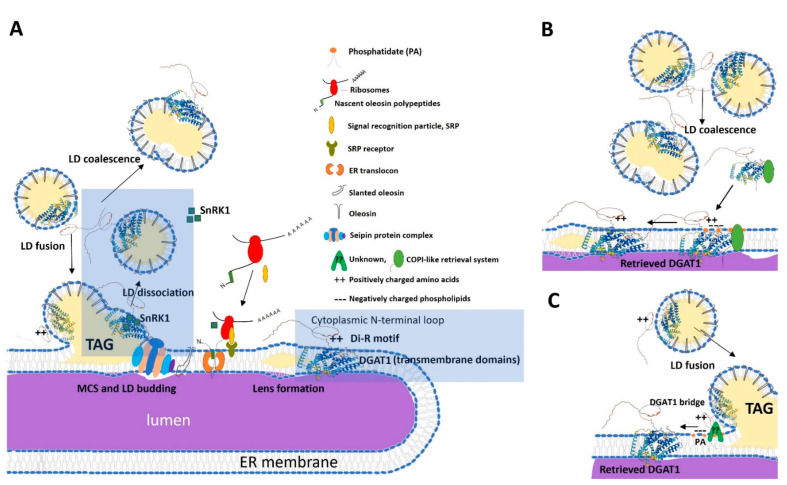 Fig. 1 Schematic model of ER-resident DGAT1 mediating TAG synthesis, lipid droplet biogenesis, DGAT1 recycling and LD fusion/coalescence.1
The biological functions of DGAT1 mainly focus on acyl transfer catalysis and neutral lipid anabolism, and it is the key molecule of lipid homeostasis regulation. Its core functional characteristics are as follows:
Creative Biolabs offers high-quality DGAT1 proteins covering various types such as full-length endoplasmic reticulum integrated enzyme protein and independent substrate binding domain mutant. This series of proteins can stably retain the catalytic activity of natural acyltransferase, which is suitable for biochemical experimental analysis of triglyceride synthesis and screening of lipid metabolism inhibitors. All DGAT1 protein products have undergone strict quality inspection, and their activity and performance are stable and uniform, which can meet the experimental application requirements of various scientific research platforms.
Not finding the membrane protein product you need? Contact us to start your one-stop custom service!
Creative Biolabs provides custom-engineered DGAT1 stable cell lines, including overexpression and blank control models. These cell lines are optimized for ER lipid synthase profiling and adipogenic signal functional analysis. Each cell line undergoes stringent validation to ensure stable expression profiles and consistent functional performance in diverse experimental contexts.
Not finding the stable cell line product you need? Contact us to start your one-stop custom service!
High-specificity recombinant antibodies targeting DGAT1 are developed via advanced antibody engineering technologies, with no cross-reactivity with DGAT2 acyltransferase homologs. These antibodies are validated for ER membrane localization detection and liver/adipose tissue expression profiling, and can be combined with lipid droplet marker reagents to analyze triglyceride synthetic complexes in metabolic cell models.
Not finding the recombinant antibody product you need? Contact us to start your one-stop custom service!
Beyond catalog products, Creative Biolabs offers specialized custom services for DGAT1 research:
DGAT1 is ER integral acyltransferase that catalyzes the final step of triglyceride synthesis by transferring acyl-CoA to diacylglycerol.
DGAT1 is the master enzyme controlling systemic fat storage, a key target for obesity, non-alcoholic fatty liver and lipid-dependent tumor therapy.
No, all DGAT1 products and services are strictly for research use only, not intended for clinical diagnosis or treatment.
Offerings include full-length DGAT1 lipid synthase proteins, isoform-specific detection antibodies and custom stable cell lines for adipogenic research.
DGAT1 proteins are validated via in vitro triglyceride synthetic catalytic assays.