
Creative Biolabs is offering the most comprehensive services for antibody development projects. With strict regulation and effective execution, we are dedicated to providing the most valuable solutions to complete your projects.
HighlightsCreative Biolabs is offering the most comprehensive services for antibody development projects. With strict regulation and effective execution, we are dedicated to providing the most valuable solutions to complete your projects.
HighlightsCreative Biolabs has established a broad range of platforms for developing novel antibodies or equivalents. These cutting-edge technologies enable our scientists to meet your demands from different aspects and tailor the most appropriate solution that contributes to the success of your projects.
HighlightsWith deep understanding in antibody-related realms and extensive project experience, Creative Biolabs offers a variety of references to help you learn more about our capacities and achievements, including infographic, flyer, case study, peer-reviewed publications, and all kinds of knowledge that can assist your projects. You are also welcome to contact us directly for more specific solutions.
HighlightsGet a real taste of Creative Biolabs, one of the most professional custom service providers in the world. We are committed to providing highly customized comprehensive solutions with the best quality to advance your projects.
Highlights Loading...
All listed services and products are For Research Use Only. Do Not use in any diagnostic or therapeutic applications.
7-Dehydrocholesterol reductase (DHCR7) is an endoplasmic reticulum transmembrane reductase encoded by the DHCR7 gene and expressed in multiple tissues, including embryonic tissues, liver, and epidermal cells. DHCR7 catalyzes the terminal step of cholesterol biosynthesis, using NADPH to reduce 7-dehydrocholesterol (7-DHC) to cholesterol. This activity contributes to maintaining the intracellular balance between cholesterol and 7-DHC and supports normal sterol homeostasis. Under physiological conditions, DHCR7 activity helps maintain cholesterol availability for cell membrane formation and steroid biosynthesis. Pathogenic variants in DHCR7 can impair enzymatic activity, leading to 7-DHC accumulation and reduced cholesterol synthesis in Smith-Lemli-Opitz syndrome (SLOS), a congenital disorder with multisystem developmental abnormalities. Altered DHCR7 expression has also been reported in tumor-associated cholesterol metabolism, although its functional impact is context dependent. Therefore, DHCR7 is an important research target for sterol metabolism, lipid enzymology, and congenital metabolic disease studies.
DHCR7 locates on endoplasmic reticulum membrane, mediates NADPH-dependent sterol reduction reaction, specifically recognizes 7-DHC through conserved coenzyme binding sites and sterol substrate pockets, and accurately completes the terminal catalytic process of cholesterol synthesis. Its unique substrate binding domain is significantly different from other endoplasmic reticulum reductases, which endows it with exclusive recognition characteristics for cholesterol precursor 7-DHC. The catalytic reaction mediated by DHCR7 can connect the upstream mevalonate pathway with the cellular cholesterol reserve, and dynamically balance the levels of sterol storage and metabolic utilization in vivo according to the proliferation needs of embryonic cells and somatic cells. This molecule actively participates in many physiological and pathological processes, such as embryonic tissue differentiation, liver sterol homeostasis maintenance and tumor lipid metabolism reprogramming. The lack of catalytic activity of DHCR7 will directly lead to the accumulation of toxic sterols, which will lead to severe developmental defect syndrome.Therefore, DHCR7 represents a pivotal research target for cholesterol synthetic enzyme study and metabolic disease therapeutic screening.
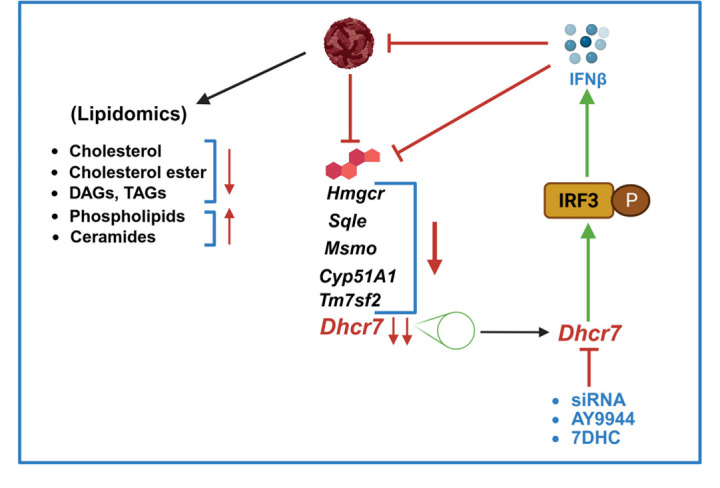 Fig. 1 Schematic diagram of DHCR7-mediated sterol biosynthesis lipid remodeling and IRF3-IFNβ innate immune regulatory axis.1
The biological functions of DHCR7 are focused on 7-DHC reduction and cellular sterol balance control:
Creative Biolabs offers high-quality DHCR7 proteins through optimized eukaryotic expression systems, including full-length ER integral enzyme and isolated substrate/cofactor binding domain variants. These products retain native 7-DHC reductase catalytic activity, suitable for cholesterol biosynthesis mechanism and metabolic inhibitor screening assays. All DHCR7 proteins undergo strict quality control and functional verification to guarantee stable, repeatable performance across all cell and biochemical research platforms.
Not finding the membrane protein product you need? Contact us to start your one-stop custom service!
Creative Biolabs provides custom-engineered DHCR7 stable cell lines, including overexpression and blank empty vector control models. These cell lines are optimized for ER sterol enzyme profiling and cholesterol synthetic pathway functional analysis. Each cell line undergoes multi-round expression validation to maintain consistent enzyme levels during long-term cell culture passages.
Not finding the stable cell line product you need? Contact us to start your one-stop custom service!
High-specificity recombinant antibodies targeting DHCR7 are developed via mature antibody engineering platforms, with zero cross-reactivity against other ER sterol metabolic enzymes. These antibodies are validated for ER membrane immunofluorescence and liver/embryonic tissue immunohistochemistry, and can be combined with HMGCR detection reagents to analyze full cholesterol synthetic axis in metabolic cell models.
Not finding the recombinant antibody product you need? Contact us to start your one-stop custom service!
Beyond catalog products, Creative Biolabs offers specialized custom services for DHCR7 research:
DHCR7 is a reductase located in endoplasmic reticulum, which catalyzes the conversion of 7- dehydrocholesterol into mature cholesterol by NADPH hydrogen supply system. It is the terminal key rate-limiting enzyme of sterol biosynthesis pathway in the body and directly determines the synthesis efficiency of intracellular cholesterol.
DHCR7 functional deletion mutation will cause a rare congenital metabolic disease, Stellen-Olson syndrome, and the abnormally high expression of this gene can promote tumor lipid metabolism remodeling and help tumor proliferation. Its unique two-way pathological regulation makes it a dual core target for the study of rare disease mechanism and tumor metabolism targeting.
Not for clinical use. All DHCR7-related proteins, antibodies and cell line products under the brand are only suitable for basic scientific research scenes in the laboratory, and have not been approved for clinical diagnosis, human treatment and related clinical applications.
The products cover full-length endoplasmic reticulum-localized DHCR7 enzyme protein, subtype-specific detection antibody and customizable DHCR7 stable cell line, which fully supports the basic experimental research related to lipid metabolism.
DHCR7 proteins are verified via in vitro 7-DHC substrate catalytic reduction activity assays.








