Creative Biolabs is offering the most comprehensive services for antibody development projects. With strict regulation and effective execution, we are dedicated to providing the most valuable solutions to complete your projects.
HighlightsCreative Biolabs is offering the most comprehensive services for antibody development projects. With strict regulation and effective execution, we are dedicated to providing the most valuable solutions to complete your projects.
HighlightsCreative Biolabs has established a broad range of platforms for developing novel antibodies or equivalents. These cutting-edge technologies enable our scientists to meet your demands from different aspects and tailor the most appropriate solution that contributes to the success of your projects.
HighlightsWith deep understanding in antibody-related realms and extensive project experience, Creative Biolabs offers a variety of references to help you learn more about our capacities and achievements, including infographic, flyer, case study, peer-reviewed publications, and all kinds of knowledge that can assist your projects. You are also welcome to contact us directly for more specific solutions.
HighlightsGet a real taste of Creative Biolabs, one of the most professional custom service providers in the world. We are committed to providing highly customized comprehensive solutions with the best quality to advance your projects.
Highlights Loading...
All listed services and products are For Research Use Only. Do Not use in any diagnostic or therapeutic applications.
Delta like non-canonical Notch ligand 1 (DLK1) protein (also known as preadipocyte factor 1 [Pref-1], fetal antigen 1 FA1, or pG2) is a type I membrane glycoprotein of about 50 kDa belonging to the epidermal growth factor (EGF)-like repeat progenitor family. Downloaded with the maternally imprinted, paternally expressed DLK1 gene on human chromosome 14q32. 2, the mature protein consists of six adjacent EGFlike repeats in its extracellular domain preceding a juxtamembrane area, a unique transmembrane alpha helix, and a modest intracellular tail. In contrast to the canonical Notch ligands DLL1, DLL3 and DLL4, DLK1 is referred to as a non-canonical ligand because it does not contain the DSL (Delta-Serenade-Lag2) domain which mediates direct activation of notch receptors. Recent studies showed that alternative splicing gives rise to multiple isoforms, which differ in sensitivity to ectodomain shedding. Recently, TNF-α-converting enzyme (TACE) was demonstrated to cleave isoforms with the juxtamembrane protease recognition site and release a large 50-kDa soluble fragment (DLK1S) into the extracellular space. Conversely, splice variants that lack this region remain stably membrane tethered (DLK1M). Although both forms are biologically active but existing evidence indicates that they serve different physiologic functions. The soluble form to a variety of newly emerging roles in serum and serves an important role as autocrine/paracrine signaling factor, whilst the membrane-bound form primarily mediates juxtacrine signaling at cell-cell interfaces.
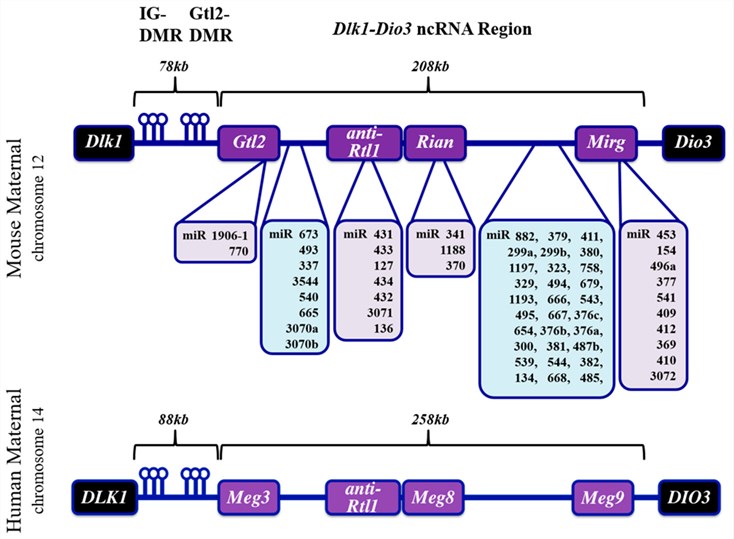 Fig.1 Schematic of Dlk1-Dio3 ncRNA locus features.1
DLK1 has biological functions in development, metabolism and oncogenesis:
Accelerate your stem cell and oncology research with our freshly prepared recombinant DLK1 protein catalog. The EGF-like repeat architecture, alternative splicing, and TACE-mediated shedding have their unique production challenges which we are cognizant of. To resolve these, we apply multi-purpose expression platforms—including mammalian HEK293 cells and E. coli systems—to generate properly folded and glycosylated DLK1 protein constructs that maintain binding affinity and native immunoreactivity. We provide full-length membrane-bound DLK1 (DLK1M), large soluble ectodomain (DLK1S) and domain-specific fragments including the EGF-like repeats. Every preparation is biophysically validated for use in structural studies, perform ligand binding assays or antibody screening.
Not finding the membrane protein product you need? Contact us to start your one-stop custom service!
Cellular models that are reliable and reproducible are essential for studying DLK1-driven biology and testing therapeutic candidates. Delivering stable cell lines engineered to express wild-type or altered versions of human, mouse and rat DLK1, as well as cells with up- or down-together endogenous extraction in which loss-of-function studies can be retained. These platforms enable scalable high-throughput adipogenesis assays, studies of cancer stem cell sphere formation, Notch reporter gene analysis and ADC internalization quantification with the level of experimental consistency demanded by multi-phase research collaborations.
Not finding the stable cell line product you need? Contact us to start your one-stop custom service!
You are covered with our wide range of high-affinity recombinant antibodies against DLK1 that have been specifically developed for challenging applications. This allows for the production of high quality monoclonal antibodies with greater specificity, sensitivity and batch to batch consistency than is achievable with more classical polyclonal antibodies. We have developed a number of DLK1 recombinant antibodies that are validated to be used in many research methods such as Western Blotting (WB), ELISA, Flow Cytometry (FCM), Immunofluorescence (IF), Immunocytochemistry (ICC), Immunohistochemistry (IHC) and immunoprecipitation with application to detect protein in different mediums ever as preadipocyte lysates and tumor biopsies or serum samples.
Not finding the recombinant antibody product you need? Contact us to start your one-stop custom service!
In addition to our catalog offerings we provide specialized custom services for protein and antibody discovery and development. With the unique background and experience we have gained over hundreds of stem cell biology, adipogenesis, and immuno-oncology studies and projects aided by our collaborative scientific approach, we can help you with:
We do offer domain-specific antibodies for the intracellular C-terminal tail and juxtamembrane stalk region devoid in the ADAM-cleaved soluble ectodomain. These clones result in robust membranous signal in assays like flow cytometry and immunofluorescence while showing little cross-reactivity with the shed extracellular domain, allowing for accurate determination of the surface resident versus secreted pools without differential centrifugation.
No, all DLK1 products and services are for research use only but not for clinical diagnosis, prevention, treatment or cure of any disease.
Yes, we have recombinant proteins and stable cell lines that express well-characterized deletion variants that knock out individual EGF-like repeats. This tool set is essential for disambiguating the roles of individual extracellular domains mediating Notch receptor engagement from membrane-anchoring and intracellular trafficking functions.
Yes. Flexible pricing tiers to meet the academic and industrial scale-up needs. Kindly fill in your expected volume and timeline in our inquiry portal to get a customized quotation.