Creative Biolabs is offering the most comprehensive services for antibody development projects. With strict regulation and effective execution, we are dedicated to providing the most valuable solutions to complete your projects.
HighlightsCreative Biolabs is offering the most comprehensive services for antibody development projects. With strict regulation and effective execution, we are dedicated to providing the most valuable solutions to complete your projects.
HighlightsCreative Biolabs has established a broad range of platforms for developing novel antibodies or equivalents. These cutting-edge technologies enable our scientists to meet your demands from different aspects and tailor the most appropriate solution that contributes to the success of your projects.
HighlightsWith deep understanding in antibody-related realms and extensive project experience, Creative Biolabs offers a variety of references to help you learn more about our capacities and achievements, including infographic, flyer, case study, peer-reviewed publications, and all kinds of knowledge that can assist your projects. You are also welcome to contact us directly for more specific solutions.
HighlightsGet a real taste of Creative Biolabs, one of the most professional custom service providers in the world. We are committed to providing highly customized comprehensive solutions with the best quality to advance your projects.
Highlights Loading...
All listed services and products are For Research Use Only. Do Not use in any diagnostic or therapeutic applications.
Delta like canonical Notch ligand 1 (DLL1) is a type I single-pass transmembrane Notch ligand encoded by the DLL1 gene, expressed on signal-sending cell plasma membranes across embryonic and postnatal developmental tissue compartments. The polypeptide carries multiple tandem extracellular EGF-like repeat folds, one transmembrane helix and a short cytoplasmic intracellular tail without intrinsic catalytic domains. Structural studies confirm the N-terminal EGF repeat cluster mediates selective non-covalent binding to extracellular Notch receptor ectodomains on adjacent cell surfaces, triggering sequential receptor proteolytic cleavage and downstream nuclear signal transduction upon sustained cell-cell contact. Lack of balanced DLL1 surface presentation disrupts lateral cell fate patterning during tissue growth, and variable DLL1 membrane abundance generates graded juxtacrine signal strength gradients to coordinate synchronized progenitor differentiation across tissue layers. Different embryonic tissue layers produce distinct DLL1 expression magnitudes matching local patterning requirements; each EGF repeat carries conserved calcium coordination residues that stabilize ligand-receptor complex geometry to tune the duration of juxtacrine signal transmission. Conserved disulfide linkages within each EGF fold lock ligand-binding pocket architecture for reversible Notch receptor association.
Sequence variants within DLL1 EGF repeat coding regions might disrupt calcium coordination sites and weaken Notch receptor binding affinity, which could distort developmental cell fate patterning gradients in embryonic tissue model systems. No other Delta family paralog fully replicates DLL1’s tissue-wide developmental expression spectrum and EGF repeat binding profile, though limited overlapping receptor interaction exists among related Notch ligands. DLL1 stably integrates into signal cell lipid bilayers and only mediates juxtacrine signals via direct cell-cell contact, without functional soluble ligand fragments under basal developmental conditions. Its type I membrane topology separates extracellular EGF ligand folds from short cytoplasmic regulatory tails, granting dual functional potential: intercellular Notch receptor engagement and weak intracellular feedback modulation upon sustained ligand-receptor complex formation. Reduced DLL1 membrane density flattens developmental signal gradients and disturbs ordered cell fate patterning, making this transmembrane ligand a suitable research target for juxtacrine developmental signaling analysis.
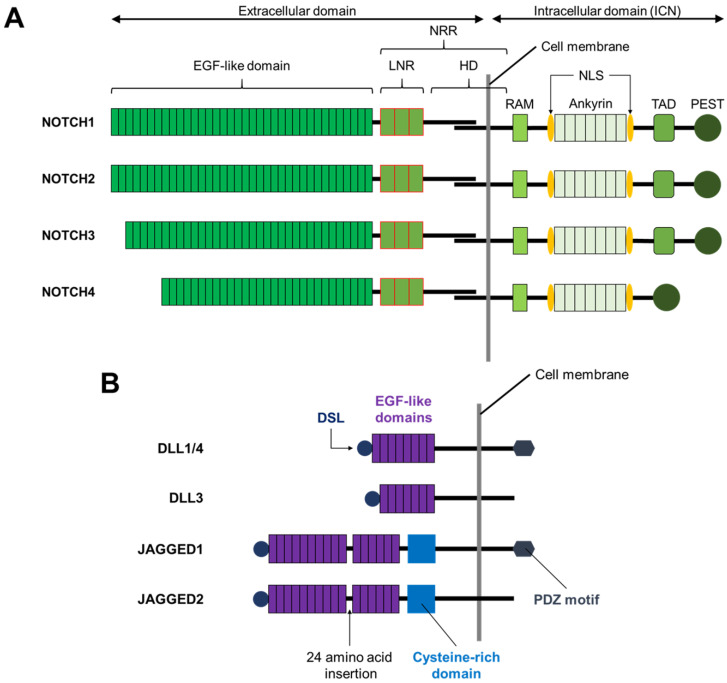 Fig. 1 Panel B shows schematic topology of human DLL1, displaying extracellular DSL module, EGF‑like repeats, single‑pass transmembrane segment and cytoplasmic tail.1
The biological functions of integral membrane DLL1 Notch ligand are focused on EGF repeat receptor coordination and developmental patterning gradient formation:
Creative Biolabs offers purified DLL1 membrane protein samples produced under unified preparation workflows, including full-length DLL1 constructs and isolated EGF repeat extracellular variants. Truncated fragments cannot support complete calcium-dependent Notch receptor binding activity, while full-length forms fit developmental juxtacrine research. All batches receive uniform quality screening. Functional assessments may only be performed under simulated lipid bilayer microenvironment setups. Calcium-coordinated EGF fold structural features are preserved across batches to support comparative receptor co-binding analysis between experimental groups. Full-length DLL1 membrane samples retain intact ligand coordination pockets post-purification, supporting reliable detection of transient ligand-receptor complexes in comparative functional analysis.
Not finding the Protein product you need? Contact us to start your one-stop custom service!
Creative Biolabs provides cell research models with adjustable DLL1 expression levels, suitable for structural observation of type I Notch transmembrane ligands and embryonic patterning research. Sample assessment covers sustained cell surface detection and Notch receptor co-binding analysis, enabling side-by-side comparison of juxtacrine signal gradient capacity under varying DLL1 abundances. These cell models can be paired with progenitor fate marker detection schemes to track patterning shift linked to DLL1 dosage changes.
Not finding the stable cell line product you need? Contact us to start your one-stop custom service!
Anti-DLL1 recombinant antibodies are generated via standardized workflows, compatible with signal cell plasma membrane localization mapping and Notch ligand-receptor complex identification. The antibody series supports multi-dimensional observation of DLL1 distribution within embryonic tissue layers.
Not finding the recombinant antibody product you need? Contact us to start your one-stop custom service!
Beyond catalog products, Creative Biolabs offers specialized custom services for DLL1 research:
DLL1 may act as type I transmembrane Notch ligand to form calcium-stabilized complexes with adjacent cell Notch receptors and generate graded juxtacrine developmental signals.
DLL1 membrane abundance might shape embryonic cell fate patterning gradients, serving as a key mediator of developmental tissue homeostasis biological processes.
No, all DLL1 related products and services are strictly for research use only, and cannot be applied in clinical workflows. All material design and functional screening are optimized exclusively for basic laboratory research, without meeting clinical application criteria.
Offerings include full-length DLL1 membrane protein, target-specific recombinant antibodies and tunable expression cell research models, supporting research on juxtacrine Notch developmental signaling.
Laboratory analysis schemes may include receptor ectodomain co-binding assays to assess calcium-dependent ligand complex formation capacity under simulated lipid bilayer environments.