Creative Biolabs is offering the most comprehensive services for antibody development projects. With strict regulation and effective execution, we are dedicated to providing the most valuable solutions to complete your projects.
HighlightsCreative Biolabs is offering the most comprehensive services for antibody development projects. With strict regulation and effective execution, we are dedicated to providing the most valuable solutions to complete your projects.
HighlightsCreative Biolabs has established a broad range of platforms for developing novel antibodies or equivalents. These cutting-edge technologies enable our scientists to meet your demands from different aspects and tailor the most appropriate solution that contributes to the success of your projects.
HighlightsWith deep understanding in antibody-related realms and extensive project experience, Creative Biolabs offers a variety of references to help you learn more about our capacities and achievements, including infographic, flyer, case study, peer-reviewed publications, and all kinds of knowledge that can assist your projects. You are also welcome to contact us directly for more specific solutions.
HighlightsGet a real taste of Creative Biolabs, one of the most professional custom service providers in the world. We are committed to providing highly customized comprehensive solutions with the best quality to advance your projects.
Highlights Loading...
All listed services and products are For Research Use Only. Do Not use in any diagnostic or therapeutic applications.
Delta/Notch-like epidermal growth factor-related receptor (DNER) is a single-pass type I transmembrane protein of 737 amino acids length with an estimated size of 82.5 kDa. The protein structure consists of an extracellular domain with ten tandem epidermal growth factor (EGF)-like repeats which are structurally related to similar domains in the Notch receptor family and bona-fide canonical Notch ligands including Delta and Jagged, followed by single transmembrane domain and short cytoplasmic tail. Unlike classical Notch ligands, DNER has lost the DSL binding domain but still binds to Notch receptors through its first and second EGF-like repeats to activate both canonical CSL-dependent and non-canonical Deltex-dependent signaling pathways. The DNER is mainly expressed in the nervous system with high expression levels in developing and adult cerebellum (especially Purkinje neurons), pyramidal neurons of the hippocampus, mitral cells of the olfactory bulb; spiral ganglion neurons and inner ear hair cells. Thus, this protein is specifically found in dendritic membranes, early endosomes and the plasma membrane, making it a key mediator during astrocytogenesis and Bergmann glial maturation. In addition to its neurodevelopmental functions, DNER is also being discovered as the target antigen of anti-Tr autoantibodies in paraneoplastic cerebellar degeneration associated with Hodgkin lymphoma and involved in cancer stemness conferring properties, prostate cancer progression and glucose homeostasis generator of pancreatic beta-cells. Moreover, genome-wide association studies have additionally implicated DNER as a susceptibility locus for type 2 diabetes and pulmonary function, emphasizing its extensive biomedical significance.
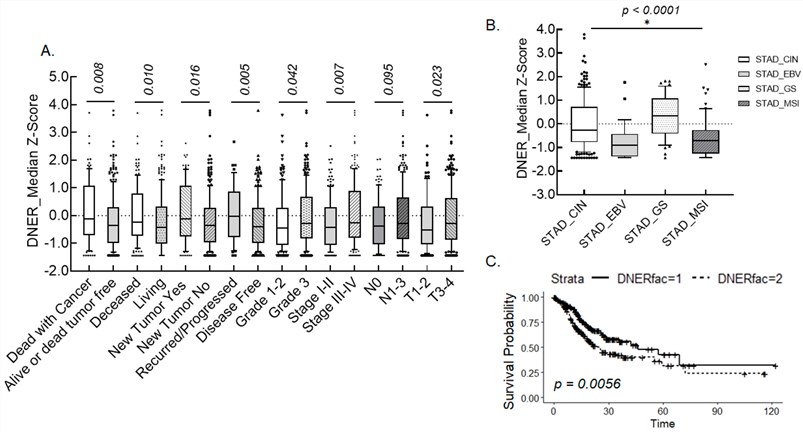 Fig.1 Association of DNER expression with various clinicopathological parameters and survival probability in gastric cancer.1
With molecular synergies reflecting versatile actions, the functional landscape of DNER spans the domains of neurodevelopment, neuroimmunology and oncology:
Creative Biolabs provides DNER membrane protein products to support structural and functional studies of this neuron-associated signaling receptor. Our membrane protein platform offers DNER constructs and preparations suitable for a range of research applications. Available products may include membrane-associated proteins or extracellular-domain constructs for structural studies, binding assays, antibody development and characterization, and investigations of DNER-related signaling and neuron–glia interactions. Product format, expression strategy, and functional characterization should be determined according to the specific product data and intended research application.
Not finding the protein product you need? Contact us to start your one-stop custom service!
Creative Biolabs offers custom-engineered DNER membrane protein stable cell lines with consistently high levels of target DNER expression. These stable cell lines will be useful for drug screening, ligand binding, Notch reporter assay, paraneoplastic antibody detection and high throughput screening as a reproducible tool to study DNER biology or pharmacology. Our science also ensures great expression and cell health, allowing you to move through your research pipeline faster. To study the Notch activation and neuron-glia interaction mechanisms, we provide DNER-overexpressing lines; we also have DNER-knockdown lines for loss-of-function studies that were validated by flow cytometry, Western blotting and functional Notch reporter assays. CSL-dependent luciferase or Deltex-dependent morphological readouts in specialized reporter cell lines with therapeutically relevant properties allow real-time monitoring of both canonical and non-canonical Notch signaling, making these powerful systems for therapeutic screening and mechanistic studies.
Not finding the stable cell line product you need? Contact us to start your one-stop custom service!
Our provision a full range of high-affinity recombinant antibodies to DNER, which are designed under the higher standard for diverse research applications. Produced using modern recombinant technologies, these antibodies are far superior in their specificity and sensitivity, with a good degree of batch to batch consistency when compared with traditional polyclonal antibodies. Please follow the links provided to view the complete list of validated products that we have available for DNER detection in whole tissues, cells or cell extracts (cerebellar tissue sections, serum, cerebrospinal fluid/CSF and cell lysates respectively) and assays such as Western Blotting (WB), ELISA, Flow Cytometry (FCM), Immunofluorescence (IF), Immunocytochemistry (ICC), Immunohistochemistry (IHC) and Immunoprecipitation(IP). The antibodies can be ordered recognizing different DNER epitopes, including glycosylation dependent epitopes mirroring those recognized by patient anti-Tr antibodies, the cytoplasmic tails (CT) approximating the studies on cellular localizations and extracellular domains (ECD), which are useful for assessing paraneoplastic antibody development and binding of Notch ligands; thus comprehensively analyzing DNER in health, disease and autoimmunity.
Not finding the recombinant antibody product you need? Contact us to start your one-stop custom service!
In addition to our portfolio products, Creative Biolabs provides specialized custom services in membrane protein and antibody discovery & development. With years of experience and fully updated platforms, we can support you with:
Recombinant DNER membrane proteins in VLP, mammalian membrane extracts, ECD-Fc fusions; stable cell line expressing DNER (overexpressing and Notch reporter lines) high-affinity recombinant DNER antibodies targeting different epitopes (extracellular domain, cytoplasmic tail, glycosylation-dependent) protein engineering & antibody discovery services fully customizable. Products exist for human, mouse, rat as well as other mammalian species.
Yes, chosen clones have been confirmed on lightly fixed cerebellar cryosections and archival paraffin-embedded specimens after antigen retrieval with specific staining along Bergmann glia radial fibers and granule cell dendritic claws that overlap with known glial and synaptic markers. This validation consisted of competition with individual peptides, absorption of ectodomain-shed fragments and controls with recombinant antigens to confirm specificity within complex distributions of native neural tissues.
Yes, the protein is a highly concentrated defined calcium containing buffer at physiological pH and free of carrier proteins, or chelating agents, and monitored for endotoxins. It allows for direct dilution into bio-layer interferometry reactions, amine-coupling to biosensor chips, or oligomerization assays without the need for dialysis or intermediary buffer exchanges and preserves the disulfide-linked EGF-repeat structure required for Notch-binding.
No, all reagents and service provided are for research use only and not for diagnostics or therapeutic purposes.