
Creative Biolabs is offering the most comprehensive services for antibody development projects. With strict regulation and effective execution, we are dedicated to providing the most valuable solutions to complete your projects.
HighlightsCreative Biolabs is offering the most comprehensive services for antibody development projects. With strict regulation and effective execution, we are dedicated to providing the most valuable solutions to complete your projects.
HighlightsCreative Biolabs has established a broad range of platforms for developing novel antibodies or equivalents. These cutting-edge technologies enable our scientists to meet your demands from different aspects and tailor the most appropriate solution that contributes to the success of your projects.
HighlightsWith deep understanding in antibody-related realms and extensive project experience, Creative Biolabs offers a variety of references to help you learn more about our capacities and achievements, including infographic, flyer, case study, peer-reviewed publications, and all kinds of knowledge that can assist your projects. You are also welcome to contact us directly for more specific solutions.
HighlightsGet a real taste of Creative Biolabs, one of the most professional custom service providers in the world. We are committed to providing highly customized comprehensive solutions with the best quality to advance your projects.
Highlights Loading...
All listed services and products are For Research Use Only. Do Not use in any diagnostic or therapeutic applications.
Epithelial membrane protein 2 (EMP2), also known as XMP, is encoded by the EMP2 gene on chromosome 16p13.13. The gene spans approximately 52 kb and contains 5 exons. The predicted 167-amino-acid EMP2 protein contains four membrane-spanning domains and three N-linked glycosylation motifs in the first extracellular loop. EMP2 shares 43% amino acid identity with peripheral myelin protein-22 (PMP22), and together with EMP1 and EMP3, these proteins form the GAS3/PMP22 family of tetraspan membrane proteins. EMP2 is localized within lipid raft domains and is thought to modulate the plasma membrane trafficking activities of integrins. EMP2 is expressed in adult ovary, heart, lung, and intestine, with lower levels in most other tissues including liver; in the fetus, high EMP2 mRNA levels are found in lung and kidney.
EMP2 functions as a key regulator of cell membrane composition by controlling the surface expression of specific membrane proteins. Through its interaction with β1 integrins, EMP2 facilitates the trafficking of integrins to the plasma membrane and regulates cell adhesion to extracellular matrix components. EMP2 also interacts with focal adhesion kinase (FAK) and Src kinases, activating downstream signaling pathways that regulate cell migration and invasion. In endothelial cells, EMP2 positively regulates vascular endothelial growth factor A through activation of PTK2. EMP2 is known to negatively regulate caveolin-1, a scaffolding protein and major component of caveolae plasma membrane invaginations. Additional functions associated with EMP2 include endocytosis, cell proliferation, cell death, cholesterol homeostasis, urinary albumin excretion, and embryo implantation. Mutations in EMP2 cause nephrotic syndrome type 10 (NPHS10), an autosomal recessive disorder characterized by early childhood onset and steroid-sensitive remission, and EMP2 is necessary for renal integrity. In cancer, EMP2 expression is up-regulated in multiple tumor types and has been associated with cancer progression. These features make EMP2 an important research target for studies of tetraspan protein biology, integrin trafficking, cell adhesion, and the molecular mechanisms underlying nephrotic syndrome and cancer progression.
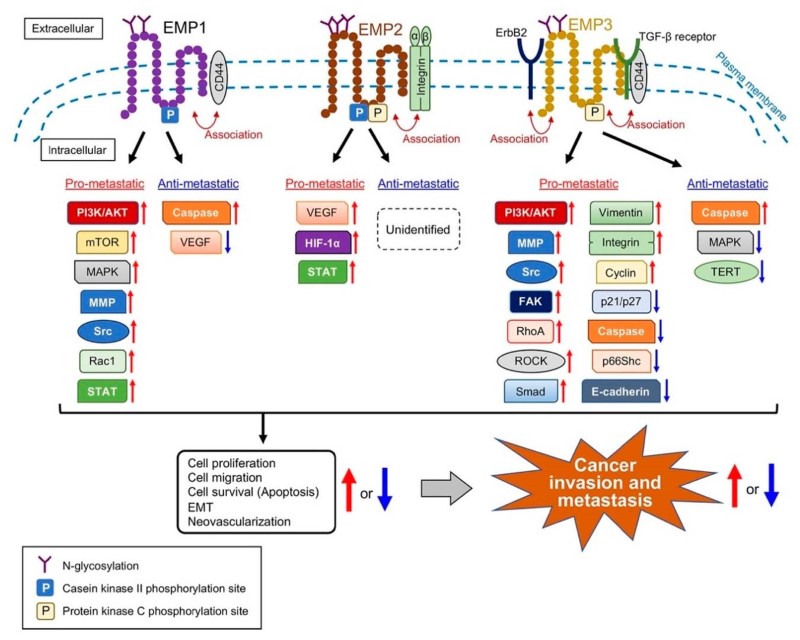 Fig. 1 Structural difference between EMPs, and signal transduction molecules of which expression and/or activation are affected by EMPs in the regulation of cancer invasion and metastasis.1
EMP2, encoded by the EMP2 gene, functions as a tetraspan membrane protein that regulates cell membrane composition and integrin-mediated signaling:
Creative Biolabs offers high-quality EMP2 membrane protein products produced using optimized expression systems. These include full-length multi-pass transmembrane protein that retains the native four-transmembrane domain architecture and extracellular loops with N-linked glycosylation sites, as well as isolated extracellular domain variants. The extracellular loops mediate protein-protein interactions involved in integrin trafficking and lipid raft organization, making these proteins suitable for studies of tetraspan protein function, integrin-membrane protein interactions, and cell adhesion characterization. All EMP2 proteins undergo strict quality control to support consistent performance across applicable research platforms.
Not finding the protein product you need? Contact us to start your one-stop custom service!
Creative Biolabs provides custom-engineered EMP2 stable cell lines, including overexpression and knockdown models. These cell lines are optimized for studies of integrin trafficking, FAK/Src signaling, cell adhesion, and nephrotic syndrome-associated molecular mechanisms. Each cell line undergoes stringent validation to ensure stable expression profiles and consistent functional performance in diverse experimental contexts.
Not finding the stable cell line product you need? Contact us to start your one-stop custom service!
High-specificity recombinant antibodies targeting EMP2 are developed using antibody engineering technologies for research applications involving EMP2 expression and localization. These antibodies can be used in studies of EMP2 distribution in epithelial tissues and lipid raft fractions and may also support characterization of EMP2-containing protein complexes in combination with appropriate detection reagents.
Not finding the recombinant antibody product you need? Contact us to start your one-stop custom service!
Beyond catalog products, Creative Biolabs offers specialized custom services for EMP2 research:
EMP2 is a tetraspan membrane protein that regulates cell membrane composition by controlling the trafficking of β1 integrins and other proteins to the plasma membrane, contributing to cell adhesion, migration, and renal integrity.
EMP2 regulates integrin trafficking and FAK/Src signaling, and its mutations cause nephrotic syndrome type 10. It is up-regulated in multiple cancers, making it important for studies of membrane protein trafficking, renal disease, and cancer biology.
No, all EMP2 products and services are strictly for research use only, not intended for clinical diagnosis or treatment.
Offerings include full-length EMP2 membrane proteins, extracellular domain variants, specific detection antibodies, and custom stable cell lines for integrin trafficking and membrane biology research.
EMP2 proteins may support studies of integrin binding and protein interactions, depending on protein format and experimental context.









