
Creative Biolabs is offering the most comprehensive services for antibody development projects. With strict regulation and effective execution, we are dedicated to providing the most valuable solutions to complete your projects.
HighlightsCreative Biolabs is offering the most comprehensive services for antibody development projects. With strict regulation and effective execution, we are dedicated to providing the most valuable solutions to complete your projects.
HighlightsCreative Biolabs has established a broad range of platforms for developing novel antibodies or equivalents. These cutting-edge technologies enable our scientists to meet your demands from different aspects and tailor the most appropriate solution that contributes to the success of your projects.
HighlightsWith deep understanding in antibody-related realms and extensive project experience, Creative Biolabs offers a variety of references to help you learn more about our capacities and achievements, including infographic, flyer, case study, peer-reviewed publications, and all kinds of knowledge that can assist your projects. You are also welcome to contact us directly for more specific solutions.
HighlightsGet a real taste of Creative Biolabs, one of the most professional custom service providers in the world. We are committed to providing highly customized comprehensive solutions with the best quality to advance your projects.
Highlights Loading...
All listed services and products are For Research Use Only. Do Not use in any diagnostic or therapeutic applications.
Ectonucleotide pyrophosphatase/phosphodiesterase family member 3 (ENPP3), encoded by the ENPP3 gene located on chromosome 6q22.33 and also known as NPP3, CD203c, PD-1β, or gp130RB13-6, is a member of the nucleotide pyrophosphatase/phosphodiesterase (NPP) glycoprotein family. ENPP3 is a type II single-pass transmembrane glycoprotein of approximately 875 amino acids with a molecular mass of approximately 100 kDa. The extracellular portion of the enzyme is composed of two tandem somatomedin B-like domains (SMB1/2), a catalytic phosphodiesterase (PDE) domain containing a conserved zinc-binding motif, a lasso loop (LL), and a C-terminal nuclease-like (NUC) domain that lacks catalytic activity. The crystal structure of human ENPP3 has been determined, revealing the structural basis for nucleotide recognition. ENPP3 is expressed in multiple organs, including on epithelial and mucosal surfaces, and notably on basophils and mast cells. Within the hematopoietic cell compartment, ENPP3 is a cell surface marker of basophil and mast cell lineages. Activation of basophils by antigen-bound IgE leads to rapid upregulation of ENPP3 to the cell surface.
ENPP3 functions as an ectoenzyme that hydrolyzes extracellular nucleotides, thereby modulating purinergic signaling. The enzyme hydrolyzes a variety of phosphodiester and phosphosulfate bonds including deoxynucleotides, nucleotide sugars, and NAD. Its primary substrates include extracellular ATP, GTP, UTP, and CTP, with hydrolysis producing pyrophosphate and nucleoside monophosphates as end products. ENPP3 also hydrolyzes extracellular 2',3'-cGAMP (cyclic GMP-AMP), a second messenger that activates TMEM173/STING and triggers type-I interferon production. Through its nucleotide-hydrolyzing activity, ENPP3 limits mast cell and basophil responses during inflammation and during the chronic phases of allergic responses. ENPP3 is rapidly induced by IgE and antigen-mediated crosslinking of the high-affinity IgE receptor FcεRI, making it an activation marker for clinical diagnosis of allergic diseases. Recent studies have also identified ENPP3 as a hypoxia-driven enzyme that hydrolyzes cGAMP and suppresses STING–IFN signaling. These properties make ENPP3 an important research target for studies of ectonucleotide metabolism, purinergic signaling, basophil and mast cell biology, allergic inflammation, and cGAS-STING pathway regulation.
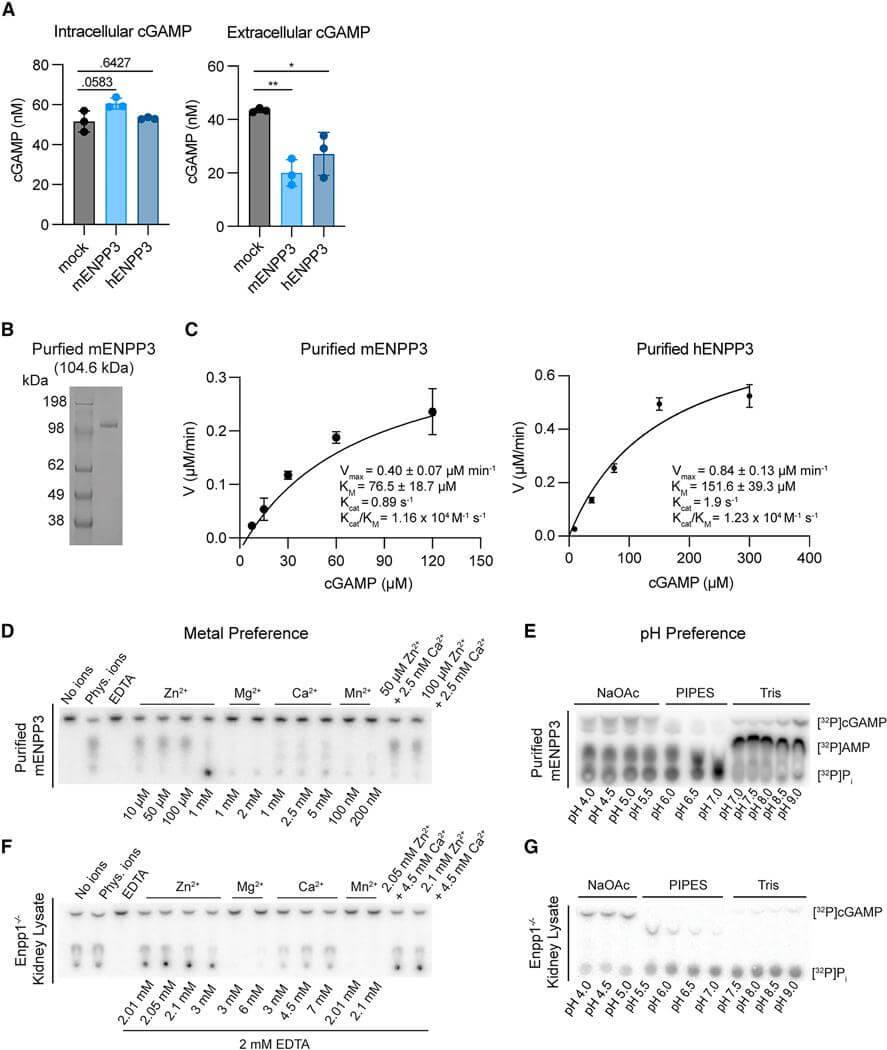 Fig. 1 ENPP3 is an efficient hydrolase of cGAMP at physiological pH.1
ENPP3, encoded by the ENPP3 gene, functions as a type II transmembrane ectoenzyme that regulates extracellular nucleotide levels and modulates purinergic signaling:
Creative Biolabs offers high-quality ENPP3 membrane protein products produced using optimized expression systems. These include full-length type II transmembrane protein that retains the native N-terminal cytoplasmic domain and membrane-spanning region, as well as isolated extracellular domain variants containing the SMB domains, PDE catalytic domain, and NUC domain. The extracellular domains mediate nucleotide binding and hydrolysis, making these proteins suitable for studies of ectonucleotide metabolism, substrate recognition, and catalytic mechanism characterization. All ENPP3 proteins undergo strict quality control to support consistent performance across applicable research platforms.
Not finding the protein product you need? Contact us to start your one-stop custom service!
Creative Biolabs provides custom-engineered ENPP3 stable cell lines, including overexpression and knockdown models. These cell lines are optimized for studies of extracellular nucleotide hydrolysis, purinergic signaling, basophil and mast cell activation, and cGAS-STING pathway regulation. Each cell line undergoes stringent validation to ensure stable expression profiles and consistent functional performance in diverse experimental contexts.
Not finding the stable cell line product you need? Contact us to start your one-stop custom service!
High-specificity recombinant antibodies targeting ENPP3 are developed using antibody engineering technologies for research applications involving ENPP3 expression and localization. These antibodies can be used in studies of ENPP3 distribution on basophils, mast cells, and epithelial surfaces, and may also support characterization of ENPP3-mediated nucleotide hydrolysis and signaling in combination with appropriate detection reagents.
Not finding the recombinant antibody product you need? Contact us to start your one-stop custom service!
Beyond catalog products, Creative Biolabs offers specialized custom services for ENPP3 research:








